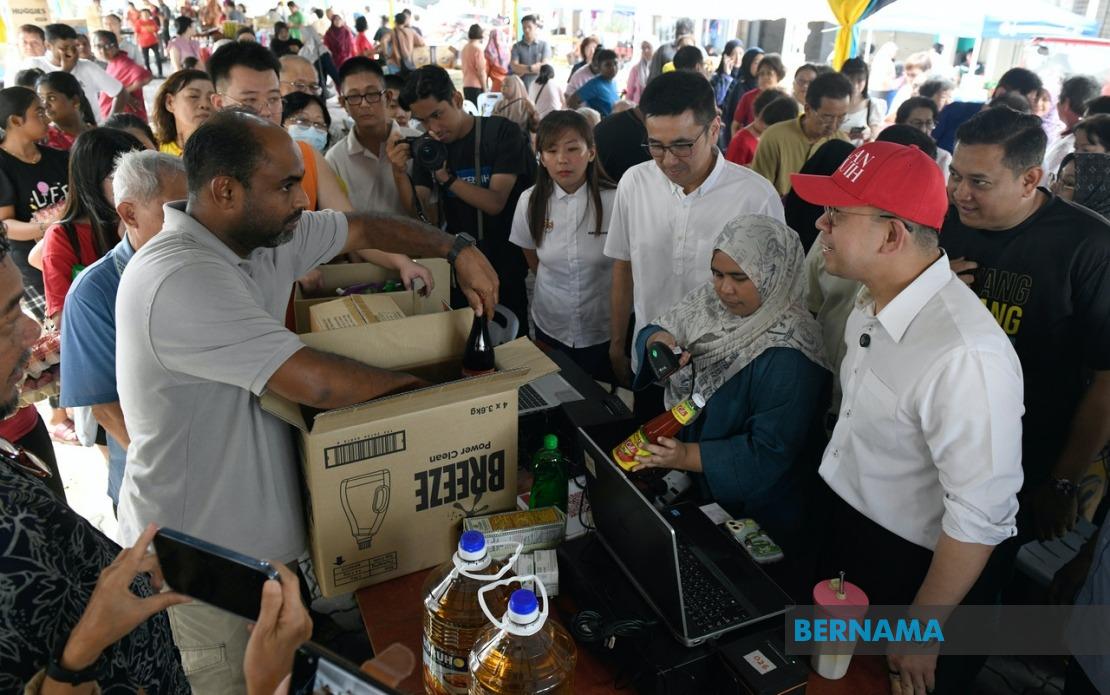
The Malaysian government is taking a more direct approach to ensuring that small and medium-sized businesses do not miss out on the economic tailwinds sweeping through the retail and wholesale sector. Through the Ministry of Entrepreneur and Cooperatives Development, known locally as KUSKOP, Kuala Lumpur is deploying a network of grassroots programmes designed to equip microenterprises, cooperative societies and independent traders with the support they need to scale operations and claim a share of sectoral growth. The strategy reflects a deliberate shift toward inclusive economic development, with government initiatives filtering down from policy level to the shopfloor level where businesses actually operate.
Minister Steven Sim Chee Keong, who oversees KUSKOP, outlined the government's commitment during a launch event for the Jualan MADANI KUSKOP programme in the Jawi state constituency in Nibong Tebal. The minister emphasised that sustained backing for grassroots entrepreneurs sits at the heart of the administration's broader economic agenda. By channelling resources and expertise toward MSMEs and cooperative bodies, the government aims to democratise access to market opportunities that have traditionally favoured larger, better-capitalised firms. This philosophy underpins much of KUSKOP's work across Malaysia's diverse business landscape, from rural trading posts to urban market stalls.
The timing of these initiatives aligns with robust growth signals emanating from the wholesale and retail trade segment itself. Data released by the Department of Statistics Malaysia revealed that sector sales reached nearly RM175 billion in April 2026, representing a year-on-year increase of 15.3 per cent. Such expansion reflects underlying economic momentum driven by healthy domestic consumer demand and improved purchasing power among Malaysian households. For policymakers, these figures validate the premise that conditions exist for small traders and cooperative enterprises to flourish, provided they receive adequate support in navigating supply chains, inventory management and market access.
According to Minister Sim, this sectoral expansion stems partly from joint efforts by government and the private sector to tackle the cost of living challenge, stabilise prices on essential goods and boost worker incomes. By reducing inflationary pressures and supporting household spending capacity, these measures have sustained domestic demand even as the global economy faces headwinds from trade tensions and geopolitical friction. Malaysia's position as an open economy leaves it vulnerable to external shocks, yet the resilience of the retail and wholesale sector demonstrates that targeted domestic policies can cushion businesses against international volatility. For MSMEs, this protective framework creates a window of opportunity to consolidate operations and plan expansion.
The Jualan MADANI KUSKOP programme exemplifies the type of ground-level intervention KUSKOP deploys to reach entrepreneurs. Rather than confining assistance to written guidelines or centralised offices, the ministry brings programmes directly to constituencies and communities where small traders operate. By mounting events and providing on-site support, KUSKOP reduces friction for business owners seeking government aid, training or market linkages. This hands-on approach resonates particularly in Malaysia's smaller towns and suburban areas, where informal retail networks remain vital to local economic life. The Jawi constituency event underscores the government's commitment to reaching all corners of the country, not just major urban centres.
Minister Sim, who also serves as Member of Parliament for Bukit Mertajam, acknowledged the challenging external environment confronting Malaysian exporters and import-reliant manufacturers. Tariff escalations between major trading partners, ongoing trade disputes and regional security tensions have complicated supply chains and created pricing uncertainties. However, the domestic retail and wholesale sector, being primarily oriented toward serving local consumers, has proved more insulated from these global tremors. This distinction offers strategic insights: while Malaysia's export-dependent sectors face cyclical headwinds, the domestic consumption-led segment presents a stable platform for MSME growth. Government efforts to strengthen this segment therefore serve a dual purpose, buttressing both small business prospects and macroeconomic stability.
The expansion of opportunities in retail and wholesale also opens doors for local businesses to forge new customer relationships and cement their presence within Malaysia's economic value chain. Historically, smaller enterprises have struggled to access distribution networks controlled by large retailers or wholesalers, limiting their ability to reach scale. Government programmes and cooperative structures can help bridge this gap by facilitating bulk purchasing, shared logistics and collective marketing. As MSMEs capture growing market share in a sector expanding at over 15 per cent annually, they contribute to a more decentralised, resilient business ecosystem less vulnerable to the dominance of any single player.
The minister stressed that the government remains committed to ensuring that the fruits of economic growth are shared broadly, with particular emphasis on supporting the local entrepreneurs who form the backbone of the national economy. This philosophy reflects recognition that sustainable development requires inclusive growth benefiting not just large corporations but also the millions of Malaysians engaged in small-scale trading and commerce. By channelling public resources toward capacity-building, market access and business support for MSMEs, the government aims to raise productivity and competitiveness across the entire business population. Such approaches have proven effective in other Southeast Asian economies like Thailand and Vietnam, where government support for SMEs has catalysed broader-based prosperity.
For Malaysian consumers and the broader economy, the expansion of healthy, competitive MSMEs in retail and wholesale sectors carries meaningful implications. Greater competition from smaller traders can exert downward pressure on prices, benefiting households. Simultaneously, as small business owners accumulate capital and employ staff, they inject demand back into local economies, creating jobs and stimulating ancillary services. The multiplier effects of MSME growth extend far beyond the retail counter, supporting transport operators, packaging suppliers, advertising services and countless other support businesses. Thus, government initiatives backing small traders represent not merely charity but calculated investment in economic dynamism.
Looking ahead, KUSKOP's expanded portfolio of grassroots programmes will likely face the challenge of reaching the most remote and underserved entrepreneurial communities. Scaling support while maintaining quality remains a perennial concern for government agencies. Additionally, as digital commerce accelerates, KUSKOP must help traditional MSMEs navigate e-commerce platforms and omnichannel retail models. The ministry's success in these domains will determine whether the current sectoral boom translates into lasting prosperity for small business owners or remains concentrated among the already-advantaged. Minister Sim's public commitment to sustained government involvement signals intent to pursue this agenda vigorously in coming months.

