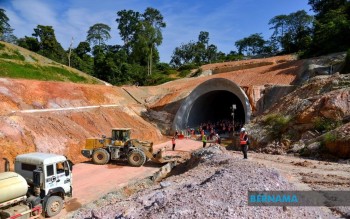
The Malaysian government has sanctioned 46 distinct projects earmarked for the Pasir Puteh parliamentary constituency in Kelantan, with a combined budgetary ceiling of RM207.2 million aimed at implementation beginning 2026. The portfolio reflects a strategic pivot toward infrastructure development designed to unlock economic opportunities around the region's emerging transport and logistics infrastructure, particularly the East Coast Rail Link (ECRL) facility.
Deputy Economy Minister Datuk Mohd Shahar Abdullah framed the initiative during parliamentary questioning as part of a broader national approach to leveraging strategic transport corridors for regional economic development. The approved schemes encompass land preparation and foundational infrastructure work specifically intended to establish an industrial area downstream of manufacturing and logistics operations in proximity to the Pasir Puteh ECRL Station, signalling government commitment to transforming the constituency into a competitive economic zone.
Central to the government's vision is an integrated planning framework known as the ECRL Integrated Land Use Master Plan, or PGTA-ECRL, which positions the Pasir Puteh station as a dual-purpose facility simultaneously serving passenger movements and cargo-logistics functions. This designation matters considerably for regional development strategy, as it establishes the station as an anchor infrastructure asset rather than a peripheral transport node, justifying the substantial upfront capital commitment across multiple project phases.
The geographical proximity of Pasir Puteh to the Tok Bali Supply Base creates what policymakers describe as a natural competitive advantage for developing integrated logistics operations. By consolidating port-related supply chain operations with rail connectivity, planners envision a hub capable of attracting private sector investment across warehousing, value-added manufacturing, and distribution sectors. The logic centres on eliminating transshipment inefficiencies and positioning local enterprises to capture value-chain segments previously dominated by larger urban centres.
Deputy Minister Mohd Shahar stressed that synergistic development between rail infrastructure and port facilities could catalyse employment creation and broader economic stimulus throughout the Kelantan constituency. The underlying premise reflects recognition that transport infrastructure alone generates limited economic benefit without accompanying industrial and commercial development that productively utilises that connectivity. This approach aligns with emerging Southeast Asian development patterns emphasising corridor-based economic zones rather than dispersed industrial locations.
Government officials emphasise that development allocations under this framework extend beyond physical infrastructure, targeting regional equity as a policy objective. The 13th Malaysia Plan (13MP) framework explicitly incorporates place-based development logic, whereby resource allocation decisions reflect each locality's comparative economic strengths. For Pasir Puteh, official analysis identified logistics and downstream industrial capacity as the primary development lever, warranting concentrated investment rather than scattered interventions across multiple sectors.
Implementation timelines indicate project commencement this calendar year with continuity through 2030, establishing a decade-long development window aligning with the broader 13MP horizon. This extended timeframe allows sequential infrastructure buildout preventing bottleneck constraints, though raises questions regarding coordination complexity and susceptibility to implementation delays characteristic of large multi-phase infrastructure programmes in Malaysia.
Monitoring mechanisms centre on the MyRMK tracking system, which furnishes Parliament with periodic progress reporting on 13MP implementation metrics. This institutional arrangement reflects parliamentary accountability for development expenditure, though practical effectiveness depends on consistent data reporting and genuine responsiveness to underperformance indicators. Previous Malaysian infrastructure programmes have experienced execution delays and cost overruns, suggesting vigilance remains warranted despite institutional oversight mechanisms.
The Pasir Puteh development package addresses broader Malaysian infrastructure policy tensions between major urban centres and less-developed peripheries. Kelantan's historical underperformance in attracting major private investment partly reflects geographic remoteness and limited transport connectivity; the ECRL corridor theoretically modifies this competitive equation by positioning the state within a modern logistics network spanning the peninsula's east coast. Whether infrastructure provision alone shifts investor location decisions remains an empirical question, particularly given Kelantan's political governance complexities and the availability of alternative logistics sites with established comparative advantages.
For Southeast Asian observers, the Pasir Puteh initiative illustrates broader regional trends toward transport-led economic development strategies, evident across ASEAN nations constructing dedicated logistics corridors. Malaysia's approach differs from some neighbours in emphasising integrated planning frameworks and parliamentary accountability, though implementation rigour ultimately determines whether capital expenditure generates sustainable local employment and income growth versus infrastructure assets underutilised due to inadequate commercial development.
The RM207.2 million allocation represents significant commitment to a single constituency, reflecting either recognition of strategic importance or political considerations favouring the district. Comparative analysis of resource distribution across comparable constituencies would clarify whether Pasir Puteh receives developmental priority meriting analysis or represents standard allocation patterns. Nevertheless, the explicit government commitment to ECRL-anchored development suggests recognition that modern transport corridors require coordinated industrial ecosystem development to maximise utilisation and economic returns.

