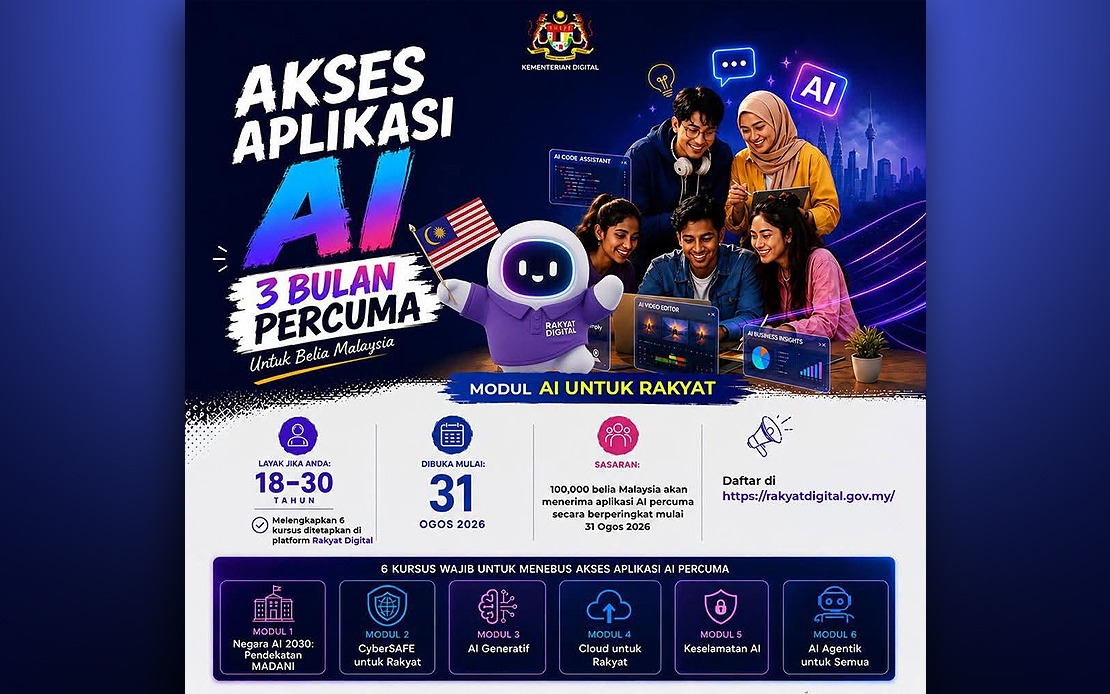
Malaysia has launched an ambitious initiative to democratise artificial intelligence access among its youth population. The AI for the People programme, unveiled by Prime Minister Datuk Seri Anwar Ibrahim, represents a significant step in the government's push to develop a digitally literate workforce capable of harnessing emerging technologies. The scheme, administered through the Rakyat Digital portal at rakyatdigital.gov.my, commenced rolling out on August 30 and seeks to enrol 100,000 Malaysians between the ages of 18 and 30 before 2027.
At its core, the programme operates on a straightforward structure designed to remove financial barriers to AI education. Young people who wish to participate must successfully complete and pass six carefully curated modules that span different dimensions of artificial intelligence and digital security. This curriculum-based approach ensures participants gain foundational knowledge before accessing premium tools, creating a structured pathway rather than merely distributing free subscriptions indiscriminately. The completion requirement also serves as a quality control mechanism, ensuring that those receiving access to advanced AI applications have the requisite understanding to use them effectively.
The six mandatory modules cover a broad spectrum of AI-related topics. Participants must work through AI Nation 2030: The MADANI Approach, a module that contextualises artificial intelligence within Malaysia's national development framework. CYBERSAFE for the People addresses digital security concerns, a crucial consideration as AI adoption accelerates. Three additional modules—Generative AI, AI Security, and Agentic AI for All—provide practical and technical knowledge, while Cloud for the People introduces participants to cloud computing infrastructure underpinning modern AI systems. This diverse range suggests the government recognises that meaningful AI literacy extends beyond understanding how to prompt language models; it encompasses security, ethics, infrastructure, and strategic deployment.
Upon successfully completing the six modules, participants receive a three-month complimentary subscription to a curated selection of AI applications and software. The initial roster of available tools reflects partnerships between Malaysia's Digital Ministry and both local and international technology providers. YTL AI Labs offers IlmuChat, a locally developed application potentially tailored to Malaysian language and context requirements. Alibaba's Wonderclip and MuleRun provide access to cloud-based AI capabilities, while Google's Gemini Enterprise delivers enterprise-grade generative AI functionality. The inclusion of both local and global providers balances support for Malaysia's domestic tech ecosystem with exposure to cutting-edge international platforms.
The government's commitment to expanding this toolkit over time signals that the initial offerings represent merely a foundation. Additional AI software and tools will be integrated in successive phases, enriching the learning experience and maintaining programme relevance as the AI landscape evolves. This phased approach also allows administrators to assess user feedback and identify which tools prove most valuable for the target demographic. For young Malaysians, this suggests that early enrolees will benefit from an expanding menu of capabilities, creating incentives to participate sooner rather than later.
The underlying rationale for the AI for the People initiative aligns closely with Malaysia's broader digital transformation ambitions. The government frames the programme as essential infrastructure for developing what it terms an "inclusive AI Nation by 2030," a concept embedded within the larger Malaysia Digital 2030 vision. This positioning suggests that policymakers view AI literacy as a prerequisite for meaningful participation in the future economy, not merely an optional enhancement. By targeting young adults aged 18 to 30, the government is investing in individuals at crucial career formation stages, potentially enabling them to pursue opportunities in AI-adjacent fields or integrate artificial intelligence capabilities into their existing professional pursuits.
Digital Ministry secretary-general Datuk Fabian Bigar emphasised that the programme aims to ensure young people not only understand AI conceptually but gain practical experience with tools applicable to learning, creative work, and productivity enhancement. This distinction between theoretical knowledge and hands-on capability is significant; many digital literacy initiatives focus on awareness-building without providing concrete access to functional platforms. By bundling training with tool access, the AI for the People scheme addresses a genuine gap in Malaysia's digital education landscape, where young people might understand AI concepts but lack affordable pathways to experiment with live systems.
The timing of the announcement—delivered as one of six digital opportunity initiatives during the 2026 National Day Premier Address—underscores the government's prioritisation of youth engagement with digital technologies. The clustering of this initiative with five others suggests a coordinated strategy to address multiple dimensions of digital inclusion simultaneously. For Malaysian youth, particularly those from lower-income backgrounds or areas with limited access to private AI training programmes, the scheme offers unprecedented opportunities to acquire skills increasingly demanded by employers across sectors ranging from software development to digital marketing and data analysis.
From a regional perspective, Malaysia's approach to democratising AI access warrants attention. Many Southeast Asian nations grapple with uneven technological development and concerns about digital inequality. By creating a pathway for 100,000 young citizens to acquire AI competencies at no cost, Malaysia positions itself as a leader in inclusive technology adoption. The initiative could serve as a model for other regional governments considering how to ensure their populations benefit equitably from artificial intelligence advancement rather than being left behind by rapid technological change.
The registration mechanism through the Rakyat Digital portal streamlines access, allowing interested youths to begin their learning journey immediately. The portal's integration as the delivery platform for this high-profile initiative demonstrates the government's confidence in its national digital learning infrastructure. For participants, this means their educational journey unfolds within a centralised ecosystem potentially offering additional resources, community engagement features, and progression tracking beyond the core six modules.
Successfully scaling this initiative to reach 100,000 young Malaysians by 2027 will require sustained funding, curriculum maintenance, and ongoing partnerships with technology providers. The three-year timeframe suggests the government views this as a medium-term commitment rather than a pilot programme, indicating confidence in the model's viability. However, programme success will ultimately depend on uptake rates, completion rates among enrolled participants, and demonstrable employment or entrepreneurial outcomes for graduates.
For Malaysian employers across sectors, the emergence of this large cohort of AI-trained young people within the next few years could significantly alter recruitment landscapes. Organisations may increasingly encounter job applicants with verified AI competencies, potentially lowering barriers to hiring for roles previously requiring expensive external training. Conversely, the programme's existence validates industry-wide awareness that AI skills have transitioned from specialised to baseline requirements for competitive contemporary workforces. The government's intervention essentially signals that developing these capabilities represents a shared responsibility between individuals, employers, and the state.

