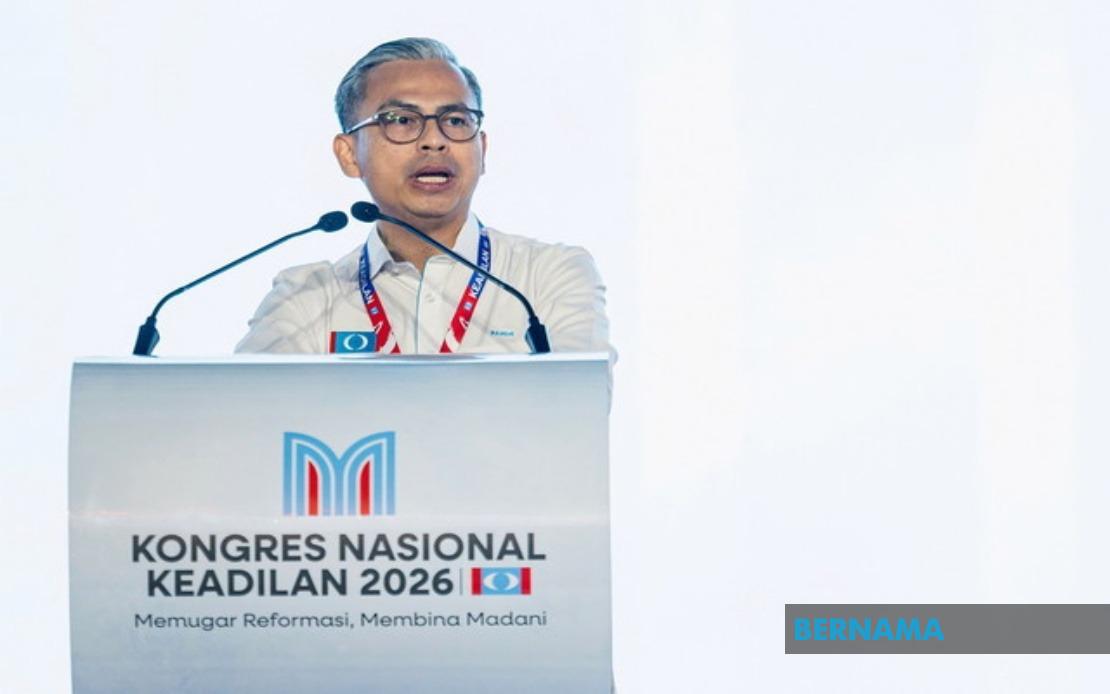
The gap between what Malaysia's government has accomplished and what ordinary citizens perceive remains a persistent challenge, according to PKR information chief Datuk Seri Fahmi Fadzil, who called for substantial improvements in how policies and achievements are communicated to the public. Speaking at the 2026 PKR National Congress in Melaka, Fahmi highlighted that despite what he characterised as successful macroeconomic management under PKR president Datuk Seri Anwar Ibrahim's leadership, many Malaysians struggle to recognise how these gains translate into their daily lives.
Fahmi, who doubles as Communications Minister, drew a distinction between what he termed the "pot economy"—macroeconomic metrics that technocrats track—and the lived experience of ordinary Malaysians dealing with household expenses, employment prospects, and quality of life concerns. The acknowledgment reflects a broader frustration within government circles that strong economic fundamentals do not automatically convert into political goodwill if citizens fail to link national achievements with personal benefit. This perception gap, he suggested, stems partly from inadequate messaging rather than policy failure.
The communication challenge extends beyond simple information delivery. Fahmi stressed that government messaging must account for the emotional and psychological dimensions of how people process and internalise information about national performance. Technical announcements about inflation rates, foreign direct investment, or budget surpluses rarely resonate with voters confronting rising costs at the petrol pump or supermarket checkout. The government's communication apparatus, he indicated, needs fundamental restructuring to bridge this disconnect between headline statistics and household sentiment.
To address this shortfall, PKR plans to harness its grassroots network more systematically, enlisting division chiefs and local leaders to disseminate information through channels that feel familiar and trustworthy to ordinary Malaysians. Rather than relying solely on formal government announcements or mainstream media coverage, the party intends to conduct numerous smaller-scale community forums where officials can explain policies in conversational settings conducive to two-way dialogue. This approach recognises that Malaysians often trust neighbours and local figures more readily than distant government spokespersons.
Simultaneously, the government faces escalating challenges from coordinated disinformation campaigns that exploit sensitive social fault lines. Fahmi revealed that the Malaysian Communications and Multimedia Commission (MCMC) identified more than 8,410 fake social media accounts exploiting what he termed "3R issues"—religion, race, and the royal institution—since the recent Johor state election alone. These coordinated inauthentic networks create emotionally charged narratives that can overwhelm factual government messaging, particularly among voters already sceptical of official claims.
The proliferation of such false-information operations suggests that communicating positive policy outcomes has become harder in an environment where malicious actors deliberately amplify discord and distrust. Fahmi framed MCMC's account takedown efforts as essential defensive measures preventing the manipulation of citizens' emotional responses to government performance. By removing fraudulent accounts before they accumulate large followings, authorities aim to preserve the informational landscape from organised contamination.
Regarding media relations, Fahmi adopted a cautious tone, emphasising that the government does not seek to control editorial decisions or suppress legitimate criticism. Rather, his communications team intends to address factually inaccurate reporting through proper channels, requesting corrections when news organisations publish demonstrably false claims. This distinction—between accepting criticism of government performance and rejecting false statements of fact—represents the government's stated position on media accountability versus press freedom.
The strategic emphasis on cooperation with the Wanita wing indicates recognition that women often serve as primary information distributors within families and community networks in Malaysia. Mobilising female party activists and government officials to explain policies could potentially reach household decision-makers and opinion-formers who shape family attitudes toward government performance. This gendered approach to communication strategy acknowledges demographic realities about information flow within Malaysian society.
Fahmi's comments come amid broader structural changes within Malaysia's political economy. As the Anwar-led government heads toward the 2026 national elections, demonstrating tangible public benefit from macroeconomic stability becomes increasingly vital for electoral prospects. Opposition parties have long hammered messaging that growth statistics mask unchanged or declining living standards for working-class and middle-income Malaysians. The government's communication overhaul represents an attempt to reclaim narrative dominance by making abstract economic indicators concrete and personally relevant.
The underlying tension Fahmi acknowledges reflects a fundamental challenge for any technocratic government: economic competence does not automatically translate into political support if citizens feel disconnected from prosperity narratives. Malaysia's experience parallels global trends where solid macroeconomic fundamentals have failed to prevent electoral punishment for incumbent parties perceived as out of touch with popular concerns. Successful communication strategies must therefore maintain credibility by grounding claims in observable improvements to ordinary people's circumstances.
Looking forward, PKR's communication initiative will likely consume substantial resources and require sustained coordination across party structures, government ministries, and statutory agencies like MCMC. The strategy depends on persuading grassroots activists that communicating government achievements ranks equally with traditional party activities. Success also hinges on whether smaller-scale community engagement genuinely shifts public perception or merely creates parallel information channels that reach party loyalists already inclined to support the government.
The congress concluded with Anwar scheduled to deliver closing remarks, providing opportunity for the Prime Minister to reinforce the communication message and signal commitment to improved public engagement. How effectively the government executes these communication improvements over coming months will significantly influence whether Malaysians perceive the incumbent coalition as responsive and competent heading into the 2026 general election.

