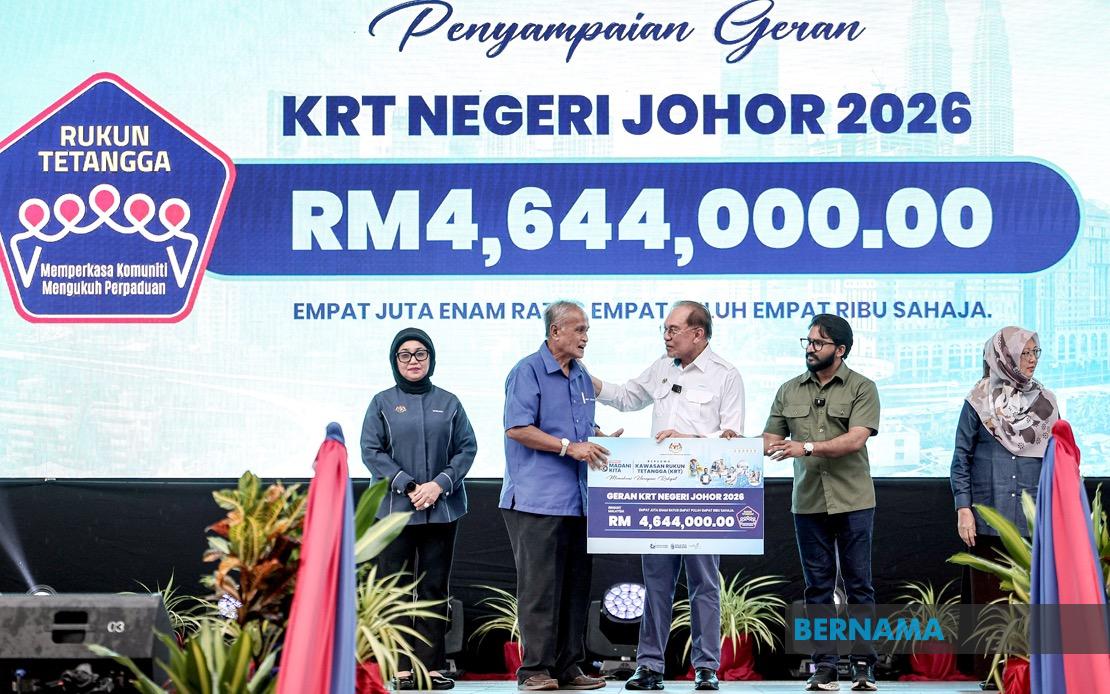
The government has made a significant commitment to strengthening community-level security and governance structures by approving a substantial increase to annual funding for Neighbourhood Watch Areas across Malaysia. During a visit to Segamat in Johor on June 24, Prime Minister Datuk Seri Anwar Ibrahim announced that the KRT allocation would rise to RM10,000 annually, representing a 67 per cent boost from the previous RM6,000 rate that had remained unchanged for the past decade. The new amount will commence disbursement beginning January 1, 2027, marking the first major adjustment to grassroots watch group funding in a generation.
Anwar framed the decision as recognition of the critical role these volunteer-run community organisations play in addressing local issues and maintaining social cohesion at the neighbourhood level. Speaking at the MADANI KITA Programme event held at Dataran Segamat, the Prime Minister emphasised that KRT groups serve as vital intermediaries between residents and government institutions, helping to identify and resolve security concerns, public welfare matters, and community development needs. The decision to elevate funding reflects the administration's acknowledgment that a decade of stagnant allocations had failed to keep pace with operational requirements and inflationary pressures affecting these grassroots bodies.
The Prime Minister articulated a broader vision for KRT organisations beyond their immediate security functions, positioning them as custodians of national unity and social harmony. He stressed that Malaysia's distinctive strength has always stemmed from its capacity to maintain peaceful coexistence among diverse racial, religious, and cultural communities since independence. In this context, KRT groups represent institutional mechanisms for nurturing consensus-building and democratic participation at the community level, preventing the fracturing of social bonds that could emerge if such forums were neglected or undervalued.
Anwar's remarks carried an implicit caution against weaponising communal differences for divisive purposes. He deliberately stated that Malaysia's racial, cultural, and religious diversity should be celebrated as a unifying national asset rather than exploited as a tool for social fragmentation. This messaging appears calibrated to reinforce the government's commitment to inclusive governance and suggests that funding increases to community organisations like KRT are part of a deliberate strategy to strengthen institutional safeguards against polarisation and social discord.
Alongside the KRT announcement, the Prime Minister unveiled additional investments in Johor's social infrastructure, signalling a multi-pronged approach to grassroots development. An immediate allocation of RM3.205 million was approved for 16 infrastructure repair and upgrading projects at Islamic educational institutions across several districts including Batu Pahat, Muar, and Segamat. These funds will address structural deficiencies, renovation needs, and facility improvements at religious schools, madrasahs, study centres, and tahfiz institutions, with the stated objective of creating more comfortable and conducive learning environments for students.
The government simultaneously committed RM1.0 million for urgent repair and maintenance work at Royal Malaysian Police quarters in Johor, acknowledging that adequate facilities for security personnel are essential for maintaining their welfare and operational effectiveness. This targeted investment recognises the connection between physical working and living conditions and the morale and performance of law enforcement officers who bear responsibility for maintaining national peace and public safety.
These announcements collectively illustrate a government approach that integrates community security, religious education, and law enforcement support as interconnected components of national resilience and social stability. The cumulative investment in grassroots watch groups, Islamic educational facilities, and police infrastructure suggests a recognition that stability emanates from multiple reinforcing institutional layers rather than from centralised authority alone.
For Malaysian communities, the KRT funding increase holds practical significance beyond symbolism. Neighbourhood Watch groups typically undertake crime prevention activities, emergency response coordination, dispute mediation, and liaison between residents and government agencies. With budgets that have remained frozen for ten years, many KRT groups have struggled to maintain basic operational capacity, organise training for volunteers, or conduct regular community engagement activities. The increase to RM10,000 annually will provide meaningful relief, though groups in urban areas with larger populations and higher operational costs may still face constraints.
The decision also reflects broader government positioning heading toward the next electoral cycle, emphasising grassroots engagement and tangible resource allocation to neighbourhood-level organisations where political impact can be directly observed. Community leaders and KRT coordinators represent influential figures within their localities, and strengthening these groups through enhanced funding builds political goodwill and demonstrates responsiveness to ground-level concerns.
Regionally, Malaysia's approach to formalising and funding community-based security and governance structures may offer models of interest to other Southeast Asian nations seeking to strengthen social cohesion and distributed security capacity. Many countries in the region grapple with balancing centralised governance with community participation, and Malaysia's evolution of the KRT system demonstrates one approach to institutionalising grassroots involvement in local affairs.
The timing of these announcements, coming slightly more than a year before the funding implementation date, suggests the government intends the KRT increase to be a marquee policy commitment carried into electoral campaigns and budget deliberations. Officials will need to ensure that the RM10,000 allocation is sufficient to attract and retain committed volunteers, enable meaningful training and capacity-building, and permit groups to respond effectively to evolving community security challenges including cybercrime awareness and disaster preparedness.
Moving forward, the government's follow-through on these funding commitments will be closely monitored by community organisations and observers tracking the MADANI administration's pledge to strengthen grassroots institutions. The effectiveness of enhanced KRT allocations in actually improving community safety, dispute resolution, and inter-communal relations will ultimately determine whether the funding increase translates into substantive improvements in quality of life and social stability at the neighbourhood level across Malaysia.