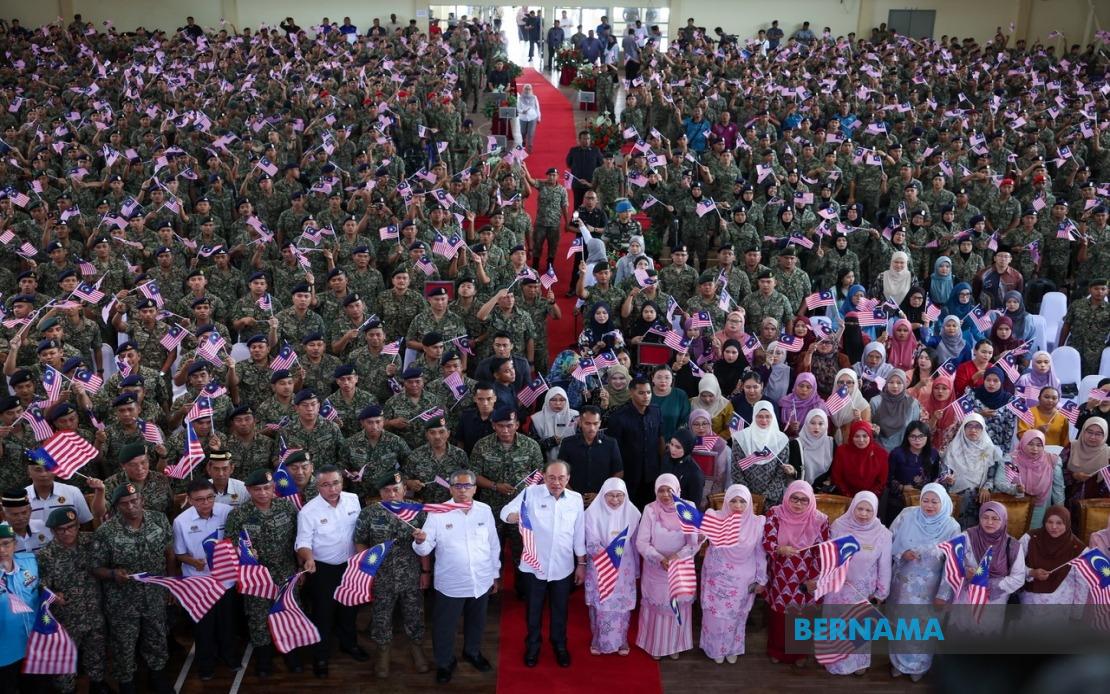
Prime Minister Datuk Seri Anwar Ibrahim has initiated a comprehensive review of the promotion mechanisms governing senior officers in the Malaysian Armed Forces, acknowledging that the current system has created bottlenecks that potentially disadvantage military personnel compared to their counterparts in other government departments. Speaking in Tampin on July 27, Anwar highlighted a structural imbalance in how the civil service manages career advancement, with senior military officers facing extended timelines before elevation to higher ranks—a concern that extends beyond mere administrative inconvenience to touch on morale, retention, and the perceived status of defence personnel within the broader public sector framework.
The Prime Minister's intervention reflects mounting pressure from military circles regarding career progression inequities. While civilian public servants have benefited from improved conditions under the Public Service Remuneration System (SSPA), military officers have reportedly experienced stagnation in their advancement opportunities. Anwar acknowledged this disparity explicitly, noting that while the number of affected senior officers may be limited, the symbolic and practical implications warrant urgent government attention. The recognition that these personnel might feel "left behind or marginalised" suggests awareness that systemic delays in promotions can erode institutional morale and discourage top talent from remaining in uniform.
Anwar tasked Tan Sri Shamsul Azri Abu Bakar, the Chief Secretary to the Government, with examining whether procedural reforms could accelerate promotion pathways for senior MAF ranks. This delegation indicates that the government views the issue as sufficiently serious to merit intervention at the highest administrative level. The involvement of Shamsul Azri—who oversees the entire civil service apparatus—signals that any solution will need to align with broader public sector protocols while carving out necessary accommodations for military personnel whose career structures differ fundamentally from civilian hierarchies.
Financial considerations loom large in this deliberation. While Anwar downplayed the scale of the affected officer cohort, he explicitly acknowledged that implementing accelerated promotion pathways would carry budgetary implications. Malaysia's defence budget already faces competing demands, and salary implications from faster promotions could trigger cascading effects throughout the military pay structure. The government appears committed to absorbing these costs—Anwar indicated a decision would materialise "soon"—but the deliberative pace suggests the finance ministry is conducting rigorous cost-benefit analysis before finalising recommendations.
The composition of attendees at this announcement underscores the issue's multi-departmental significance. General Tan Sri Malek Razak Sulaiman, the Chief of Defence Forces, and General Tan Sri Azhan Md Othman, the Army Chief, both participated in what Anwar characterised as an ongoing policy discussion. Deputy Defence Minister Adly Zahari's presence reflects parliament's oversight interest. This broad stakeholder engagement suggests the government has moved beyond conceptual discussion toward substantive negotiation between military leadership and civilian administration regarding implementable solutions.
The timing of this announcement merits consideration within Malaysia's broader defence and security posture. As the country navigates evolving regional security challenges—from maritime threats to transnational terrorism—retention of experienced senior military officers becomes strategically important. Brain drain from the armed forces due to perceived career limitations could compromise institutional continuity and operational effectiveness. By addressing promotion delays, the government signals commitment to maintaining a robust defence establishment capable of responding to sophisticated contemporary threats. This reframing positions the promotion review as a national security imperative rather than merely a personnel management matter.
Anwar's emphasis on consultation and deliberate decision-making contrasts with more autocratic approaches to military affairs. By explicitly stating that "our armed forces know they are neither left behind nor marginalised" and framing this as a government responsibility, he positioned the civilian administration as responsive to military concerns while maintaining clear civilian control over defence policy. This diplomatic approach acknowledges military grievances without appearing to capitulate to institutional demands, a delicate balance essential in democracies where military autonomy must be respected without exceeding constitutional bounds.
The SSPA reference provides useful context. This remuneration system was designed to modernise public sector compensation and improve retention of qualified professionals. That military officers have not benefited equally from these improvements represents a policy oversight worth correcting. The government's apparent willingness to extend SSPA principles to military advancement suggests a holistic approach to aligning defence personnel terms and conditions with broader public sector reforms, potentially establishing precedent for future systemic improvements.
Implementation challenges will likely emerge during the finalisation process that Anwar indicated would occur at an upcoming meeting. Balancing faster promotion pathways with merit-based advancement standards, ensuring generational equity among officer cohorts, and preventing cascading delays in lower-ranking promotions will require sophisticated policy design. The government may consider phased implementation or targeted reforms affecting only the most severely bottlenecked ranks, allowing incremental assessment of financial and organisational impacts.
For Malaysian defence personnel and their families, this review offers tangible evidence that career concerns receive executive attention. Military recruitment and retention depend significantly on perceived career prospects, and public government acknowledgment of promotion delays carries psychological weight beyond the actual policy reforms eventually implemented. The announcement itself may improve morale by demonstrating that the civilian administration takes military career development seriously.
Regionally, Malaysia's commitment to maintaining a professional, well-motivated armed forces carries implications for Southeast Asian security architecture. As the region confronts diverse threats and navigates great power competition, the capacity to retain experienced military leadership becomes increasingly valuable. By proactively addressing retention mechanisms like promotion opportunities, Malaysia positions itself to sustain defence capabilities in an environment where human capital represents an increasingly scarce resource.
The government's decision timeline remains unspecified, with Anwar indicating action "soon" and referencing an imminent meeting to finalise details. This vagueness may reflect genuine uncertainty about financial implications or the complexity of coordinating across multiple government agencies. Defence ministry officials will likely conduct detailed impact assessments examining precedent from other nations' militaries, budgetary availability, and organisational structure implications. The eventual outcome will establish whether Malaysia opts for comprehensive system overhaul or targeted interventions addressing the most acute bottlenecks, with consequences extending well beyond the affected officers to institutional morale and defence effectiveness.

