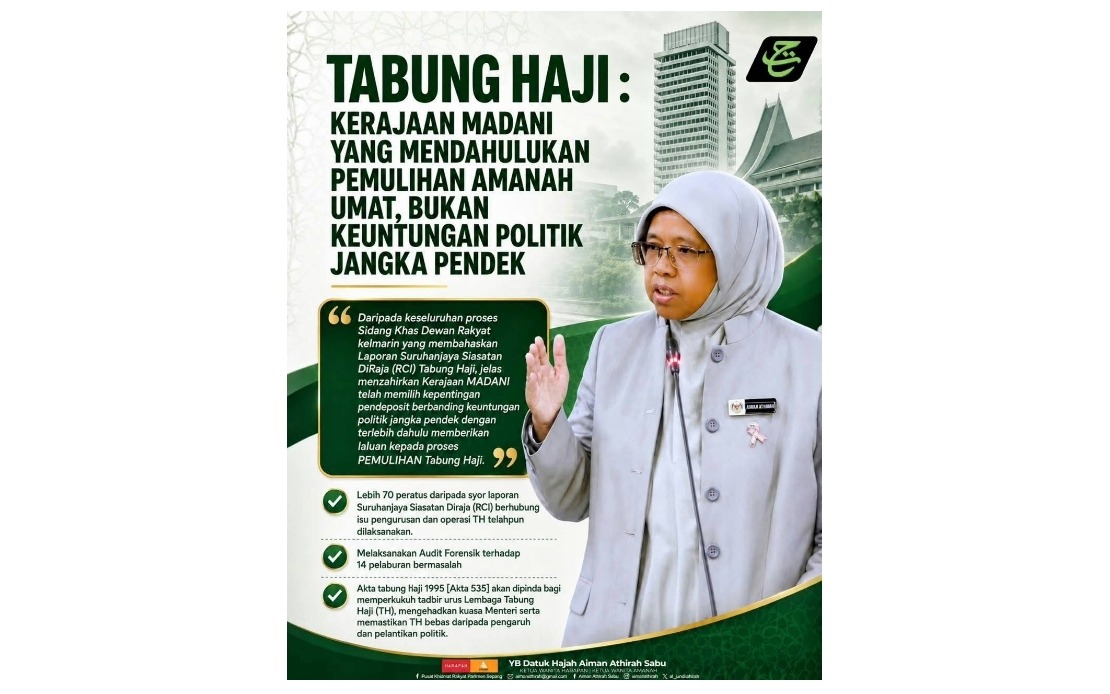
The Malaysian government is defending its measured approach to disclosing findings from the Tabung Haji Royal Commission of Inquiry, with senior officials arguing that protecting the nation's 10 million Muslim pilgrims' savings takes precedence over political considerations. Deputy Minister of Housing and Local Government Datuk Aiman Athirah Sabu emphasised that the cautious timeline for releasing the RCI report reflects a deliberate choice to safeguard the financial stability of an institution whose collapse could trigger widespread economic and social consequences across the Muslim community.
Tabung Haji occupies a unique position in Malaysia's financial landscape as both a savings vehicle and a spiritual conduit for Muslims fulfilling the fifth pillar of Islam. The institution manages deposits from more than 10 million Malaysians, making it far more than a conventional investment entity. Any destabilising disclosure risks triggering the kind of panic withdrawals witnessed in 2018, when depositors withdrew over RM6 billion in the aftermath of governance scandals. That historical precedent informs the current administration's decision to implement reforms and bolster investor confidence before subjecting the institution to public scrutiny through the RCI's full findings.
The government's restraint has drawn criticism from opposition quarters, particularly Parti Islam Se-Malaysia (PAS) and Parti Wawasan Negara (Wawasan), which have questioned why the report remains undisclosed. Aiman Athirah countered that such political criticism, delivered without acknowledging the institutional stakes involved, prioritises short-term partisan advantage over the genuine welfare of depositors. She characterised the response as requiring factual engagement rather than rhetorical positioning, signalling the administration's frustration with what it views as opportunistic scrutiny divorced from practical considerations.
The significance of the governance failures at Tabung Haji extends beyond financial metrics. His Majesty Sultan Ibrahim, King of Malaysia's statement calling for thorough investigation underscored that the institution's troubles represented serious structural weaknesses rather than routine operational lapses. This royal acknowledgement validated the government's positioning that the matter demands comprehensive remediation, not hasty disclosure. The sovereign's involvement elevated the issue from bureaucratic mismanagement to a constitutional matter touching the interests of the Muslim community as a whole.
Progress in implementing recommendations has already begun materialising, with Minister in the Prime Minister's Department (Religious Affairs) Dr Zulkifli Hasan disclosing during a special parliamentary sitting that over 70 per cent of RCI recommendations relating to Tabung Haji's management and operations have been operationalised. Forensic audits into 14 troubled investments represent a particularly significant undertaking, providing granular examination of how losses accumulated and where accountability lies. This investigative work addresses not merely the financial dimension but the governance architecture that permitted such deterioration.
The scale of accumulated losses provides sobering context for the administration's caution. During the special parliamentary sitting, Second Finance Minister Datuk Seri Amir Hamzah Azizan revealed that 14 troubled investments generated nearly RM13 billion in losses, with seven recording total loss. The government bore RM10.2 billion through a 2018 rescue mechanism involving Urusharta Jamaah Sdn Bhd, while Tabung Haji itself absorbed RM2.6 billion in impairment losses between 2018 and 2025. These figures demonstrate that the institution's difficulties stem from substantial structural problems requiring careful unwinding rather than rapid exposure.
The government's broader recovery strategy combines financial rehabilitation with institutional strengthening. Investment income reached a record RM4.64 billion in 2025, while profit distributions expanded from 1.25 per cent in 2018 to 3.5 per cent in 2025, indicating improving asset performance and depositor returns. Simultaneously, Tabung Haji has maintained the cost of performing hajj at RM33,000 across three consecutive seasons despite mounting operational expenses, demonstrating commitment to accessibility for Malaysian pilgrims. These improvements represent concrete gains that would face jeopardy if premature disclosure triggered confidence erosion.
Governance enhancement forms a critical plank of the reconstruction agenda. The administration has committed to amending the Tabung Haji Act 1995 to curtail ministerial discretion, eliminate political appointments, and insulate the institution from partisan influence. Such legislative reformation addresses the root cause of earlier mismanagement by removing mechanisms through which political interests could distort institutional decision-making. This structural recalibration signals intent to transform Tabung Haji into a professionally managed entity resistant to future politicisation.
Aiman Athirah's intervention represents deliberate rhetorical positioning by the government to shape public understanding of why full RCI disclosure remains pending. By framing the issue as institutional stewardship rather than political obstruction, the administration seeks to preempt opposition arguments that it is concealing unfavourable findings. The characterisation of opposition parliamentary walkouts during the special sitting as irresponsible attempts to politicise the matter further sharpens the government's claim to occupy the higher ground of depositor protection.
The challenge facing Malaysian policymakers involves balancing transparency with stability in ways that democratic societies increasingly expect from government. While the administration's emphasis on protecting depositor confidence carries genuine weight, the extended delay in releasing RCI findings inevitably invites suspicion about what remains hidden. For readers across Southeast Asia, the Tabung Haji situation illustrates broader tensions within emerging economies between the technical requirements of financial system management and the political pressures inherent in governance of institutions entrusted with citizens' savings.
The decision to prioritise implementation of reforms before disclosure reflects calculation that demonstrable institutional improvement strengthens the government's position when the RCI report eventually emerges. By the time findings become public, the administration hopes to present them within a narrative of correction rather than crisis, with concrete evidence that systemic weaknesses have been remedied. This approach assumes that depositor confidence derives partly from tangible improvements in returns and governance, not merely from institutional reputation. Whether this sequencing strategy ultimately vindicates itself depends on whether markets and depositors judge the delay as responsible stewardship or suspect concealment.

