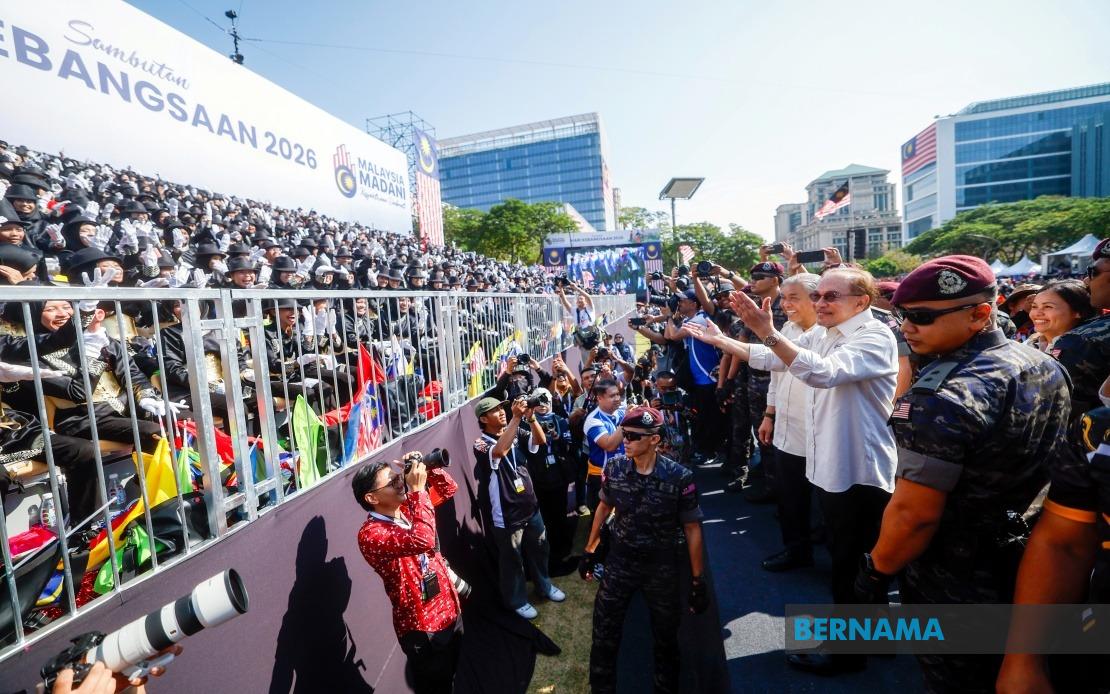
Prime Minister Datuk Seri Anwar Ibrahim on Saturday praised the overwhelming public participation and festive spirit displayed at the 69th National Day celebration held at Dataran Putrajaya, describing the event as a resounding success that showcased Malaysian unity and pride. Addressing reporters after observing the colourful parade and procession, Anwar expressed his gratitude to all participants and members of the public who gathered to commemorate the occasion, emphasising the significance of such collective celebrations in reinforcing national bonds.
The National Day festivities, which commenced at 8 am, proved to be a grand affair graced by His Majesty Sultan Ibrahim and Her Majesty Raja Zarith Sofiah, the King and Queen of Malaysia. The royal couple's presence underscored the importance the institution places on national commemorations. Anwar and his wife, Datuk Seri Dr Wan Azizah Wan Ismail, received Their Majesties on arrival, alongside Communications Minister and 2026 National Day and Malaysia Day Main Committee chairman Datuk Seri Fahmi Fadzil, highlighting the ceremonial significance of the occasion.
The parade itself demonstrated the scale and ambition of Malaysia's national celebrations. Organised under the theme Malaysia MADANI: Kesejahteraan Dinikmati—emphasising the government's vision of a nation prioritising people's well-being and respecting diversity—the event featured 10,819 participants distributed across 76 contingents and 22 marching bands. The pageantry extended beyond traditional ground displays, incorporating 328 land, sea and air assets, 112 service animals, and 22 electric vehicles, alongside creative human graphics performances staged on terraces throughout Dataran Putrajaya.
The magnitude of public engagement proved remarkable, with more than 100,000 people attending the celebration. Many had arrived the previous evening, camping at the venue to secure advantageous viewing positions, while others commenced their journeys early in the morning. This level of participation reflects the enduring appeal of National Day festivities among Malaysians, transcending generational and demographic boundaries.
Beyond formal proceedings, Anwar demonstrated accessibility and engagement with ordinary citizens by walking more than 500 metres around Dataran Putrajaya and mingling with enthusiastic crowds. These interactions, which included obliging numerous photograph requests, emphasised a leadership style that emphasises proximity to citizens and responsiveness to public sentiment. Such gestures carry symbolic weight in Malaysian political culture, where direct engagement between senior leaders and the public remains relatively uncommon at major state events.
The celebrations provided an opportune platform for the government to announce welfare initiatives aimed at improving the living standards of ordinary Malaysians. During his National Day address delivered the preceding day, Anwar unveiled six key government initiatives, with particular emphasis on fuel subsidies affecting millions of households. The restoration of the BUDI MADANI RON95 (BUDI95) programme's monthly basic eligibility quota from 200 litres to 300 litres addresses a concern affecting more than 16 million users of subsidised RON95 petrol.
This policy adjustment carries significant implications for the middle and lower-income households that depend on fuel subsidies to manage transportation and logistics costs. By restoring the monthly quota to its previous level of 300 litres, the government acknowledges mounting cost-of-living pressures facing ordinary Malaysians and signals commitment to maintaining existing welfare provisions. The measure reflects broader economic anxieties about inflation and household budgeting that have become central concerns in Malaysian public discourse.
Complementing the RON95 subsidy enhancement, Anwar announced that more than half a million eligible owners of diesel-powered pickup trucks and jeeps would receive up to 400 litres of BUDI Diesel monthly, effective from September 1. This extension of subsidised fuel schemes to commercial users—particularly those operating small-to-medium enterprises dependent on transportation—acknowledges the distinct economic pressures facing this constituency. The timing and announcement of these measures during National Day celebrations demonstrates strategic communication of welfare policies when public attention is heightened and national sentiment is elevated.
The enthusiastic public response to these announcements, including unsolicited gratitude expressed by attendees, suggests that fuel subsidy measures resonate significantly with ordinary Malaysians. The individual who thanked Anwar for the BUDI95 restoration exemplifies how these policies directly impact household finances and purchasing power. Such ground-level feedback provides government with real-time assessment of policy effectiveness and public reception.
The 2026 National Day celebration thus served multiple purposes simultaneously—functioning as a patriotic commemoration, a vehicle for demonstrating government accessibility and responsiveness, and a platform for announcing economic policies affecting millions. The successful execution of the event, reflected in high attendance figures and enthusiastic participation, suggests that carefully orchestrated state ceremonies continue to command public engagement and emotional resonance in contemporary Malaysia.
Looking forward, the National Day celebration's emphasis on the Malaysia MADANI vision—articulated through the theme of well-being and diversity—positions the government's policy agenda within a broader narrative of inclusive development. This framing connects specific welfare measures like fuel subsidies to larger ideological commitments about the state's role in ensuring equitable prosperity. The integration of modern elements, including electric vehicles in the parade, alongside traditional ceremonial components indicates attempts to present the government as simultaneously grounded in national tradition and oriented toward contemporary challenges and solutions.
The strong attendance and positive public response to the 2026 National Day proceedings provide the government with significant momentum heading into the latter phases of its current term. Such celebrations, when successfully executed, generate goodwill and reinforce public connection to national institutions and symbols. For Malaysians across the country, participation in these events offers opportunities to express patriotism, witness the pageantry of state power, and experience collective belonging, elements that remain psychologically and politically significant in a multicultural nation navigating complex economic and social transitions.

