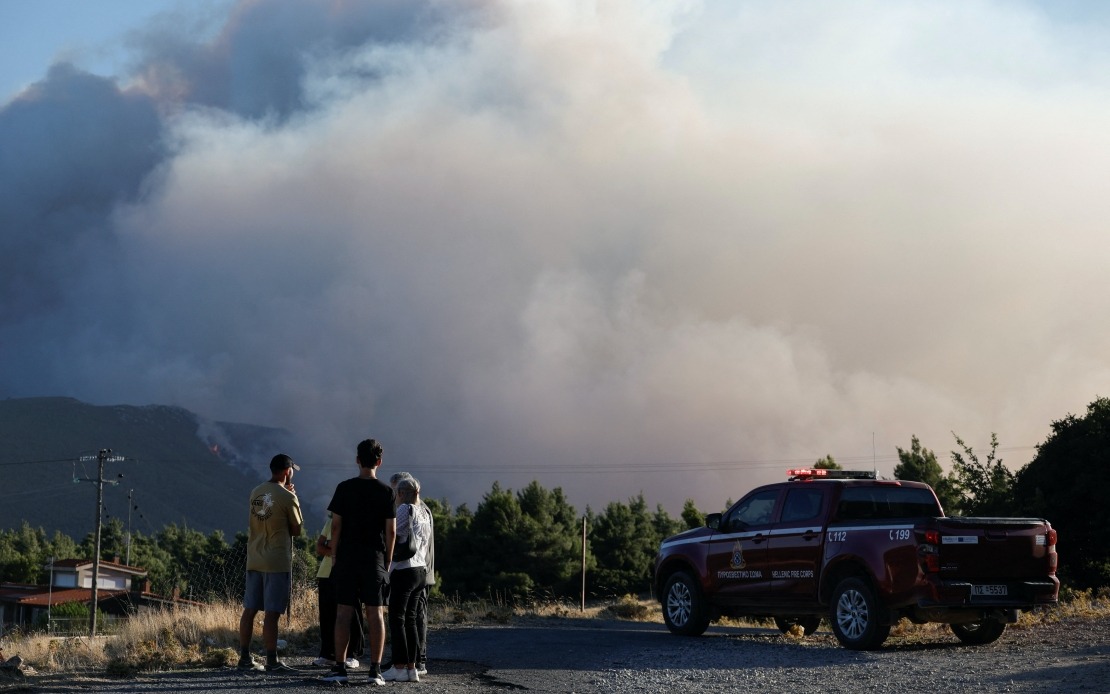
Hundreds of firefighters were deployed throughout Sunday night to combat a sprawling wildfire burning across the Kithairon Mountains, located roughly 50 kilometres west of Athens. The Greek authorities mobilised military vehicles, equipment from volunteer organisations, and heavy machinery to contain the advancing flames in what has become one of the summer's most challenging fire emergencies in the region. As daybreak arrived, the operational tempo intensified when aerial firefighting units resumed their work, with both helicopters and specially equipped planes dropping water and flame retardant across affected zones.
The fire's trajectory has proven unpredictable and dangerous, driven by strong winds that cause the flames to move with alarming speed across the landscape. Two communities—Veniza and Psatha—have experienced particularly severe damage, with homes and vegetation destroyed by the rapidly advancing wall of fire. The eastern movement of the flames has created mounting concern among residents and officials, as the fire now sits only kilometres away from Megara, a significant population centre that could face evacuation orders if the fire continues its current trajectory.
International cooperation has become essential to managing the crisis. At least 500 firefighters from Greece, Romania, and France are now working in coordinated efforts to establish firebreaks and contain the blaze's expansion. This multilateral response reflects the scale of the emergency and the recognition that domestic resources alone would be insufficient to protect communities and critical infrastructure in the path of the flames. The presence of foreign personnel and equipment demonstrates the interconnected nature of Mediterranean fire management during peak summer season.
Authorities have begun investigations into the fire's origin, with law enforcement taking an aggressive stance on negligent conduct. So far, 13 individuals have been arrested across the country and charged with negligent arson, suggesting that human activity—whether accidental or deliberate—may be contributing to the proliferation of fires. This criminal dimension adds urgency to the firefighting response while raising questions about enforcement of fire prevention protocols and public awareness campaigns.
The crisis extends beyond the Athens region. The island of Cephalonia is simultaneously experiencing a major wildfire, though current assessments indicate that populated areas are not yet in immediate danger. The situation remains fluid, however, with weather conditions and wind patterns capable of altering fire behaviour in unpredictable ways. On Crete, the situation appears more stable, with firefighting teams reporting that most active fires have been extinguished following evacuation orders that were implemented as a precautionary measure.
The scale of destruction on Crete offers a sobering glimpse of what could unfold elsewhere. Media outlets have reported that approximately 200 homes have been destroyed in that region, though official government confirmation of these figures remains pending. The destruction of residential structures represents not merely property loss but significant human displacement and long-term recovery challenges for affected families and communities. The psychological and economic impacts of such destruction extend far beyond immediate emergency response.
Metorological assessments suggest that approximately 10,000 hectares of land in the northwestern and western regions surrounding Athens have been burned. This figure encompasses forests, agricultural land, and natural vegetation that will require years to regenerate. The environmental implications are substantial, affecting air quality, watershed management, and biodiversity across a critical Mediterranean ecosystem. Such large-scale landscape transformation has cascading effects on local agriculture, water supplies, and the broader regional environment.
For Malaysian and Southeast Asian observers, these events underscore the growing challenge that uncontrolled wildfires pose to densely populated regions globally. Climate conditions increasingly favour fire spread during summer months, and the economic and human costs of coordinated firefighting operations have become substantial. The reliance on international mutual aid arrangements reflects a reality that no single nation can independently manage mega-fires during peak season.
The coordination challenges evident in this Greek emergency—involving multiple nations, civilian and military assets, and aerial support—offer relevant lessons for Southeast Asian nations facing increasing fire risks from agricultural burning, deforestation, and climate variability. The importance of pre-positioning resources, establishing cross-border firefighting agreements, and maintaining trained personnel becomes evident when examining major fire emergencies in densely populated regions.
Greece's experience also highlights the necessity of rapid response mechanisms and clear communication channels during fire emergencies. Evacuation decisions, resource allocation, and inter-agency coordination all require functioning governance structures capable of operating under extreme stress. For regional policymakers in Southeast Asia, where transboundary fire smoke regularly affects multiple nations, the Greek example demonstrates both the complexity of modern fire management and the imperative for advance preparation and institutional capacity building.

