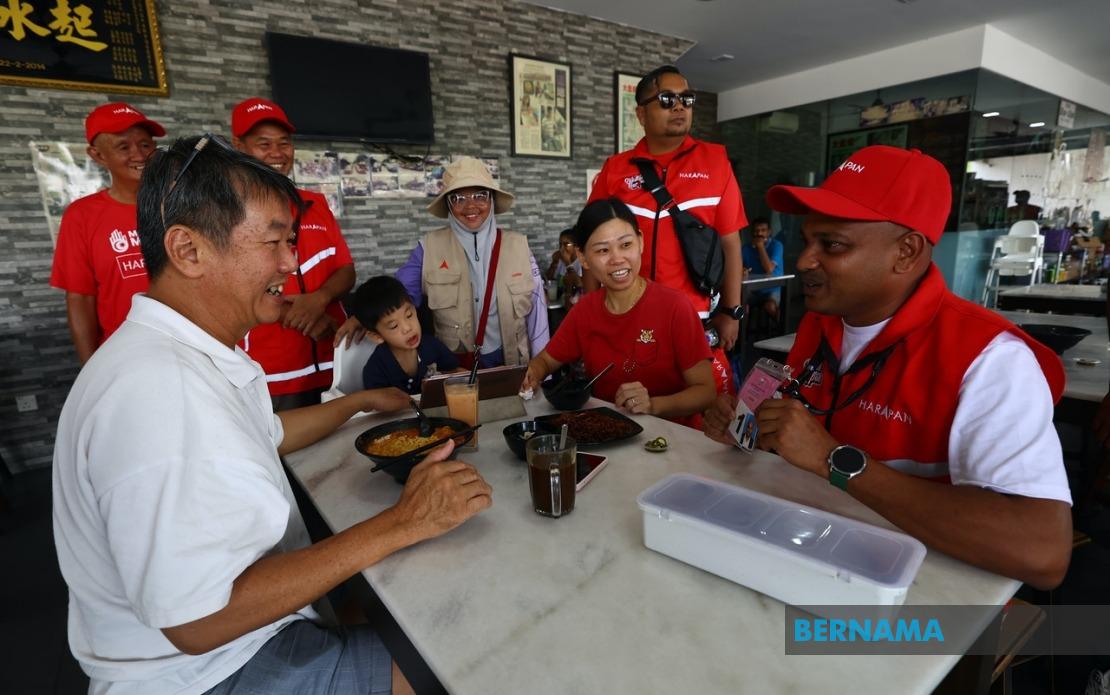
Pakatan Harapan candidate Guna Balakrishnan is mounting an aggressive final push to reach remaining voters in the Layang-Layang state constituency, with the Johor election just five days away. Speaking at the PH operations centre in Kluang, Guna acknowledged that while his campaign machinery had already canvassed roughly four-fifths of the constituency, the closing phase demanded maximum effort to connect with the roughly one-fifth still unreached. His determination to elevate his campaign intensity underscores the competitive nature of a three-way contest that has sharpened in its final week.
The Layang-Layang seat presents a complex political picture typical of contemporary Malaysian state elections. With 25,181 registered voters, the constituency will see Guna competing against Barisan Nasional's Chua Jian Boon and Perikatan Nasional's Abd Mutalip Abd Rahim, the sitting incumbent. This triangular arrangement reflects the broader fragmentation of Malaysia's political landscape, where the traditional two-coalition dominance has given way to multi-cornered contests that can dramatically reshape outcomes. Such contests often hinge on voter consolidation and the ability to mobilise support in the final crucial days.
Guna's manifesto addresses practical, ground-level concerns that resonate with rural and semi-urban constituencies across Malaysia. The explicit focus on flood mitigation speaks to a persistent infrastructure challenge in Johor, a state historically vulnerable to seasonal inundation and poor drainage management. By coupling flood control with street lighting upgrades and road infrastructure improvements, Guna positions himself as attentive to basic service delivery—the foundation of local governance. These are not visionary promises but concrete, deliverable projects that voters can assess against past performance.
Digital connectivity features prominently in Guna's platform, reflecting a broader recognition that rural Malaysia lags urban areas in internet infrastructure and access quality. This concern extends beyond entertainment; inadequate broadband connectivity directly hampers educational outcomes for students in remote areas and constrains business opportunities for rural entrepreneurs. By pledging to address unstable internet coverage, Guna acknowledges that digital access has become as fundamental to rural development as traditional utilities, a shift in campaign messaging that indicates evolving voter expectations.
The human capital and welfare dimensions of Guna's agenda reveal a strategic positioning toward traditionally underserved demographics. Women's entrepreneurship programmes and expanded TVET opportunities address youth unemployment and skills gaps, longstanding challenges in Malaysia's employment landscape. The proposal to establish a senior citizen activity centre (PAWE) signals concern for ageing populations, a demographic shift that will dominate Malaysian politics over the coming decade. These pledges, whether fully costed or implemented, indicate sensitivity to lifecycle needs across the community.
Reactions from local residents suggest that Guna's messaging is finding purchase among voters concerned with tangible improvements rather than partisan rhetoric. Trader Tan Ah Kiat's endorsement reflects appreciation for problem-specific solutions—flood mitigation and infrastructure—rather than ideological appeals. The emphasis on how improved connectivity would enable education and business activities in rural areas demonstrates voter sophistication about cause-and-effect relationships between infrastructure and economic opportunity. Such feedback, if representative, suggests that local voters are evaluating candidates on practical competence rather than party affiliation alone.
The early voting scheduled for Tuesday, July 7, preceding the main poll on July 11, introduces additional campaign dynamics. Guna's intensified outreach aims to mobilise supporters before early voting concludes, a strategic necessity in constituencies where voter turnout and support consolidation can determine outcomes. The five-day window is compressed further by the division of effort required to contact remaining unreached voters while simultaneously reinforcing commitment among those already identified as sympathetic.
For Malaysian observers beyond Johor, the Layang-Layang contest exemplifies contemporary state election patterns. The three-cornered contest prevents any candidate from securing victory through a fragmented plurality, making coalition-building or anti-incumbent sentiment decisive. The geographic and demographic profile—a mixed rural-urban constituency with infrastructure deficits—mirrors numerous seats across Malaysia, making Layang-Layang's outcome potentially instructive for understanding voter priorities and campaign effectiveness in similar contexts.
The PH campaign machinery's ability to cover nearly 80 per cent of the constituency before the final week suggests adequate organisational resources, though the remaining 20 per cent may prove disproportionately challenging to reach. In Malaysian electoral practice, the final unreached voters often include those with weaker partisan attachments or those deliberately avoiding canvassers, making their persuasion correspondingly difficult. Guna's commitment to extend campaign intensity reflects the reality that electoral outcomes frequently turn on marginal mobilisation in closing days.
The manifesto's reception among sampled residents provides anecdotal evidence of campaign traction, though representative polling data remains absent from the available information. The endorsements from Tan and Kalaiselvan specifically highlight practical governance concerns—infrastructure, skills development, and social welfare—rather than expressions of partisan loyalty. This framing suggests that voters in mixed constituencies like Layang-Layang are evaluating candidates as custodians of local development rather than primarily as representatives of statewide or national political projects.
As Johor voters prepare to cast ballots on July 11, contests like Layang-Layang will collectively determine not only state composition but also provide signals about voter sentiment regarding national political trajectories. The intensity of Guna's final campaign push and the apparent responsiveness of local voters to development-focused messaging will contribute to a broader picture of where Malaysian electoral preferences currently reside.

