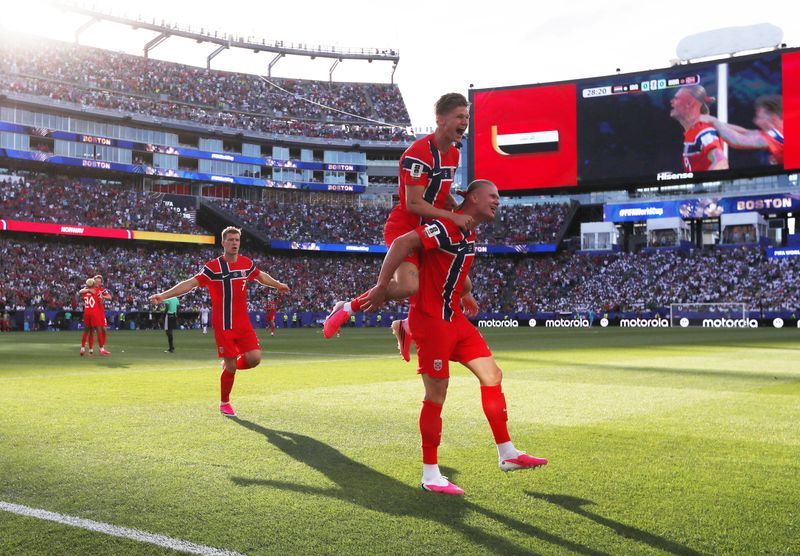
Erling Haaland announced himself on football's grandest stage with characteristic conviction, netting twice in a dominant first-half performance that propelled Norway to a commanding 4-1 victory over Iraq on Tuesday. The Manchester City striker's brace fulfilled the considerable expectations placed upon him as his nation's standard-bearer, delivering an early statement of intent in his inaugural World Cup campaign. Few observers questioned whether the prolific forward would rise to the occasion in this ultimate test of international football, and his early intervention effectively settled any doubts.
The significance of Haaland's performance extends beyond the mere scoreline. By adding World Cup goals to his already impressive résumé, the 23-year-old striker has now scored on his competitive debut across multiple elite competitions: the German Bundesliga, the English Premier League, the Champions League, and now the World Cup finals. This extraordinary consistency in major tournaments underscores his reputation as one of football's most clinical finishers, a player who performs when the stakes are highest. The demonstration of such poise and effectiveness in unfamiliar surroundings, against organised international opposition, marks him as a genuine contender for the tournament's accolades.
Norway's performance, however, masked underlying vulnerabilities that would concern manager Stale Solbakken despite the convincing margin of victory. The Norwegian side created numerous opportunities to expand their lead but squandered chances through imprecise passing and loose decision-making in the final third. The pattern of play suggested a team still finding cohesion under tournament conditions, one heavily dependent on converting opportunities when they materialised rather than controlling proceedings throughout. This reliance on individual brilliance rather than collective dominance emerged as a recurring theme during the opening period, with defensive organisation also wavering at crucial moments.
Haaland's first goal exemplified his predatory instincts, demonstrating the positioning and timing that have defined his meteoric rise through European football's elite divisions. David Moller Wolfe's measured delivery across the Iraqi penalty area found the striker unmarked, and he finished with the clinical precision expected of a world-class operator. His second strike came through a different avenue: recognising hesitation in Iraq's defensive play, Haaland pressed aggressively, forcing a panicked backpass that the goalkeeper struggled to manage. The striker's reaction to this error was instantaneous, blocking the clearance attempt and watching as the ball nestled in the net. Such opportunism distinguishes exceptional strikers from merely competent ones, and Haaland's movements throughout the first period consistently found him in advantageous positions.
The striker's unusually reserved demeanour towards media engagement contrasts sharply with his eloquence on the pitch. Within the typically open Norwegian camp environment, Haaland maintains a deliberate distance from press attention, preferring to communicate through the language of goals rather than words. This tactical reticence extends to his refusal to engage in the typical pre-match narratives that dominate tournament discourse. Yet when asked to comment following the victory, his observations carried characteristic directness. He acknowledged the relief of opening the tournament positively while expressing awareness that far greater challenges lay ahead, indicating a mentality that views initial success as merely the foundation for deeper accomplishment rather than cause for complacency.
Captain Martin Odegaard, typically the creative fulcrum through which Norway's attacking play flows, endured an uncharacteristically subdued performance in midfield. The Arsenal midfielder's limited influence on proceedings underscored how thoroughly Haaland's twin strikes had dominated the match narrative and resource allocation. When primary playmakers operate at reduced capacity, the onus falls upon opportunistic strikers to create and convert moments through individual intervention. This dynamic played directly into Haaland's strengths, allowing him to define the match through his predatory movements rather than through the construction of elaborate team attacking sequences.
Defensive lapses punctuated Norway's otherwise commanding display, most notably when Iraq pulled level through Aymen Hussein, suggesting that the Norwegian back line had not yet achieved the concentration levels required to maintain complete control. Such moments, while ultimately inconsequential given the final margin, provided Iraq with encouragement and revealed that Stale Solbakken's squad remains vulnerable to organised opposition willing to exploit transitional phases. The concession served as a useful reminder that no World Cup opponent, regardless of perceived quality differential, can be complacently dominated from start to finish.
Norway's positioning atop their group on goal difference ahead of France, who defeated Senegal 3-1 earlier on the same day, offered a striking contrast to the long period of international football wilderness the Nordic nation had endured. The previous 28 years since Norway last competed in a men's World Cup finals tournament represented an extended absence from the sport's premier competition. The return to this stage carried profound national significance, transforming Tuesday's encounter from a mere opening fixture into a symbolic restoration of Norwegian football's standing on the world stage. Such context imbued the victory with emotional resonance extending far beyond tactical or statistical analysis.
Haaland himself recognised the broader implications of Norway's successful re-entry into World Cup football. His relaxed post-match assessment acknowledged that the outcome had validated the considerable expectations and hopes invested in his generation of Norwegian players, while simultaneously emphasising the requirement for substantially improved performances in forthcoming matches. The balance between satisfaction and urgency in his comments reflected awareness that opening victory provides momentum and confidence but offers no guarantee of sustained success in a tournament format where consistency across multiple matches determines ultimate achievement. With celebrations anticipated across Norway, attention now turns toward whether the national team can build upon this encouraging foundation.