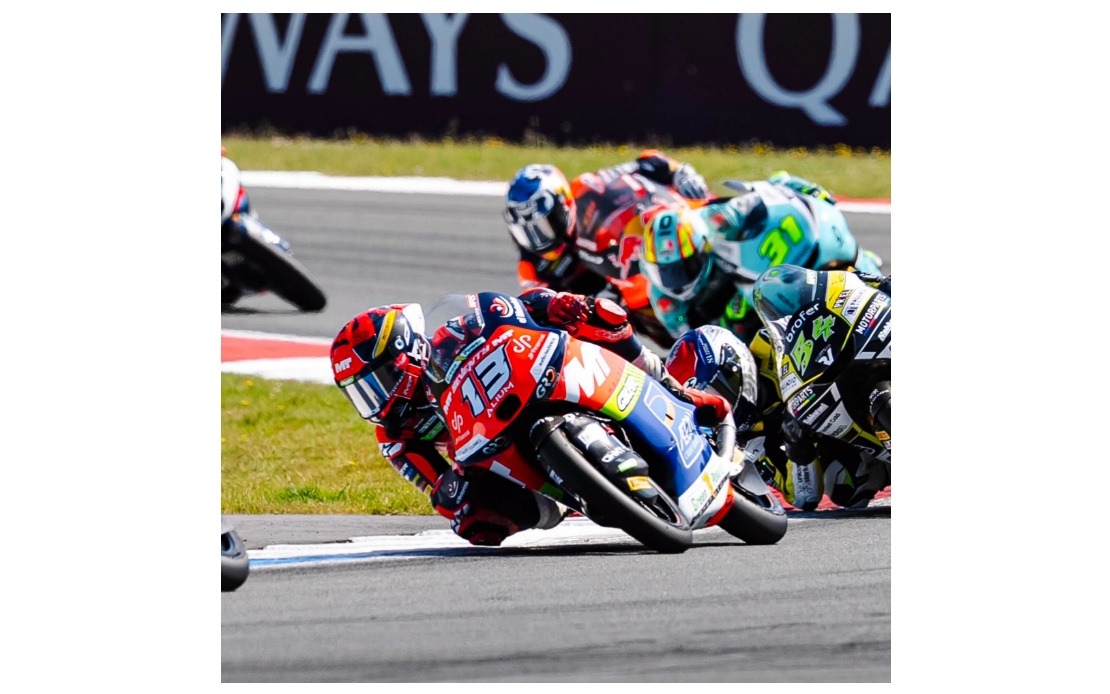
Malaysian motorcycle racing talent Muhammad Hakim Danish delivered a resilient performance at the Moto3 Dutch Grand Prix, crossing the line in seventh place at the TT Circuit Assen despite facing significant mechanical challenges throughout the race. The 18-year-old's finishing time of 33 minutes 56.275 seconds on the demanding 25-lap circuit represented a solid recovery from a challenging grid position, underlining his growing maturity in international competition. The points haul from this weekend moved him closer to the top tier of the Moto3 championship standings, reinforcing Malaysia's continued presence in this competitive junior category.
Starting from 16th on the grid, Hakim Danish demonstrated tactical awareness and racecraft that belied his relative inexperience at this level. Rather than remaining mired in the midfield, he executed a deliberate strategy to work his way forward through the field during the opening phase of the race. His ascent into the leading group occurred methodically, reflecting a disciplined approach to tire management and positioning—critical factors in Moto3 racing where fuel consumption and mechanical wear accumulate steadily throughout the full distance. The Malaysian rider's ability to identify and exploit gaps in the pack, combined with his willingness to take calculated risks in the early stages, set the foundation for what would ultimately prove a competitive afternoon.
For much of the race, Hakim Danish maintained presence in the upper echelon of competitors, remaining within striking distance of the podium places. His performance during the middle stint suggested he had adapted effectively to track conditions and had secured a good setup that allowed sustained pace. However, this promising trajectory encountered complications as the race progressed into its final stages, introducing an element of attrition that ultimately would determine the outcome. The intensity escalated considerably when a secondary group of riders closed significantly on the frontrunners, creating a congested scenario where multiple competitors vied for limited track real estate and the valuable championship points that accompany higher finishes.
The final five laps proved decisive in reshaping the result, as Hakim Danish encountered the grip limitations that had been building throughout the race. Tyre degradation—a persistent challenge in modern motorcycle racing—became pronounced as the Dunlop rubber moved beyond its optimal performance window. This deterioration in mechanical confidence forced the Malaysian rider to become increasingly defensive in his riding approach, a necessary adjustment to preserve forward momentum but one that inevitably ceded ground to fresher competitors still managing their tires more effectively. Multiple overtakes occurred in this closing sequence, puncturing what had appeared a trajectory toward a higher finishing position and ultimately settling the race outcome at seventh.
Despite not securing the stronger result that competitive display seemed to warrant, Hakim Danish expressed philosophical contentment with the championship value extracted from the afternoon. The ninth points awarded for seventh place may not match the prestige of podium finishes, but in a closely competitive field where consistency often determines season outcomes, such incremental accumulation proves essential. Over a long campaign, gathering points at races where conditions prove unfavorable or machinery operates below optimal parameters becomes the hallmark of riders who ultimately contest for championships. His measured assessment of the race—acknowledging both the challenges and his own contributions—reflected mature self-evaluation.
The Dutch Grand Prix result repositioned Hakim Danish in the championship landscape, elevating him to sixth position in the Moto3 standings with an accumulated total of 82 points. This ranking places him within reasonable striking distance of the frontrunners, though substantial gaps remain to be closed before championship contention becomes a realistic proposition. The numerical position masks the competitive reality that Moto3 remains extraordinarily tight, with multiple riders separated by modest point margins capable of being overturned through a single strong performance or a single poor outing. Hakim Danish's trajectory thus far in the season indicates genuine potential to accumulate further points and potentially edge higher still as the calendar progresses.
For Malaysian motorsport followers accustomed to celebrating the achievements of their representatives competing at international level, Hakim Danish's campaign demonstrates the depth of talent emerging from the domestic pipeline. His progression through junior categories has followed a methodical path, with each season introducing increasingly difficult competitors and more demanding technical challenges. The Dutch Grand Prix appearance exemplified both his growing adaptability to variable conditions and his capacity to extract competitive performances even when circumstance proves unfavorable. Such performances accumulate over time, building both championship points and the institutional confidence that allows ambitious career planning.
The TT Circuit Assen itself carries historical significance in motorcycle racing, the venue's challenging layout and reputation for technical difficulty serving as a proper test of rider skill and machine setup. That Hakim Danish managed to extract a competitive result from this particular circuit, despite starting from a disadvantaged grid position and struggling with tyre conditions, speaks to his continuing development as a complete competitor. Future circuits on the Moto3 calendar may suit his machinery and riding style more favorably, creating opportunities for breakthrough performances that could substantially alter championship mathematics. The potential clearly exists; translating that potential into consistent podium finishes and victories remains the ongoing task confronting the Malaysian prospect.

