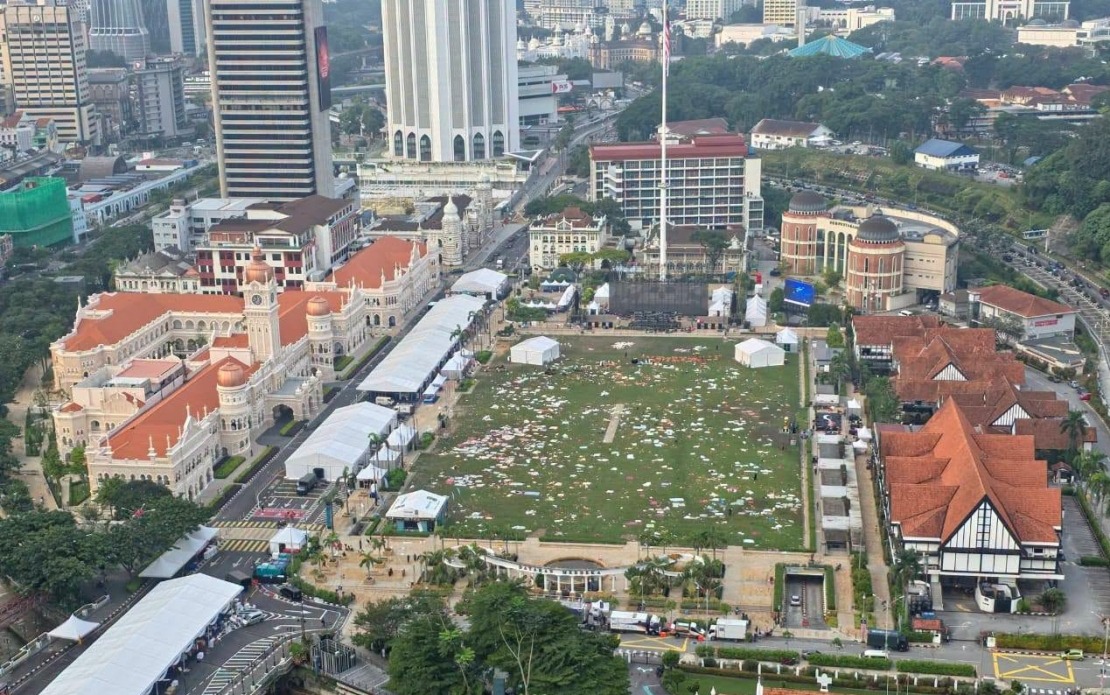
Federal Territories Minister Hannah Yeoh has publicly acknowledged the dedication of Kuala Lumpur City Hall (DBKL) workers who worked extensively to restore Dataran Merdeka following the public screening of the 2026 FIFA World Cup final, during which the historic venue became significantly littered. In commending their efforts, Yeoh simultaneously delivered a broader message to Malaysian citizens about the fundamental importance of personal accountability in maintaining public spaces.
Despite recognizing DBKL's fulfillment of its institutional obligations, Yeoh emphasized that the responsibility for maintaining cleanliness extends beyond municipal workers into the hands of every individual who uses these spaces. She articulated a distinction between receiving public services—a right earned through taxation—and expecting those same services to compensate for citizens' lack of personal discipline. This framing positions proper waste disposal not as an inconvenience but as a baseline expectation of citizenship that requires minimal effort yet yields maximum collective benefit.
The incident at Dataran Merdeka serves as a microcosm of broader urban management challenges facing Malaysia's capital city. Public screening events, while fostering community engagement and national pride during international sporting occasions, simultaneously test the city's infrastructure and social contract. When large gatherings result in significant littering, the burden falls disproportionately on a relatively small municipal workforce tasked with maintaining the aesthetic and functional standards of the nation's most symbolically significant public venue. This dynamic illustrates why individual behavioral change proves essential to scaling sustainable urban management.
Yeoh's invocation of Dataran Merdeka's historical significance carries particular weight in the Malaysian context. The site represents far more than a modern event venue; it embodies the nation's journey toward independence and serves as a physical manifestation of shared national identity. By framing cleanliness as a preservation imperative tied to national dignity rather than mere aesthetic preference, Yeoh attempts to reframe waste disposal through an emotional and patriotic lens that might resonate more powerfully than purely functional arguments.
The minister's commentary directly reflects Prime Minister Datuk Seri Anwar Ibrahim's philosophical emphasis on measuring national progress through cultural and behavioral indicators rather than infrastructure development alone. This approach acknowledges that a modern, developed nation cannot be defined solely by its buildings, roads, and facilities. Instead, genuine progress requires a populace that demonstrates respect for shared assets and understands that civic virtues—including personal responsibility for public cleanliness—remain non-negotiable foundations of social cohesion.
The Malaysia MADANI framework, which Yeoh referenced, represents an aspirational governance philosophy emphasizing shared prosperity, wellness, and dignity. Interpreted through this lens, the cleanliness of public spaces becomes emblematic of broader values: whether citizens view public spaces as communal assets deserving protection or as arenas where individual convenience supersedes collective well-being. This framing positions everyday behavioral choices within a larger national development narrative, elevating seemingly mundane decisions about bin usage into acts of nation-building.
Yeoh's Facebook statement, while acknowledging DBKL's competence and commitment, subtly addresses a potential complacency wherein citizens might assume that paying taxes automatically absolves them of personal responsibility. This nuance proves important in the Malaysian context, where municipal services sometimes struggle with both resource constraints and behavioral challenges. By praising workers while simultaneously critiquing public behavior, Yeoh avoids demonizing municipal staff while holding citizens accountable for their choices.
The minister's comparison of public spaces to shared homes resonates with communitarian values embedded in Malaysian society. The metaphor suggests that Kuala Lumpur—and by extension, Malaysia—functions as a collective household where each person bears responsibility for maintaining cleanliness and dignity. This domestic framing may prove more effective than abstract appeals to civic duty, as it connects public space management to family values and household responsibilities that most Malaysians internalize from childhood.
From a practical governance perspective, Yeoh's emphasis on citizen responsibility addresses a recurrent challenge in Southeast Asian cities where rapid urbanization and large public gatherings sometimes strain municipal infrastructure. Rather than simply increasing DBKL's budget or staffing, addressing behavioral patterns through ministerial messaging attempts to shift social norms regarding personal accountability. Success in this domain ultimately depends on whether such appeals translate into sustained behavioral change or remain ephemeral expressions of exhortation soon forgotten once media attention moves elsewhere.
The incident and subsequent ministerial response also carry implications for future major public events scheduled in Kuala Lumpur. Organizers may feel compelled to implement stronger waste management protocols, including pre-event public education campaigns, on-site bin placement optimization, and perhaps even post-event cleanup incentive schemes. How DBKL and other authorities balance accommodating large public gatherings with managing their environmental footprint will shape the feasibility of hosting similar events in years to come.
Yeoh's intervention exemplifies how individual ministerial voices can contribute to broader conversations about societal values and shared expectations. By connecting a specific cleanup incident to larger national development aspirations, she frames civic behavior not as a minor inconvenience but as integral to Malaysia's trajectory. Whether Malaysians internalize and act upon this message remains an open question, but the attempt to elevate public consciousness around shared responsibility reflects a governance approach that recognizes limits to what government alone can achieve.

