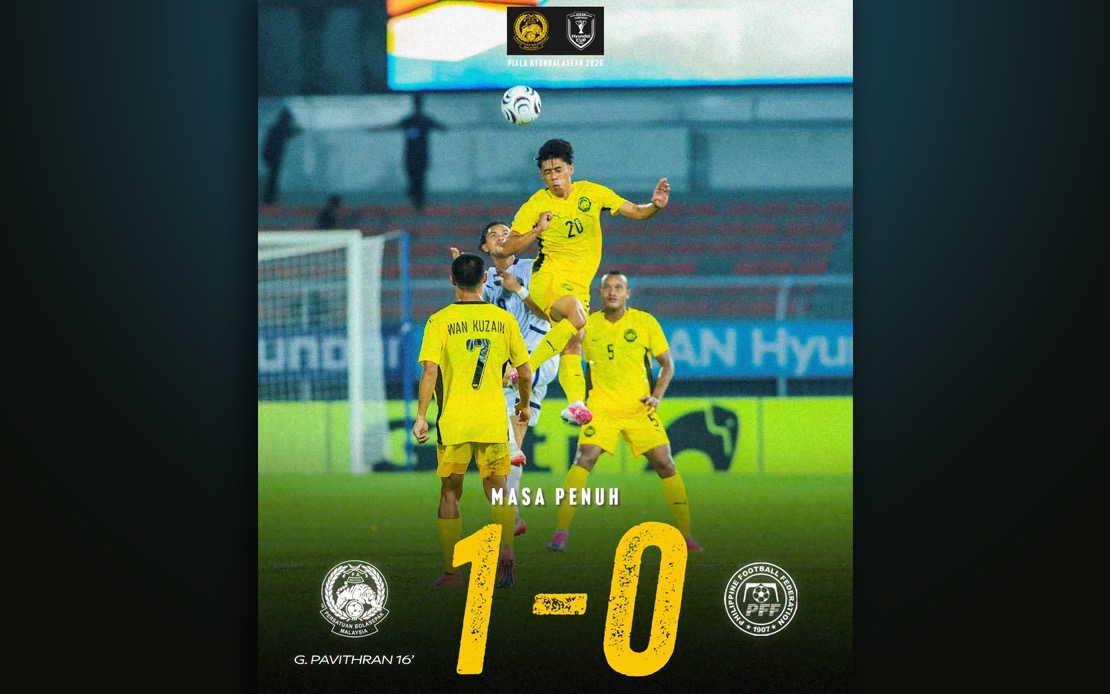
Malaysia's national football team has secured a place in the semi-finals of the 2026 ASEAN Cup following a commanding 1-0 home victory over the Philippines at the Kuala Lumpur Football Stadium in Cheras on August 8. The win, achieved under the stewardship of interim head coach Tan Cheng Hoe, propelled the Harimau Malaya to second place in Group B with nine accumulated points, setting up a highly anticipated clash against defending champions Vietnam in the knockout stage.
The match witnessed an electric atmosphere at the 18,000-capacity venue, where a sea of black and yellow-clad supporters created an intimidating environment for the visiting Philippine side. This home advantage proved decisive as Malaysia's players capitalised on the energy of the crowd to dictate proceedings throughout the encounter. The early breakthrough came in the 16th minute when midfielder Wan Kuzain Wan Ahmad Kamal delivered a pinpoint cross into the Philippines penalty area, allowing striker G. Pavithran to rise unmarked and plant a firm header past the goalkeeper.
Following the opening goal, Malaysia maintained possession and territorial dominance while the Philippines struggled to fashion meaningful attacking opportunities in the opening period. Coach Carles Cuadrat's side attempted to surge forward in search of an equaliser before half-time but lacked the precision and coordination required to pierce Malaysia's defensive shape. The resilience displayed by the Malaysian defence, anchored by captain Paulo Josue, prevented any serious scares during a tense opening 45 minutes.
The second half saw the Philippines emerge with greater attacking intent and intent to find parity. However, despite their increased pressure and willingness to take risks in the attacking third, they repeatedly encountered a well-drilled Malaysian back line that stood firm against sustained waves of attack. The Philippines' inability to convert their possession into clear-cut chances ultimately proved their undoing, as Malaysia's defensive discipline frustrated their attempts to restore balance to the contest.
An opportunity to extend Malaysia's lead materialised in the 85th minute when Pavithran found himself in a scoring position following a low cross from a teammate near the penalty spot. However, Philippines defender Jaime Rosquillo managed to intervene decisively, denying what could have been a match-sealing second goal. Despite this missed chance to add gloss to the scoreline, Malaysia's solitary goal proved sufficient to secure a valuable three points.
Malaysia's progression comes within the broader context of a competitive Group B that also featured Thailand, who topped the standings with 12 points following their 2-0 dismantling of Myanmar in a parallel fixture on the same evening. The War Elephants' superior goal difference and points total sees them advance as group winners, with Malaysia trailing by three points but comfortably securing the secondary qualification spot ahead of rivals. Thailand's dominance in the group has established them as formidable opponents in the tournament's latter stages.
The semi-final draw has positioned Malaysia for a stern examination against Vietnam, the holders of the ASEAN Cup trophy and conquerors of Group A. This matchup carries significant historical weight, given Vietnam's recent pedigree in regional competitions and the prestige associated with defending champions. The two-legged tie, scheduled for August 16 and August 19, will determine which team progresses to the final and harbours realistic ambitions of claiming regional supremacy.
For Malaysian football and its passionate fan base, this advancement represents a positive development after periods of inconsistency in recent campaigns. The performance against the Philippines, while not flamboyant, demonstrated the tactical discipline and defensive solidity that Tan Cheng Hoe has endeavoured to instil within the squad. The interim coach's tenure may yet extend beyond these tournament fixtures should results continue to trend positively, providing continuity in the national team's development.
The upcoming semi-final engagement against Vietnam will prove a rigorous test of Malaysia's credentials and appetite for competing at the highest level of regional football. Vietnam's experience, technical quality, and tournament pedigree represent a qualitative step up from the opposition faced thus far. Nevertheless, the confidence derived from home victory and the backing of a mobilised Malaysian football public could prove catalytic in mounting a credible challenge.

