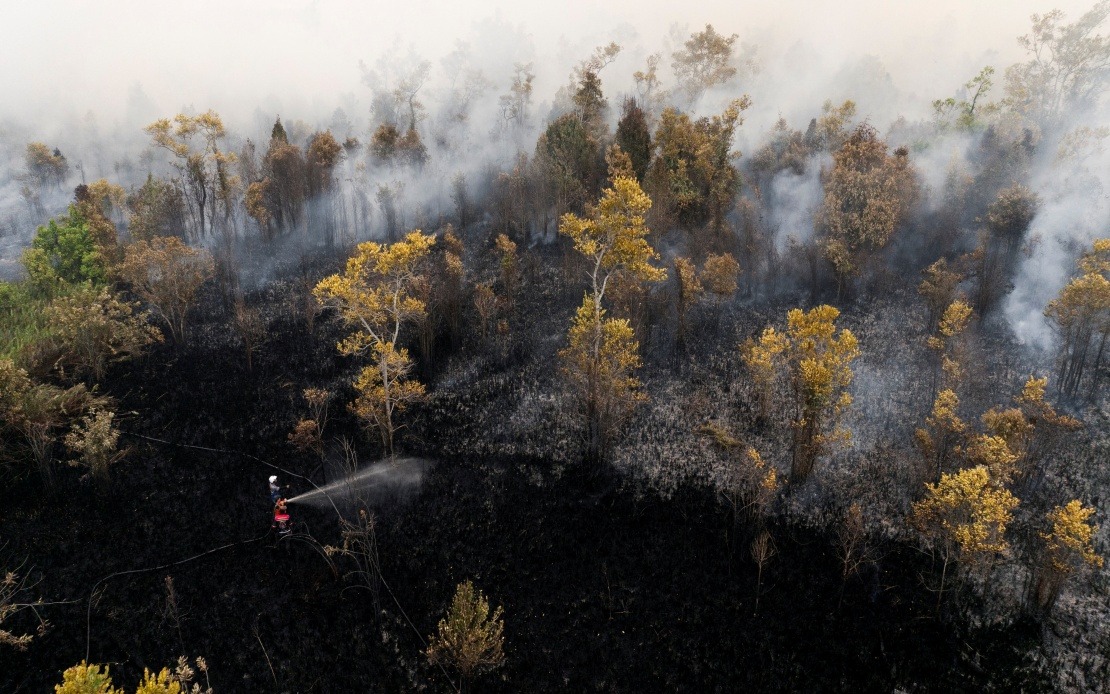
Singkawang Airport in Indonesia's West Kalimantan province suspended all domestic flight operations on Saturday as smoke from widespread forest and land fires across Kalimantan rendered visibility dangerously low. The airport announced the decision through its official Instagram account, citing flight safety as the primary reason for the cancellation and directing passengers to contact their airlines for rebooking options. Singkawang, situated approximately 145 kilometres north of Pontianak, the provincial capital, serves as a critical transportation hub for the western section of Indonesian Borneo and the surrounding industrial and agricultural regions.
The aviation cancellations underscore the escalating severity of Indonesia's fire season in Kalimantan, an issue that directly affects regional connectivity and has become an increasingly familiar crisis in Southeast Asia. Indonesia's Transport Ministry confirmed on Friday that it was actively tracking smoke dispersion patterns from the burning zones and assessing their cascading effects on multiple airports across the island. Director-General of Civil Aviation Lukman F. Laisa emphasised that visibility thresholds form the foundation of aviation safety standards, explaining that flight operations face mandatory adjustments—whether through delays, diversions, or complete cancellations—whenever atmospheric conditions deteriorate below minimum operational requirements.
The ministry's commitment to maintaining safety protocols reflects international aviation standards that prioritise passenger protection over schedule adherence. When haze reduces visibility to dangerous levels, pilots cannot safely navigate approach and landing procedures, and air traffic controllers lose adequate sight lines for ground coordination. This creates genuine operational hazards rather than mere inconveniences, justifying the Singkawang suspension despite the economic costs to airlines, airports, and affected travellers. For Malaysia and other neighbouring nations, these disruptions serve as reminders of the transnational nature of environmental crises in Southeast Asia, as smoke and air pollution regularly cross borders and impact regional connectivity.
Satellite monitoring systems operated by NASA's Terra and Aqua satellites painted a concerning picture of the fire situation across Kalimantan as of Friday evening. The Transport Ministry reported detecting 56 high-confidence hotspots in Central Kalimantan, 51 in West Kalimantan, and 19 in South Kalimantan at 9:30 pm local time. These satellite detections indicate active burning zones with sufficient thermal signatures to be registered as confirmed fire locations, suggesting that the situation extends beyond isolated incidents and represents a systematic fire outbreak affecting multiple provinces simultaneously. The Meteorology, Climatology and Geophysics Agency (BMKG) corroborated these findings, documenting that substantial portions of West and Central Kalimantan were experiencing very unhealthy air quality—a classification indicating hazardous conditions for public health and visibility.
Indonesian authorities have mobilised comprehensive firefighting responses to combat the blazes, deploying both ground-based and aerial operations including water-bombing sorties from helicopters and fixed-wing aircraft. These interventions demand considerable financial resources and operational coordination across multiple agencies, yet success remains heavily dependent on weather patterns. The government has also prepared weather modification operations—cloud-seeding programmes designed to induce precipitation over fire zones—though these can only be deployed when atmospheric conditions provide suitable cloud formations to work with, limiting their immediate effectiveness during crucial periods of rapid fire spread.
Beyond immediate firefighting efforts, the Indonesian police system is pursuing accountability through criminal investigations targeting those responsible for initiating fires. Central Kalimantan police chief Inspector-General Iwan Kurniawan announced that approximately 12 suspects had been identified and named in forest and land fire cases as of mid-August, with investigations continuing across the province to establish causation and apprehend additional perpetrators. These law enforcement actions reflect official recognition that many fires result from deliberate actions by land developers, plantation operators, or others seeking rapid land clearance, rather than purely natural causes. The investigation outcomes may eventually reveal whether negligence, economic desperation, or intentional arson drove specific incidents.
For Malaysian observers and policymakers, the Singkawang airport closure carries particular significance given Malaysia's historical experience with transboundary haze from Indonesian fires. The 2015 haze crisis created unprecedented air pollution levels across Malaysia and Singapore, disrupting transportation, commerce, and public health across the region for weeks. Events like the Singkawang closure demonstrate how environmental disasters in Kalimantan possess immediate economic consequences within Indonesia while simultaneously threatening broader regional stability. Airlines operating routes connecting Malaysia to Indonesian destinations must maintain contingency planning for frequent disruptions, and businesses relying on time-sensitive shipments through Kalimantan transit hubs face recurring supply chain vulnerabilities.
The seasonal pattern of these fires reflects deeper structural challenges within Indonesia's land management system, where competing pressures from agricultural expansion, timber harvesting, and conservation clash in an environment prone to severe dry seasons. Kalimantan's peatlands present particular fire risks because subsurface organic matter, when drained for development, burns with extreme intensity and produces voluminous smoke. Regional cooperation mechanisms, including the ASEAN Transboundary Haze Pollution Agreement framework, exist but critics argue they lack sufficient enforcement mechanisms and financial resources to address underlying causes of recurrent fire crises.
The implications of the Singkawang closure extend beyond immediate passenger inconveniences. Reduced air connectivity constrains business movement, separates families, and limits access to medical services for residents of remote areas dependent on aviation transport. For the broader Southeast Asian aviation network, each major airport closure creates ripple effects through diverted traffic, cancellations on connecting routes, and increased operational stress on alternative airports already operating near capacity. The sustainability of regional connectivity depends not only on aircraft availability but equally on environmental conditions that permit safe operations.
As fires continue burning across Kalimantan and smoke plumes persist in affecting multiple provinces, the challenge for Indonesian authorities involves balancing immediate crisis response with fundamental prevention. Addressing underlying vulnerabilities requires integrating better land-use planning, strengthening regulations against deliberate fire-setting, restoring protective peatland hydrology, and ensuring enforcement across remote provincial areas where monitoring capacity remains limited. Until these systemic issues receive sustained attention and resources, Southeast Asia should anticipate recurring episodes of aviation disruption, transboundary haze, and environmental stress arising from Kalimantan's seasonal fire cycles.

