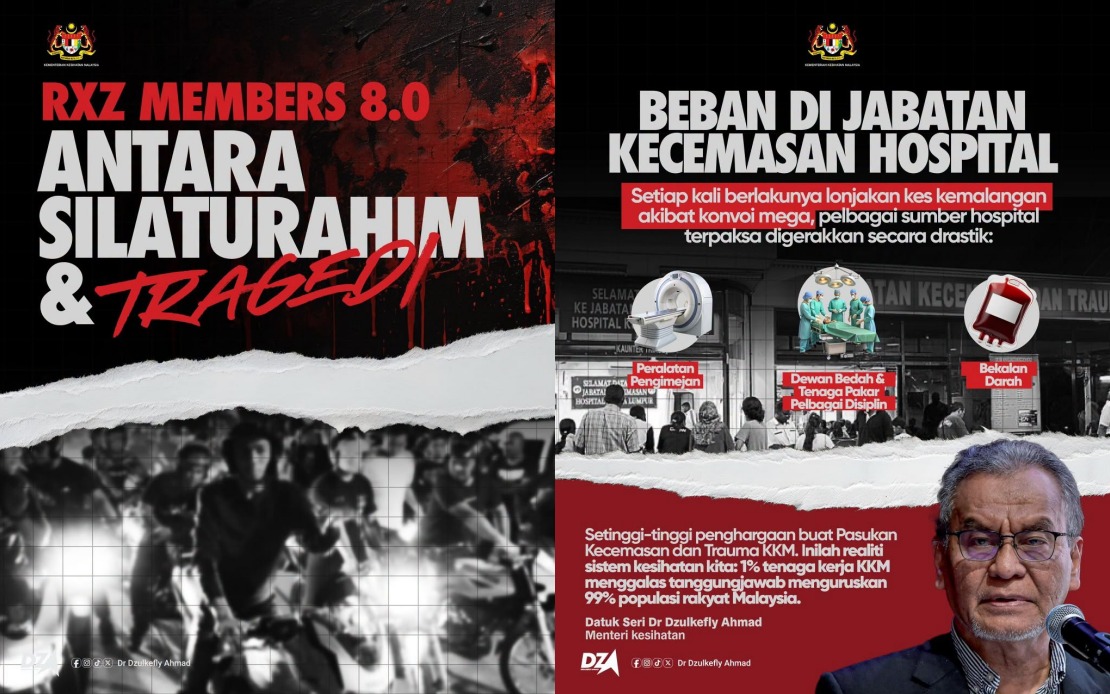
Health Minister Datuk Seri Dr Dzulkefly Ahmad has expressed deep concern over a spate of road accidents connected to the RXZ Members 8.0 motorcycle gathering held at the Gong Badak Motor Racing Circuit in Kuala Nerus, Terengganu. In a statement released from Putrajaya, he extended condolences to the families of those who lost their lives in the incidents and called for a fundamental shift in riding culture across the country. The tragic events have reignited the debate over the safety of large-scale motorcycle convoys, which have become increasingly popular among enthusiast communities across Malaysia.
The scale of Malaysia's road fatality crisis cannot be overstated. According to data cited by the minister from the Malaysia Road Fatalities Index maintained by the Ministry of Transport, approximately 18 Malaysians die in road accidents daily, with the problem showing no signs of abating. What makes this statistic particularly alarming for health authorities is that nearly six in ten of these deaths involve motorcycle riders, a demographic that faces disproportionate vulnerability on the nation's roads. This concentration of fatalities among motorcyclists reflects broader challenges in how two-wheeled transport is regulated and how riders are educated about risk mitigation.
The specific incidents arising from the RXZ gathering demonstrated the cascading consequences of road accidents beyond the immediate tragedy. In Pahang, three motorcyclists were killed and two others sustained injuries across four separate collisions as participants travelled towards and from the event. In Kuala Nerus itself, a 13-year-old boy suffered severe burn injuries amounting to 60 per cent of his body surface area and remains in an induced coma, a grim reminder that road accidents extend their destructive reach to innocent bystanders caught in the chaos. These incidents are not isolated tragedies but represent a systemic failure in how large gatherings of motorcycle enthusiasts are managed and policed.
Dzulkefly highlighted the acute strain that such accident surges place on the nation's already stretched healthcare infrastructure. When weekend motorcycle events occur, emergency departments across the country experience sudden spikes in patient admissions, forcing hospitals to mobilise blood banks, imaging services, operating theatres, and specialists from multiple disciplines simultaneously. This emergency reallocation of resources occurs within a healthcare system where a mere one per cent of the Ministry of Health workforce is tasked with delivering care to 99 per cent of Malaysia's population. The compounding effect of preventable accidents therefore represents not just a loss of life but a drain on finite medical resources that could otherwise serve the general population.
Beyond the human cost, the economic ramifications of road fatalities are substantial. The ministry utilises the Value of Statistical Life metric to quantify these losses, calculating that the government absorbs at least RM3.12 million in economic value for every person killed on the roads. These figures are not abstract statistics but translate into the loss of household breadwinners, young people with potential careers ahead, and productive members of society whose contribution to the economy is irrevocably cut short. When multiplied across the approximately 6,570 annual road deaths in Malaysia, the aggregate economic impact becomes staggering.
The minister acknowledged the legitimate appeal of motorcycle gatherings, recognising the spirit of camaraderie and shared passion that drives participation in large-scale convoys. However, he drew a critical distinction between celebrating motorcycle culture and tolerating the dangerous practices that have become associated with these events. He pointed to a troubling pattern whereby successive editions of the RXZ gathering have been marred by fatal accidents, suggesting that the problem is not incidental but structural. This pattern indicates that without substantial intervention, similar tragedies will likely recur at future events unless fundamental changes are implemented.
Dzulkefly placed significant responsibility on event organisers to embed safety advocacy into the very fabric of their gatherings. He argued that organisers bear a duty of care extending beyond logistical coordination to encompass active promotion of responsible riding behaviours. This includes establishing and enforcing speed limits within convoys, providing safety briefings before events commence, and making clear the consequences of reckless behaviour. The minister suggested that safety should not be an afterthought or secondary consideration but rather the central theme around which all event planning revolves. Without this reorientation of priorities, organisers risk enabling the very incidents they claim to mourn.
Central to the minister's advocacy is a call for a cultural shift away from what he characterised as extreme mindsets on the road towards an embrace of moderation and safety. He articulated a vision of a new slogan centred on responsible riding, strict adherence to speed limits, and the ultimate goal of zero road accidents. This cultural reorientation would require buy-in from motorcycle enthusiasts themselves, who must internalise the message that survival and safety are more valuable than the momentary thrill of high-speed riding. For this message to resonate, it must come not only from government officials but from respected figures within the motorcycle community who can model and advocate for safer practices.
The distinction between replaceable and irreplaceable resources provides the philosophical underpinning to Dzulkefly's appeal. Medical facilities, equipment, and even trained personnel can be replenished and renewed through investment and time. Human lives, by contrast, cannot be restored once lost. This asymmetry should inform how society approaches road safety and how enthusiast communities police themselves. The minister's insistence that lives take precedence over the preservation of event traditions or the pursuit of speed represents an implicit challenge to riders to reassess their priorities and the values their community promotes.
For Malaysia and the broader Southeast Asian region, road safety remains a persistent public health emergency that demands coordinated action across government, civil society, and community organisations. The incidents surrounding the RXZ gathering provide an opportunity for policymakers to strengthen regulations around large motorcycle events, for event organisers to commit to safety-first protocols, and for riders themselves to embrace a culture that prizes self-preservation over performance. Unless this convergence of action occurs, Malaysia will likely continue to see preventable tragedies that claim lives and drain resources from a healthcare system already operating at capacity. The minister's message serves as both a wake-up call and an invitation for the motorcycle community to become part of the solution rather than perpetuating a cycle of loss and grief.
The path forward requires sustained commitment from all stakeholders. Organisers must implement enforceable safety protocols, law enforcement must ensure these protocols are observed, and most importantly, individual riders must internalise the message that no gathering, no matter how significant, is worth the cost of lives. This represents not a rejection of motorcycle culture but rather a maturation of that culture towards responsible stewardship. Until this transformation occurs, Malaysia's roads will continue to exact a terrible price from those who fail to heed the warning that safety must always remain paramount.

