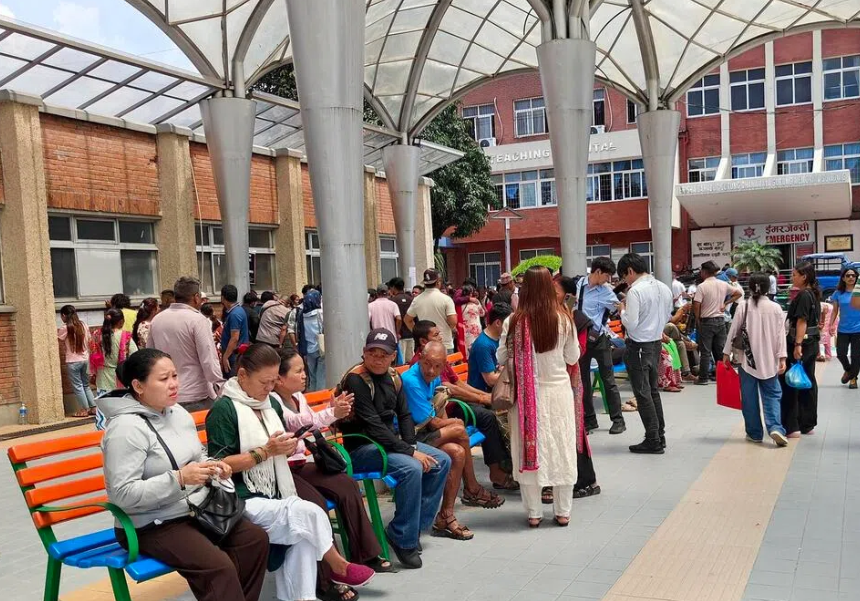
The gates of Tribhuvan University Teaching Hospital in Kathmandu have become an unwilling memorial to Nepal's worst natural disaster in recent years. Over two days, the hospital's entrance transformed into a grim identification centre where photographs of flood victims line the walls—a haunting tableau that encapsulates the human cost of the devastating flash flood that swept through the country's border region on August 26. The disaster has already claimed more than 500 lives in northern Nepal, with hundreds still unaccounted for as search teams navigate the treacherous Bhotekoshi river system and its aftermath.
The catastrophe unfolded with terrifying speed in Rasuwa district, a critical transit corridor linking Nepal to the Chinese border where trucks ferry goods constantly. Among those caught in the deluge was Dolma Tamang's sister and brother-in-law, who were transporting merchandise when their phones went dead on the morning of August 26. For three days, Tamang shuttled between Kathmandu's hospitals with nothing but hope and desperation, scanning rows of photographs for any sign of the couple. "It has been very difficult; my tears have run dry," she told The Straits Times, her words capturing the emotional toll on thousands of families now living in uncertainty. The hospital's walls have become plastered with missing person posters as distraught relatives print photographs of their loved ones on paper, clutching them as they move from ward to ward.
The scale of the missing persons crisis has grown exponentially in just seventy-two hours. By the afternoon of August 28, the list of those unaccounted for at TUTH alone exceeded 1,500 individuals. Among the international missing are nine Singaporeans whose status remains unknown, alongside approximately 288 Indian nationals and several British citizens. The Nepal Tourism Board reported that while 121 foreign tourists had been rescued by August 28—including 85 Indians and 16 Chinese nationals—the rescue operation revealed just how many more remain trapped or lost. Many of these missing foreigners were engaged in religious pilgrimage along the Kailash-Mansarovar route, a sacred journey that traditionally passes through the very districts most devastated by the flood. The Gyirong border crossing between Nepal and Tibet, filmed being engulfed by mudslides and torrents of water, has become a symbol of the disaster's devastating power.
The emotional weight of the search is visible in every face outside the hospital gates. Bikesh Shrestha, searching for his cousin Rakesh, found himself unable to look at the photographs of the deceased displayed for identification. "I had to turn my eyes away," he said, his voice breaking as he fought to maintain composure. Inside the hospital, twenty-three-year-old Sushila Shrestha clung to fragile hope while searching for her twenty-one-year-old brother Bir Bahadur, a truck driver heading to China when the flood struck. The absence of any news, paradoxically, became a source of optimism for her. "I am convinced he will return; he has to return," she insisted, embodying the desperate hope that grips families across the capital.
The logistical challenge of managing the disaster has strained Nepal's infrastructure to its breaking point. Over 4,400 police personnel have been deployed across search and rescue zones, supplemented by the Nepali Army and Armed Police Force. However, the operation faced an unexpected pause on the morning of August 28 when fears of a barrier lake breach threatened to unleash another catastrophic flood. By evening, rescues resumed after officials determined there was no immediate threat, though uncertainty continued to cloud the rescue effort. The sheer scale of the operation has revealed cracks in Nepal's capacity to respond to such crises. Hospitals in downstream districts like Chitwan—renowned for its national parks and elephant sanctuaries—are facing critical shortages of morgue space. By August 28, Chitwan had recovered 186 bodies but possessed collective mortuary capacity for only thirty to fifty cadavers across all its facilities. The Kathmandu Post reported that several district hospitals have begun running out of space entirely.
International assistance has begun flowing into Nepal, though the government has carefully calibrated its approach based on lessons learned from the 2015 earthquake. Prime Minister Balen Shah declined offers from China, India, and other nations to deploy their own search and rescue teams, recognising that the influx of international rescue operations after the 2015 quake created coordination nightmares that ultimately hampered rather than helped recovery efforts. Instead, Nepal has requested financial assistance channeled through a single coordinated mechanism that the government plans to announce shortly. India has provided immediate humanitarian support, dispatching forty-seven tonnes of assistance including temporary shelters, blankets, hygiene kits, solar lamps, medicines, and food packets via military aircraft. New Delhi has additionally offered prefabricated truss bridges to help rebuild critical infrastructure, with dozens of bridges large and small destroyed in the flood.
The tragedy has drawn international families to Kathmandu in search of their missing relatives. Early on August 28, a group of men from Tamil Nadu arrived on a morning flight from New Delhi, representing a travel party that had been returning from Mount Kailash pilgrimage when the flood struck. Among them was a man from Coimbatore who came to support his friend in locating his wife and son caught in the disaster. "Whatever it is, we will face it together; you have to be strong," he told his friend upon arrival, words that reflected the collective resolve of hundreds of families now converging on the capital. The concentration of missing pilgrims at the Gyirong border crossing—devastated by mudslides and torrential waters—suggests that many may never be found, swept into the river system or buried under debris across multiple districts.
The human and infrastructural toll extends far beyond the immediate death count. Chitwan district, lying downstream and adjoining the Indian border, has been particularly ravaged, with roads transformed into channels of debris and silt. The district's famous national park infrastructure has been severely compromised, and basic connectivity remains disrupted. The disaster has highlighted Nepal's vulnerability to climate-driven natural hazards, particularly in border regions where commercial traffic and pilgrimage routes concentrate populations in narrow corridors with limited escape routes. The flash flood, moving with extraordinary violence through Rasuwa and into downstream areas, created a bottleneck scenario where thousands found themselves trapped with nowhere to go.
For Malaysian readers, the Nepal disaster carries particular resonance given the region's shared vulnerability to monsoon-driven floods and mountain hazards. The tragedy underscores the importance of cross-border emergency coordination, improved early warning systems, and international preparedness protocols. Nepal's decision to manage the crisis domestically rather than accept competing international rescue operations reflects a critical lesson: during catastrophic events, coordination efficiency often matters more than raw resource deployment. As Nepal grapples with the immediate aftermath and begins planning reconstruction, the stories of families searching hospital gates in Kathmandu serve as a stark reminder of how quickly natural forces can overwhelm even well-intentioned modern infrastructure and humanitarian response systems.

