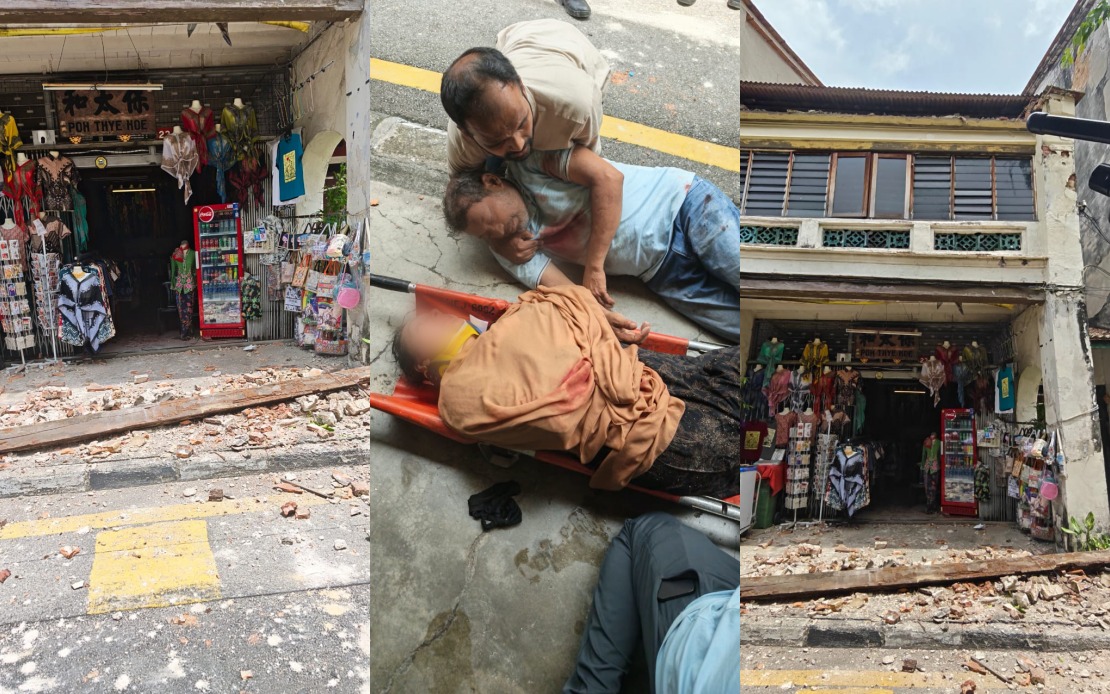
A structural failure at a heritage building in George Town's Armenian Street left two visiting tourists injured on Monday afternoon, raising fresh concerns about the safety standards of Penang's older buildings and their capacity to protect the thousands of visitors who navigate the UNESCO World Heritage Site each year. The incident occurred when materials from an upper storey gave way, with witnesses reporting that stones and wooden beam fragments cascaded onto Mohamad Ammtar, 66, and Fatimah, 55, both from Sri Lanka. Emergency responders arrived at the scene within minutes of receiving the alert at 1.11 pm, according to the Penang Fire and Rescue Department's assistant director of operations John Sagun Francis.
The affected structure, located along one of George Town's most frequented pedestrian corridors, housed a ground-floor grocery operation with apparently unoccupied upper levels. The couple had been exploring the historic district as part of their Malaysian visit and were scheduled to depart for Sri Lanka the following day. Initial medical treatment was administered by Health Ministry personnel at the scene, with both victims subsequently transferred to Penang Hospital for comprehensive assessment and care. While their injuries were not initially described as life-threatening, the incident highlighted how quickly disaster can strike in crowded heritage precincts where structural integrity may have deteriorated over decades.
The collapse has prompted an immediate policy response from Penang's tourism and heritage administration. Wong Hon Wai, chairman of the State Tourism and Creative Economy Committee, visited the affected site and subsequently announced that both George Town World Heritage Incorporated and the Penang Municipal Council would be tasked with distributing safety advisories to all registered heritage property owners across the state. The directive represents an acknowledgment that individual inspections conducted in response to specific incidents are insufficient to guarantee public safety across an entire heritage district containing hundreds of structures dating back centuries.
Wong's statement underscored a critical distinction in how authorities now view heritage preservation: as an obligation extending beyond architectural conservation to encompass visitor safety and pedestrian protection. He emphasised that the scope of concern must encompass not merely the damaged building but the entire inventory of heritage and older structures throughout Penang, many of which may exhibit similar signs of structural weakness, material degradation, or maintenance deferral. The chairman indicated that such inspections should be treated as urgent rather than routine, given the volume of foot traffic these buildings accommodate and the potential consequences of further collapses.
The incident carries particular significance for Penang's tourism economy, which relies heavily on the distinctive character and perceived safety of the World Heritage zone. International and regional visitors, including substantial numbers from South Asia, are drawn to George Town specifically for its well-preserved colonial architecture and cultural atmosphere. An accident involving visiting tourists, even one causing non-fatal injuries, risks damaging the destination's reputation for safe, accessible heritage tourism at a moment when regional travel patterns are normalising following pandemic disruptions. The state government's swift outreach to the Sri Lankan High Commission in Kuala Lumpur signals awareness of the diplomatic and commercial dimensions of the incident.
Penang's heritage building stock presents a complex management challenge inherent to Southeast Asian cities attempting to balance preservation with modernisation. Many structures predate contemporary building codes and safety standards; some occupy commercial ground floors with residential or industrial uses above, complicating ownership responsibilities and maintenance accountability. The grocery shop operator may hold no authority over upper-storey conditions, while the building owner may lack resources for comprehensive remediation. This fragmented responsibility structure has historically enabled maintenance backlogs to accumulate until catastrophic failures force intervention.
The immediate focus on structural inspections reflects a reactive rather than proactive governance approach, yet it represents a necessary starting point. George Town World Heritage Incorporated and municipal authorities will need to establish clear protocols for assessing structural integrity, identifying buildings requiring urgent intervention, and coordinating repairs or restrictions on public access. Given Penang's limited municipal budgets and the often-contentious relationship between heritage preservation advocates and cost-conscious property owners, implementation will likely face obstacles regarding funding allocation and enforcement mechanisms.
For Malaysian tourism stakeholders more broadly, the George Town incident serves as a cautionary narrative about infrastructure maintenance in heritage destinations. Langkawi, Malacca, and other heritage tourism zones in Malaysia host comparable building stock. The incident suggests that national tourism authorities should consider establishing minimum structural safety standards for heritage precincts, potentially including mandatory insurance requirements and staged compliance timelines that incentivise rather than penalise conservation property owners.
The state government has indicated that a comprehensive investigation into the collapse's underlying causes remains pending. Determining whether the failure resulted from material fatigue, inadequate maintenance, structural design flaws, or external environmental factors will inform both immediate remedial actions and longer-term policy development. Wong stated that conclusions drawn from this investigation should extend into broader heritage management frameworks rather than remaining confined to the individual property.
The experience of the two injured tourists underscores how heritage tourism, while economically valuable, carries inherent risks when visitor flows intersect with aging infrastructure. Penang's response now focuses on minimising such risks through systematic inspection and safety assurance, a process that will require sustained commitment and adequate resource allocation over coming months. The incident has converted a single accident into a catalyst for examining systemic vulnerabilities across the entire heritage district.

