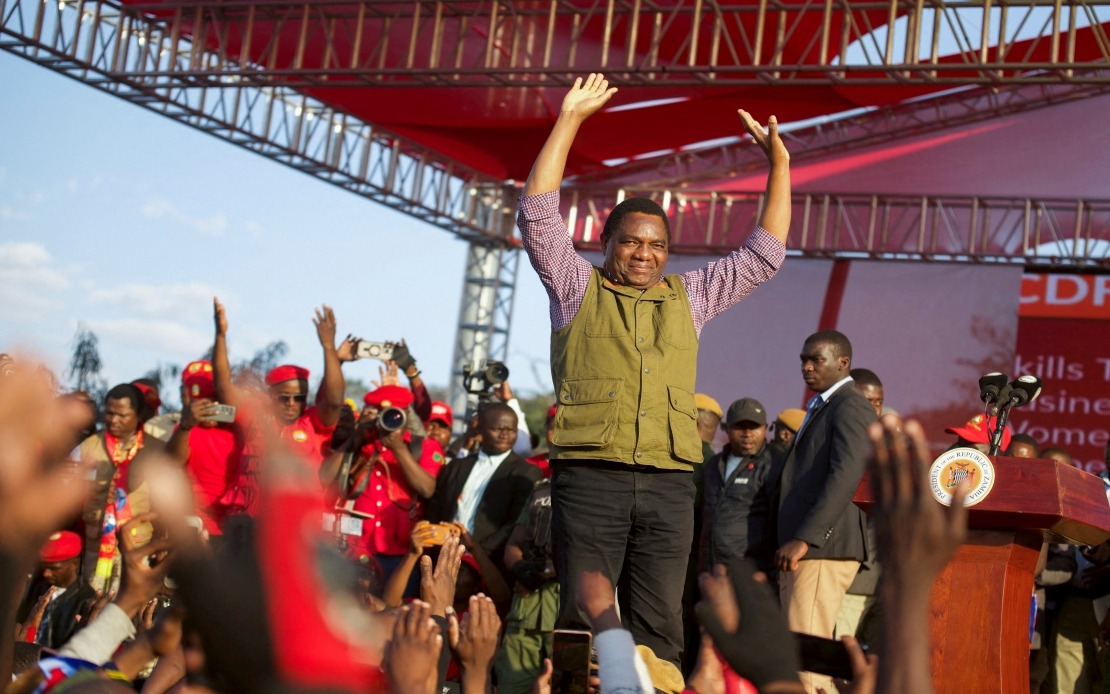
Zambian President Hakainde Hichilema appears poised to secure a second consecutive term in office, having accumulated a decisive electoral advantage in Sunday's presidential contest. With results tallied from 135 of the nation's 226 constituencies, Hichilema has garnered 1,544,140 votes, establishing a commanding margin over his nearest competitor. The Electoral Commission of Zambia announced the consolidated tally at the National Election Results Centre in Lusaka on Sunday evening, signalling that the incumbent retains substantial support across multiple regions of the southern African nation.
The 64-year-old economist and rancher is contesting the election under the United Party for National Development, the governing party he has led since his surprise landslide victory in 2021. His principal challenger is Brian Mundubile, a 55-year-old lawyer representing the National Reconciliation Party for Unity and Prosperity, who has attracted 1,030,662 votes so far. The gap between the two frontrunners stands at more than 500,000 votes, a substantial cushion that would require an unprecedented shift in voting patterns across the remaining uncounted constituencies for Mundubile to overtake the sitting president. Twelve other candidates are also competing in the contest, though none have accumulated votes approaching those of the leading contenders.
Zambia's constitutional framework requires that any victor obtain more than 50 per cent of all valid votes cast nationally. Should no candidate surpass this threshold once all ballots are counted, the Electoral Commission would proceed to a second round of voting limited to the top two finishers. Given Hichilema's present lead and the proportion of results already processed, political observers assess that the incumbent has multiple pathways to victory even if his current share of the vote declines modestly in remaining constituencies. The concentration of population and economic activity in Zambia's urbanised zones, particularly Lusaka and the Copperbelt mining region, may prove decisive in final outcomes.
Hichilema's political resurgence represents a notable chapter in Zambian democratic history. When he first ran for office in 2021, few predicted he would defeat then-president Edgar Lungu with such a decisive margin—exceeding one million votes—or that voters would subsequently entrust him with another term. His initial campaign capitalised on public discontent with economic mismanagement and sought to reset the country's political trajectory. Since taking office in September 2021, the incumbent has pursued an ambitious agenda centred on economic restructuring and institutional renewal.
The president's administration highlights several policy achievements as justification for re-election. Most prominently, Hichilema's government has undertaken substantial debt restructuring, addressing a crisis inherited from the Lungu era that had rendered Zambia unable to meet international obligations and severely constrained public investment. This initiative, though painful during implementation, has begun restoring the nation's creditworthiness in international financial markets. Beyond fiscal consolidation, the administration has prioritised revitalising Zambia's crucial mining sector, particularly copper production, which generates the bulk of export revenue and provides employment across the Copperbelt region.
The expansion of social programme funding signals another dimension of Hichilema's political platform. The government introduced free education across public primary and secondary schools, a policy that directly touches millions of Zambian families and represents a tangible demonstration of state capacity to deliver services. Such programmes carry particular resonance during electoral cycles, as voters weigh their immediate material circumstances against broader economic indicators. The decision to maintain and expand such initiatives despite fiscal constraints reflects a political calculation that securing popular legitimacy through visible welfare provision outweighs orthodox fiscal discipline.
Mundubile's opposition coalition has achieved scattered victories, particularly in urban constituencies and along the Copperbelt, suggesting that Hichilema's support, while dominant overall, is not uniformly distributed across all regions. Opposition-held parliamentary seats in urbanised areas typically indicate that cities contain more heterogeneous electorates less amenable to incumbent advantage. These pockets of resistance may prove consequential for national politics beyond the current presidential contest, as parliamentary composition will influence the legislative environment the president encounters during a potential second term. The opposition's capacity to retain seats in economically significant constituencies demonstrates that Hichilema's victory, if confirmed, will not translate into absolute hegemony across all political institutions.
The electoral dynamics reflect broader continental patterns in African democracies, where incumbent advantages—stemming from control of state resources, media access, and administrative machinery—typically benefit sitting presidents, particularly those managing visible improvements in public welfare or economic indicators. Zambia's experience with debt restructuring and renewed mining revenues has provided Hichilema with legitimate policy achievements to highlight, distinguishing his case from scenarios where incumbents rely primarily on institutional advantages divorced from substantive governance improvements. Nonetheless, questions regarding inclusive growth, regional equity, and whether debt relief translates into meaningful livelihood improvements for ordinary Zambians remain contested in political discourse.
For Malaysian and regional observers, the Zambian election underscores broader questions about democratic stability and economic governance in developing nations. Zambia's ability to manage a significant debt crisis while maintaining electoral competition and respecting constitutional processes demonstrates institutional resilience, though the country's resource dependence and vulnerability to commodity price fluctuations continue to constrain long-term developmental trajectories. The contrast between Hichilema's demonstrated policy ambition and the persistent structural constraints facing Zambia illustrates the complex reality confronting leaders across the developing world who must balance orthodox fiscal management with popular expectations of service delivery and employment.
As counting proceeds toward completion, political attention shifts toward the magnitude of Hichilema's eventual victory margin and the implications for his mandate to pursue further reforms during a second term. A narrow victory, if it materialises, would suggest weakening support compared to 2021 and might embolden parliamentary opposition or civil society scrutiny. Conversely, a convincing reaffirmation of popular confidence would strengthen his hand in pursuing contentious reforms, particularly in further mining sector restructuring or additional fiscal adjustments required by international creditors. The trajectory of Zambian politics in coming years will depend substantially on whether Hichilema can convert electoral mandate into tangible improvements in living standards, particularly for citizens in rural and peripheral regions less visible in campaign narratives dominated by urban and mining sector concerns.

