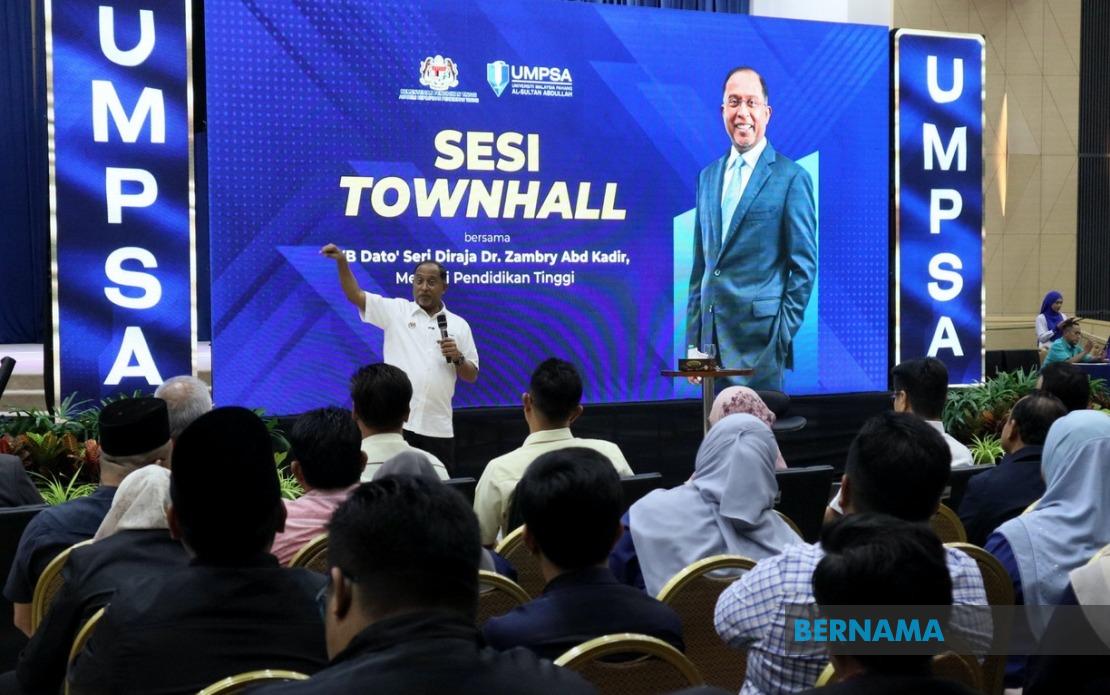
The Ministry of Higher Education (KPT) is now executing follow-up measures in response to Prime Minister Datuk Seri Anwar Ibrahim's recent instruction concerning how universities handle student disciplinary cases, particularly those involving criticism of the government and state institutions. The directive marks a significant shift in the government's approach to campus governance and student activism, reflecting broader policy changes on academic freedoms within Malaysian tertiary education.
Minister Datuk Seri Dr. Zambry Abd Kadir explained that the ministry's implementation takes into consideration legislative decisions and university regulations affecting student freedoms. He indicated that the framework encompasses multiple components, with initial evaluations conducted through each institution's Student Affairs Department. The comprehensive nature of the review suggests that universities will need to reassess existing cases and establish clearer guidelines for future disciplinary proceedings involving student expression and political commentary.
A significant development occurred when all vice-chancellors from public universities met with the Higher Education ministry's director-general to align their approaches. The convergence signals a coordinated response across Malaysia's university system rather than fragmented institutional decisions. Following this meeting, the ministry plans to issue a unified statement providing clarity on implementation procedures and expectations. This coordination is particularly important given that universities operate with considerable autonomy under Malaysian law, yet must ultimately answer to the government.
The Prime Minister's intervention directly references the ongoing repeal of the Universities and University Colleges Act (AUKU) 1971, which has historically restricted student political activities and freedoms of assembly. Anwar indicated that students currently facing disciplinary measures for criticising government policies should be relieved of such penalties immediately, rather than waiting for formal legislative amendments. This expedited approach reflects recognition that legislative reform could require extended periods, during which students would remain under disciplinary sanctions—a politically and socially undesirable outcome.
A crucial qualification centres on the distinction between university disciplinary action and criminal law. The Prime Minister's instruction applies only to academic sanctions imposed by institutions themselves through their internal mechanisms. Students implicated in criminal matters under Royal Malaysia Police investigation remain outside the scope of this exemption, maintaining the boundary between campus discipline and the criminal justice system. This delineation prevents the directive from being interpreted as blanket amnesty for all student-related cases.
The extension of these policies to private institutions presents a more complicated landscape. Datuk Seri Dr. Zambry acknowledged that private higher educational institutions operate under different legal frameworks, specifically the Private Higher Educational Institutions Act 1996 (Act 555), which provides different regulatory structures than their public counterparts. While the ministry cannot mandate compliance among independent private universities, officials hope that state-owned or state-related private institutions will voluntarily align with the new approach, creating de facto consistency across Malaysia's tertiary sector.
This initiative emerged during a gathering of 500 young academics and administrators aged forty and below at Universiti Malaysia Pahang Al-Sultan Abdullah convocation hall in Pekan. The event, part of the Kembara KARISMA Pemimpin Muda MADANI (Zon Timur) Tahun 2026 programme, convened higher education leaders from Pahang, Terengganu, and Kelantan. The deliberate inclusion of younger leadership cadres suggests the government recognizes that campus culture reform requires buy-in from emerging institutional leaders who will shape university environments over the coming decades.
For Malaysian readers and regional observers, this development represents a substantive recalibration of how the federal government conceptualizes student activism within universities. The tension between maintaining institutional order and protecting academic freedoms has long characterized higher education globally, but Malaysia's approach has historically tilted toward control mechanisms. The current pivot—however incremental—reflects an administration that views restricted student expression as potentially counterproductive to Malaysia's aspirations as a progressive, knowledge-based economy.
The implications extend beyond individual student cases. Universities considering reform to disciplinary procedures must determine what constitutes legitimate criticism versus conduct warranting sanctions. The lack of clarity regarding exactly which cases qualify for relief creates immediate implementation challenges for vice-chancellors already managing complex student grievance systems. Many institutions may require time to review historical cases and establish new precedents guiding future determinations.
Regionally, Malaysia's approach offers a potential template for other Southeast Asian nations grappling with student activism. Countries across the region have confronted similar tensions between developmental governance models emphasizing stability and democratic impulses favoring youth participation in public discourse. Malaysia's phased approach—maintaining criminal law protections while easing internal institutional sanctions—offers a middle path that other governments might study.
The timing of this directive, following recent parliamentary discussions on AUKU repeal, suggests the government views student freedoms as compatible with educational governance rather than threats to institutional function. Whether this philosophical shift translates into lasting cultural change within Malaysian universities depends heavily on implementation consistency and institutional cultures accepting greater student political expression. The coming months will reveal whether this represents genuine reform or primarily symbolic gesture.

