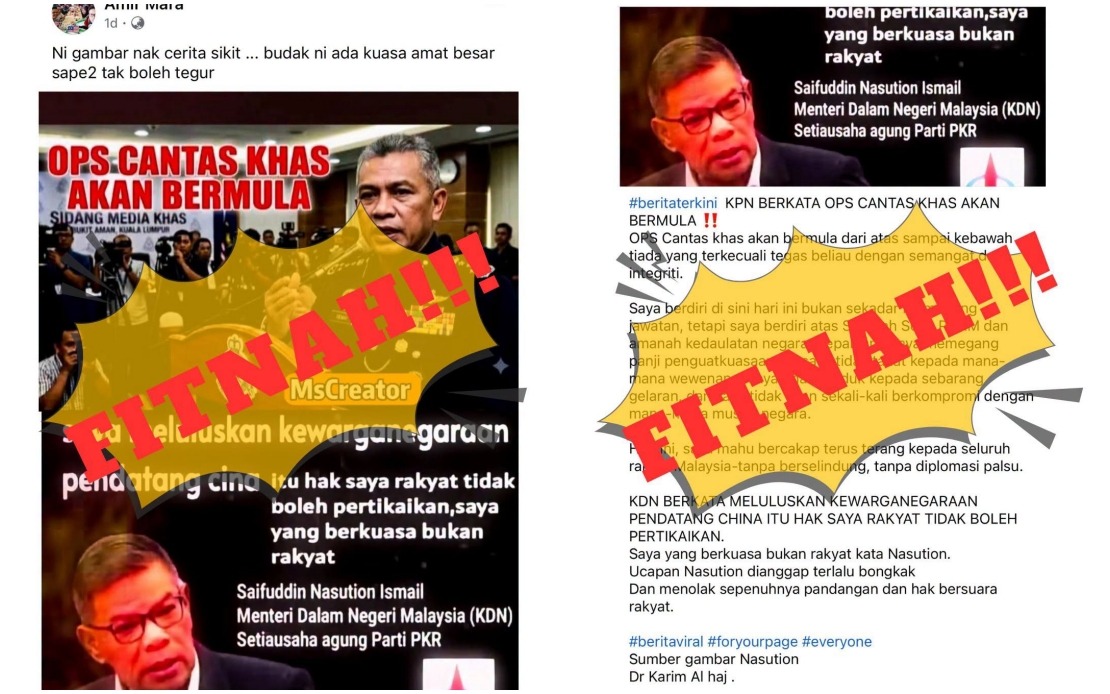
Home Minister Datuk Seri Saifuddin Nasution Ismail has firmly rejected persistent allegations that Malaysia's Home Ministry engaged in wholesale citizenship grants to foreign nationals, dismissing claims that 1.2 million Chinese nationals remain in the country without proper documentation. Speaking from Putrajaya, the minister characterised the repeated circulation of these narratives as a calculated effort to mislead the public, despite previous official clarifications backed by documented evidence and data.
The minister's statement underscores a growing concern within government circles about the weaponisation of unverified claims on social media platforms. Saifuddin Nasution emphasised that he has consistently refuted these allegations through multiple public statements, yet certain parties continue to resurrect and redistribute digitally-manipulated videos, posters, and narratives that have already been comprehensively addressed by official sources. This recycling of debunked claims represents a deliberate strategy to circumvent fact-checking and exploit public anxiety around citizenship and immigration issues.
The proliferation of such allegations on social platforms reflects deeper anxieties about demographic change and national identity that resonate particularly strongly in Malaysia's multicultural context. These narratives have gained traction partly because they intersect with longstanding public concerns about citizenship verification and border management, making them inherently more believable than they might otherwise be. By linking citizenship questions to specific ethnic groups, the claims tap into sensitive communal sensitivities that can quickly escalate tensions if left unchecked.
Saifuddin Nasution stressed that the government has already provided formal explanations through official channels, comprehensive documentation, and verified data sources. The minister pointed out that these explanations had been extensively reported in media coverage, creating a clear public record. Yet the continued spread of contradictory claims suggests that a significant segment of the population either remains unaware of these official clarifications or actively distrusts government statements on the issue. This gap between official narratives and public perception poses a genuine challenge to institutional credibility.
The minister identified multiple harms arising from the unchecked dissemination of false citizenship claims. Beyond damaging the reputations of individuals and institutions directly involved in immigration administration, such misinformation threatens to erode public confidence in state institutions more broadly. Malaysia's stability depends partly on citizen trust in governmental systems and official data; when that trust is deliberately undermined through false narratives, the consequences extend beyond a single policy area into the broader realm of political legitimacy and social cohesion.
Particularly concerning to Saifuddin Nasution are the potential consequences for communal harmony and national security. False narratives about citizenship and demographic composition can inflame inter-ethnic tensions, particularly when they single out specific communities or nations of origin. In a country as ethnically diverse as Malaysia, where historical communal relations have occasionally been fraught, stoking such divisions through deliberate falsehoods represents not merely a reputational threat but a potential security vulnerability. The minister's emphasis on this dimension reflects official anxiety about how digital misinformation can translate into real-world conflict.
The minister called upon all stakeholders to cease sharing these discredited claims and cautioned against exploiting sensitive national issues for political advantage or social media engagement. This plea addresses both organised actors with political motives and ordinary users who may share such content without verification. Saifuddin Nasution's appeal recognises that the problem encompasses both bad-faith actors deliberately spreading falsehoods and well-intentioned but careless individuals who amplify unverified claims without considering consequences.
Crucially, the minister urged the Malaysian public to adopt greater discernment when encountering information online, specifically recommending that citizens verify claims through official government sources before accepting or sharing them. This call for digital literacy and institutional trust reflects a broader government strategy to combat misinformation by encouraging citizens to distinguish between verified fact and unsubstantiated rumour. The recommendation implicitly acknowledges that official channels must maintain transparency and accessibility if they hope to win public confidence in their data and statements.
Saifuddin Nasution's final message encapsulated a fundamental principle: factual reality is not negotiable, and data speaks for itself. By asserting that "facts are facts, and data is data," the minister attempted to reestablish objective standards against which competing claims can be evaluated. This insistence on empirical grounding represents an effort to move beyond he-said-she-said dynamics where claims are treated as equally valid regardless of evidentiary support. In the context of Malaysia's immigration and citizenship debates, where emotionally-charged narratives often overshadow technical details, this recentering of fact-based discourse carries significant political weight.

