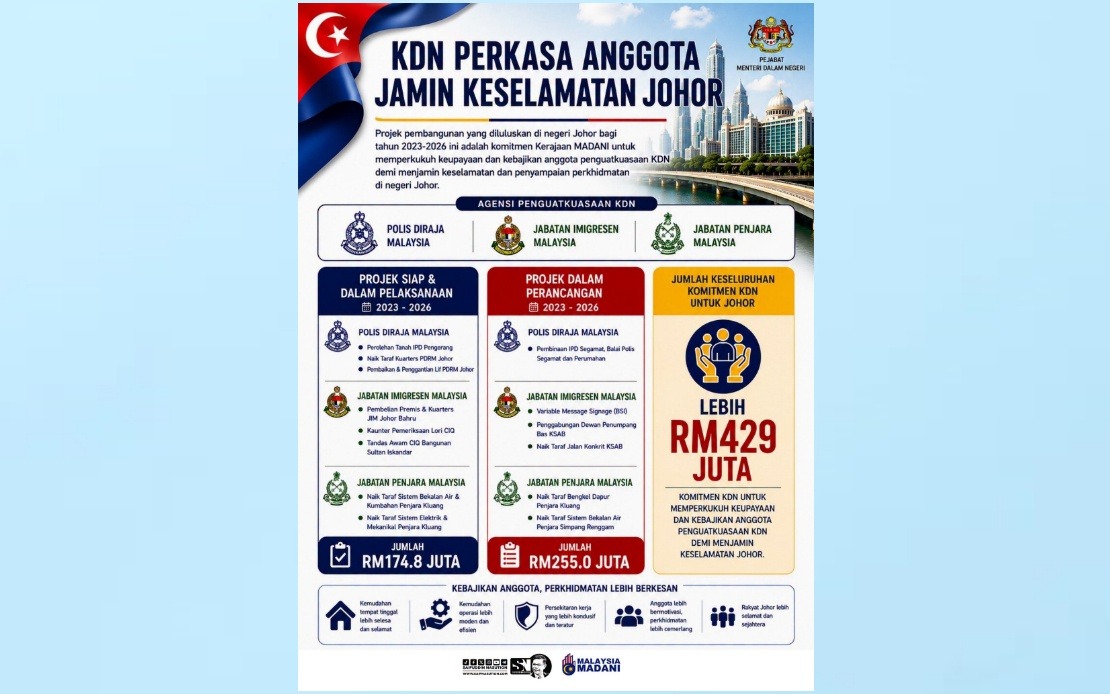
The Malaysian Home Ministry has channelled over RM429 million since 2023 into a comprehensive programme designed to elevate both the working conditions of enforcement personnel and the operational effectiveness of security agencies operating throughout Johor. Datuk Seri Saifuddin Nasution Ismail, the Home Minister, framed this substantial investment as integral to the government's broader strategy of ensuring that those tasked with maintaining public order can execute their responsibilities with maximum efficiency and safety. The initiative encompasses three critical institutions that form the backbone of Johor's security infrastructure: the Royal Malaysia Police, the Malaysian Immigration Department, and the Malaysian Prisons Department.
The financial commitment has been structured into two distinct phases to maximise project delivery and adaptability. Of the total allocation, RM174.8 million has been earmarked for initiatives already underway or recently completed, enabling tangible improvements to take effect relatively swiftly across the state. The remaining RM255 million represents future investments still in the planning and design stages, allowing the Home Ministry to respond to emerging needs and incorporate evolving standards into new facilities and systems. This bifurcated approach provides both immediate relief to operational constraints while building long-term infrastructure capacity.
Currently advancing projects demonstrate the ministry's focus on addressing critical infrastructure gaps in Johor's enforcement landscape. Land acquisition for the Pengerang District Police Headquarters represents an expansion of police presence in a strategically significant area, while the purchase of office premises and residential quarters for the Johor Bahru Immigration Department signals investment in dignified working environments for immigration officials. Simultaneously, renovation efforts at Kluang Prison are modernising basic facilities, acknowledging that improved conditions directly influence both staff morale and institutional security. These initiatives collectively signal a recognition that enforcement agencies require contemporary infrastructure to function optimally in an increasingly complex operating environment.
Pipeline projects underscore the government's longer-term vision for Johor's security apparatus. The construction of the Segamat District Police Headquarters, which will integrate both operational facilities and residential accommodation, reflects best practices in integrated police infrastructure design. The consolidation of the bus passenger terminal at the Sultan Abu Bakar Complex addresses administrative efficiency while supporting integrated security operations. Additional planned upgrades to kitchen facilities at Kluang Prison and water supply systems at Simpang Renggam Prison may appear prosaic but represent essential investments in institutional functionality and human dignity within the correctional system. Collectively, these projects demonstrate sophisticated understanding of how infrastructure investments translate into operational capability and personnel retention.
Home Minister Saifuddin Nasution articulated a philosophy extending beyond mere facility provision, positioning personnel welfare as a strategic security asset rather than an ancillary benefit. When enforcement officers work within conducive environments with comfortable quarters and modern operational tools, the reasoning goes, they perform their duties more effectively and safely. This perspective aligns with contemporary evidence from organisational research suggesting that working conditions fundamentally influence both job performance and institutional effectiveness. For Johor residents, this translates into more responsive policing, efficient border management, and secure correctional facilities—all essential to public confidence in state institutions.
The broader context of this allocation reflects the MADANI Government's commitment to devolved development priorities. Saifuddin Nasution emphasised that the initiative exemplifies how Putrajaya ensures different states receive support calibrated to their specific requirements and development aspirations. This messaging becomes particularly significant given historical regional sensitivities regarding equitable resource distribution. The explicit acknowledgement that Johor's development and management allocation has increased substantially—from RM10.2 billion to approximately RM14.6 billion—provides quantifiable evidence of enhanced federal investment in the state's growth trajectory.
Prime Minister Datuk Seri Anwar Ibrahim's recent parliamentary statement regarding Johor's increased budgetary allocations adds ministerial weight to the narrative of enhanced state support. This coordinated messaging from multiple cabinet levels suggests deliberate government effort to underscore commitment to Johor's development priorities. For state leaders and business communities, such signals carry implications for confidence in longer-term infrastructure planning and resource stability. The emphasis on concrete projects—police headquarters, immigration facilities, prison upgrades—demonstrates commitment beyond rhetorical statements.
For Malaysia's enforcement community, these investments address longstanding concerns about working conditions that have periodically surfaced in personnel discussions and union representations. Police quarters, immigration department facilities, and prison infrastructure had in various instances fallen below contemporary standards, affecting recruitment and retention. By systematically addressing these deficiencies, the government responds to both humanitarian concerns for officer welfare and pragmatic requirements of institutional stability. For immigration officials, improved office and residential facilities in Johor Bahru acknowledge the department's critical role in managing one of Malaysia's most crucial international borders.
The security implications for Johor are substantial given the state's geographical position, economic significance, and cross-border dynamics. Strengthened police operational capabilities, enhanced immigration infrastructure, and improved correctional facilities contribute to integrated security governance in a state that serves as crucial interface between Malaysia and Singapore, managing substantial commercial, tourism, and population flows. Modern facilities and well-supported personnel directly influence the state's capacity to address transnational crime, terrorism prevention, and immigration integrity—all matters of national security significance extending beyond Johor's borders.
Looking forward, this RM429 million investment signals that the MADANI Government prioritises law enforcement capacity and institutional quality as central to its governance agenda. For Johor citizens and businesses, improved police responsiveness, immigration efficiency, and prison security enhance the foundational conditions supporting economic activity and social stability. For other states observing federal allocation patterns, the Johor investment provides a template suggesting that sustained advocacy for infrastructure needs can yield budgetary outcomes. The initiative underscores how security and welfare investments, properly articulated and resourced, become essential components of broader development strategy rather than peripheral administrative functions.

