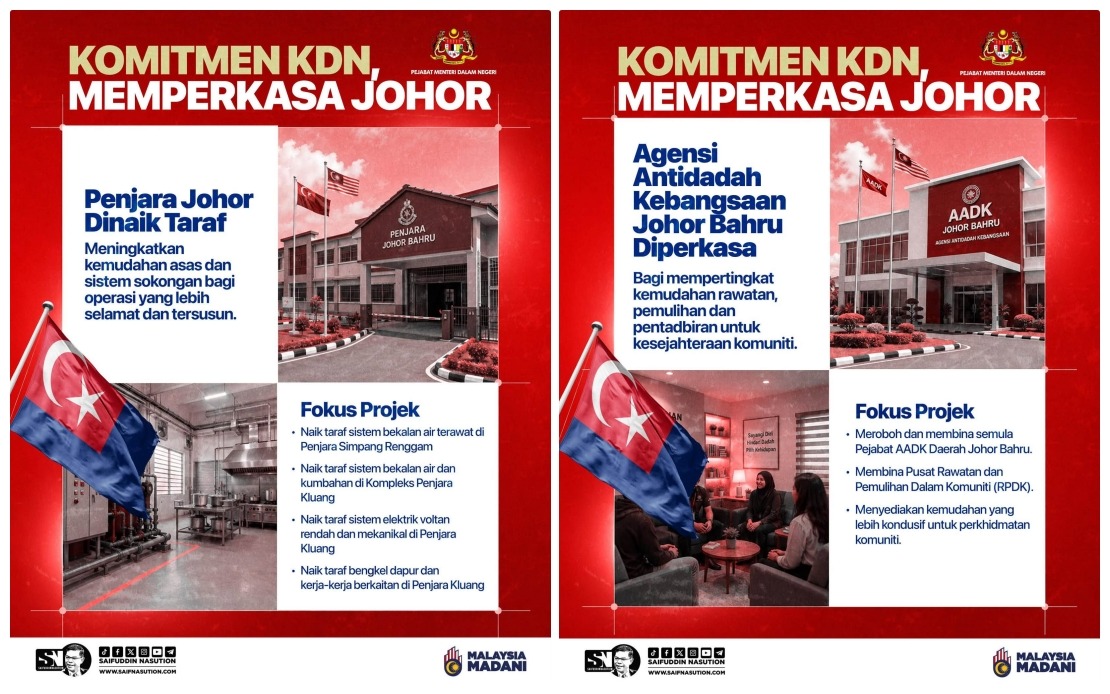
The Home Ministry has outlined an ambitious portfolio of development projects across Johor aimed at reinforcing the state's security apparatus and streamlining public service delivery mechanisms. Home Minister Datuk Seri Saifuddin Nasution Ismail characterised the southern state as a strategic asset for the nation, serving as a critical security hub and international gateway that warrants sustained institutional investment.
Johor's geographic position and role as a major entry point for commerce, tourism and cross-border movement have long positioned it as essential to Malaysia's broader security and administrative framework. The ministry's initiatives reflect recognition that infrastructure modernisation at federal and state levels remains fundamental to maintaining both public confidence and operational readiness. By concentrating resources across multiple agencies, the Home Ministry seeks to demonstrate coordinated governance capable of addressing contemporary security challenges and citizen expectations simultaneously.
The Royal Malaysia Police will undertake construction of the Segamat district headquarters and acquire land for Pengerang district facilities, complemented by maintenance work on existing police buildings and residential quarters. These physical upgrades target not only enhanced operational capacity but also improved working conditions for personnel deployed across the state. Immigration infrastructure receives parallel attention, with the ministry prioritising facility upgrades at the Sultan Iskandar Building and Sultan Abu Bakar Complex to accelerate border processing and strengthen integrity controls at international entry points.
Beyond policing and border management, the National Registration Department will establish a new district office in Batu Pahat, addressing administrative service gaps in that locality. Prison infrastructure receives targeted investment through system upgrades at Kluang and Simpang Renggam facilities, reflecting the ministry's holistic approach to custodial administration. The National Anti-Drugs Agency will undergo office redevelopment and treatment centre modernisation, signalling intensified commitment to combating narcotics trafficking and addiction within the state.
Maritime security capabilities will expand through jetty improvements and building upgrades at Abu Bakar Maritime Base, enabling the Malaysian Maritime Enforcement Agency to operate more effectively across Johor's extensive coastline. This investment carries particular significance given increasing regional maritime challenges, including smuggling, piracy concerns and the need to protect exclusive economic zones. Enhanced facilities support more sustained and technologically current operations essential for protecting territorial waters.
The cumulative scope of these projects reveals a ministry strategy emphasising infrastructure as foundational to institutional modernisation. Rather than pursuing fragmented initiatives, the Home Ministry has constructed an integrated programme targeting multiple security and administrative functions simultaneously. This approach acknowledges that effective governance requires parallel advancement across police, immigration, prisons, anti-narcotics and maritime domains rather than sequential or isolated improvements.
Saifuddin Nasution emphasised that implementation will prioritise tangible public benefit and personnel welfare alongside strengthening security agency preparedness. This framing attempts to connect infrastructure investment to citizen experience—faster border processing, improved police responsiveness, enhanced treatment options for addiction. The minister positioned the expenditure as advancing Johor's development trajectory toward becoming demonstrably safer and more efficient.
For Malaysian policymakers, these announcements carry implications extending beyond Johor. The southern state's development precedent may establish benchmarks for similar multisectoral investments in other regions. Investment patterns here could shape approaches to provincial security infrastructure nationwide. Additionally, efficient execution of these programmes would validate the Home Ministry's capacity to coordinate complex, multi-agency development initiatives—a competency increasingly important as security challenges become more sophisticated and interconnected.
The timing of these announcements coincides with Johor state elections, in which approximately 2.7 million registered voters will select 56 state assemblymen. Political context undoubtedly influences the public communication of development initiatives, though this does not diminish the substantive planning reflected in the ministry's comprehensive project portfolio. Voters will assess whether announced investments translate into tangible service improvements and security outcomes in coming months and years.
Regional security dynamics underscore why Johor infrastructure investment matters beyond state boundaries. The state's role as Malaysia's primary interface with Singapore and southern Thai provinces positions it centrally in regional security architecture. Modernised facilities and enhanced capacity at Johor's security agencies contribute to broader Southeast Asian stability by improving intelligence sharing, cross-border enforcement cooperation and dispute management capabilities. Enhanced maritime capabilities particularly affect regional trade security and freedom of navigation considerations.
Implementation efficiency will ultimately determine whether these investments achieve stated objectives. Government track records in completing infrastructure projects on schedule and budget vary considerably. The Home Ministry's commitment will be tested through actual execution—whether construction timelines are met, whether upgraded facilities operate as intended, whether personnel training and systems keep pace with physical infrastructure. Johor residents and security professionals will measure ministry performance against concrete outcomes rather than announced intentions.
Moving forward, the Home Ministry's stated commitment to ensuring allocations deliver direct public benefit and strengthen agency preparedness remains aspirational without demonstration. The integration of security infrastructure development with public service modernisation suggests recognition that contemporary governance requires balancing enforcement capabilities with citizen convenience. How effectively the ministry calibrates these competing demands will determine whether Johor emerges as a model for strategic security and administrative investment or merely another collection of infrastructure projects.

