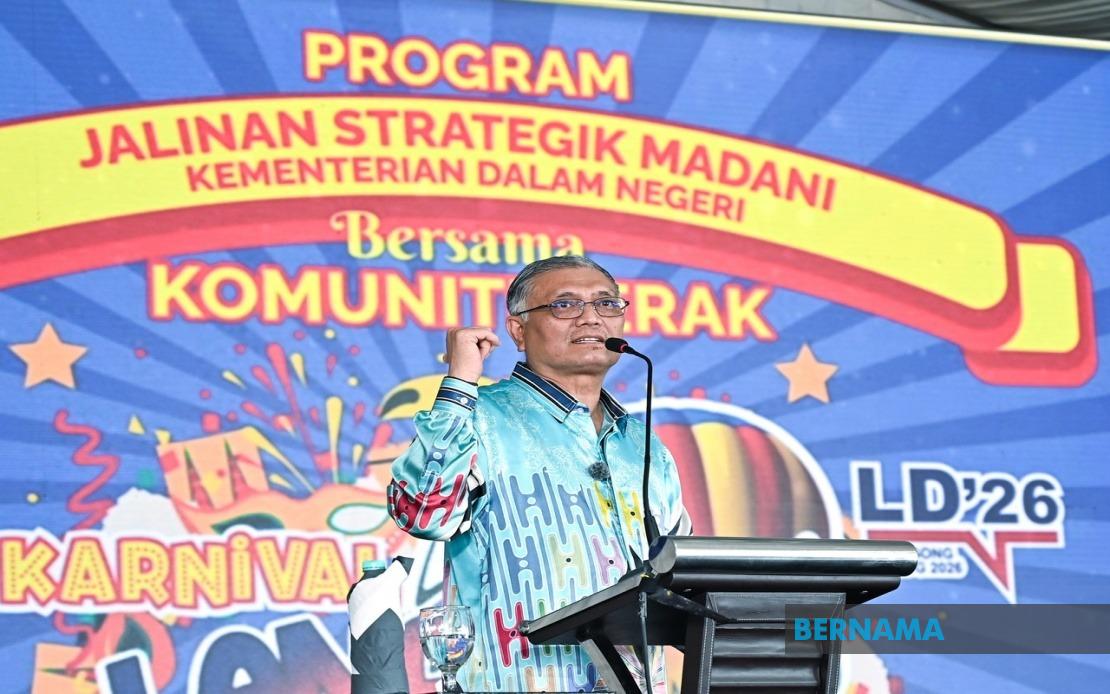
Malaysia's Home Ministry launched its MADANI Strategic Partnership Programme in Lenggong this week, marking an ambitious attempt to bridge the distance between security agencies and ordinary Malaysians by literally bringing government counters into the community. The two-day initiative, held at Dataran Lenggong, represents a shift in how the ministry approaches public engagement—moving beyond traditional office-based service delivery to create a festival-like atmosphere where families can interact with police, immigration officials, and anti-drugs personnel in relaxed, accessible settings.
Deputy Home Minister Datuk Seri Dr Shamsul Anuar Nasarah framed the programme as more than a service-delivery exercise. In his remarks at the official opening, he emphasised that MADANI exists fundamentally to enable two-way conversation between security agencies and grassroots communities about shared concerns: crime prevention, drug abuse, and neighbourhood security. This positioning suggests the ministry recognises that effective governance in these sensitive areas requires active community buy-in rather than top-down enforcement alone. The Lenggong MP acknowledged that residents often lack convenient opportunities to update their records with government agencies, lodge formal complaints, or simply seek specialist advice—friction points that the programme aims to eliminate.
The event's design reflected a deliberate strategy to lower barriers to government engagement. Rather than expecting citizens to navigate government buildings and bureaucratic processes, the programme organised activities appealing to different demographics. Children participated in colouring competitions and creative performances, while religious talks catered to the spiritual interests of the broader community. This multi-generational approach means families spending time at Dataran Lenggong encountered government services almost incidentally, potentially reducing the intimidation factor that sometimes surrounds interactions with police and immigration authorities.
Three major KDN agencies established service counters that reportedly received strong attendance: the Royal Malaysia Police (PDRM), the Immigration Department of Malaysia (JIM), and the National Anti-Drugs Agency (AADK). Each agency mounted exhibitions describing their work and available services. For Lenggong residents, this created a rare opportunity to understand what these organisations actually do beyond their enforcement roles—a perception gap that exists throughout Malaysia. The police counter, for instance, could showcase community policing initiatives rather than being associated solely with traffic stops or crime investigations. Similarly, AADK's presence alongside recreational activities linked the agency to health and wellness rather than exclusively to arrest and rehabilitation.
The programme's centrepiece was a combined Fun Ride and Fun Run that drew approximately 1,190 participants, organised jointly by the People's Volunteer Corps (RELA) and AADK. Rather than a typical urban marathon, participants traversed villages circling Lenggong, experiencing the region's natural attractions and UNESCO World Heritage Site status firsthand. This integration of physical activity, community participation, and tourism promotion reflects growing Malaysian government interest in linking security narratives to positive community identity. By associating anti-drugs work with healthy lifestyle choices and cultural heritage, organisers attempted to reframe drug prevention as part of broader community wellbeing rather than as a law-enforcement burden.
Lenggong itself offers particular advantages as a venue for such initiatives. The Lenggong Valley, recognised by UNESCO for its archaeological significance, represents Malaysia's rich prehistoric heritage. Drawing visitors through rural villages around the valley during the Fun Ride and Fun Run allowed the programme to serve dual purposes: strengthening KDN-community relations while showcasing tourism potential and cultural assets. For a Perak community, this association between security agencies and heritage preservation may subtly influence how residents perceive government priorities and investment in their region.
The programme's emphasis on accessibility and convenience addresses persistent Malaysian complaints about government service quality. Many Malaysians report frustration with inflexible office hours, long queues, and impersonal interactions at government counters. By bringing services to a community gathering, KDN demonstrated willingness to meet citizens where they are—literally and figuratively. Residents could address administrative matters, ask questions, or provide feedback without scheduling special trips or taking time off work. This approach reflects lessons from international best practices in citizen engagement and reflects Malaysia's broader MADANI framework, which emphasises prosperity through stronger community foundations.
The two-way engagement model that Shamsul Anuar highlighted carries particular significance for security governance in Malaysia. Crime prevention, drug trafficking prevention, and community safety all depend partly on public cooperation—residents reporting suspicious activity, providing intelligence about drug distribution, or participating in neighbourhood watch schemes. However, such cooperation requires trust and positive relationships between communities and security agencies. Programmes like MADANI, which create non-confrontational spaces for interaction, may gradually build social capital that translates into enhanced community participation in security initiatives.
For other Malaysian states and municipalities considering similar programmes, the Lenggong model offers a replicable template. The combination of family-friendly activities, agency exhibitions, accessible service counters, and community participation through recreation creates multiple entry points for different demographic groups. The success metrics—positive visitor response to service counters, strong turnout for recreational activities, and organic community engagement—suggest the approach resonates with Malaysian expectations. As government agencies increasingly face criticism for poor service delivery and low public trust, programmes demonstrating genuine commitment to accessibility may prove valuable for broader institutional reform.
The Perak Community 2026 designation in the programme title hints at forward planning and sustained engagement rather than a one-off event. If KDN intends to build on momentum from the Lenggong initiative, subsequent programmes might address specific community feedback collected during this event or tackle particular security challenges identified through the two-way conversations that Shamsul Anuar emphasised. Such iterative improvement would demonstrate that the MADANI framework genuinely incorporates community input rather than simply broadcasting government services.

