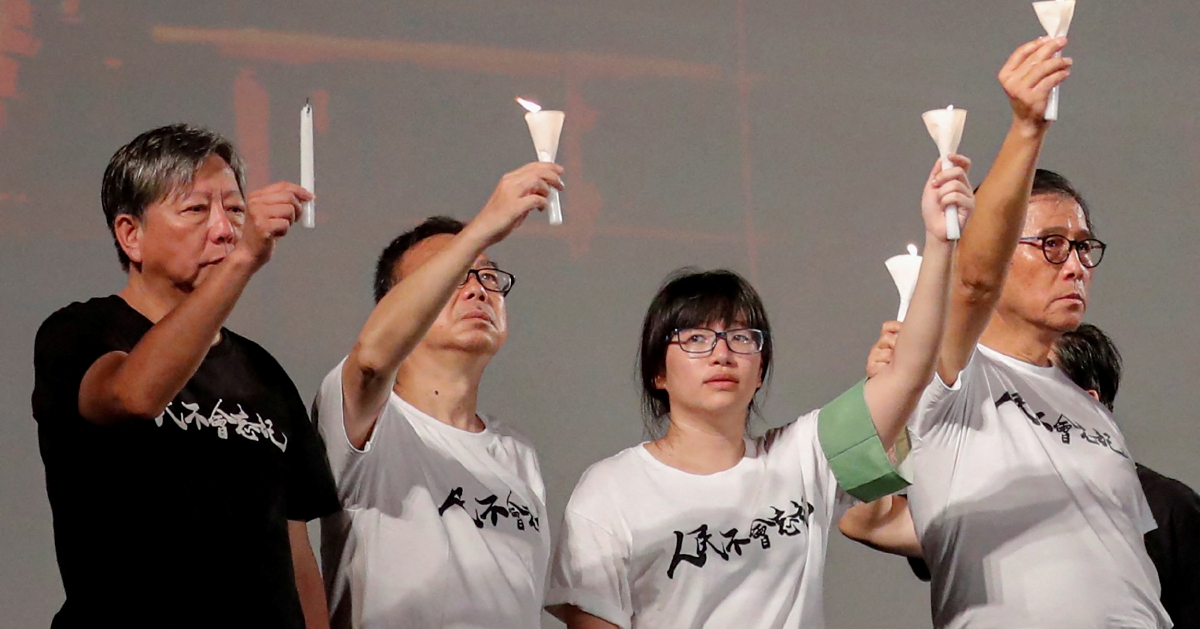
Two prominent Hong Kong activists have been found guilty of inciting subversion by a local court for their role in organising annual vigils commemorating the 1989 Tiananmen Square crackdown. The verdict, delivered on Friday, represents a landmark moment in Hong Kong's evolving political landscape and underscores the tightening grip on freedom of expression under the national security framework introduced in recent years.
The convictions relate to the activists' organisation of candlelit memorial gatherings held each June to remember the students and workers killed during the military intervention in Beijing. These vigils had become one of Hong Kong's most visible forms of political commemoration, drawing thousands of participants who gathered in Victoria Park and other public spaces to maintain collective memory of the incident. The decision to prosecute those who coordinated these events signals a fundamental shift in how authorities approach public assembly and historical remembrance.
The charges of incitement to subversion carry significant legal weight under Hong Kong's national security landscape, which underwent substantial transformation following the 2019 pro-democracy protests. The framework criminalises acts deemed to undermine state authority or incite opposition to central government policies, providing prosecutors with broad interpretive tools to address political dissent. For Malaysian observers, this development parallels ongoing debates in Southeast Asia regarding the balance between national security concerns and civil liberties, though Hong Kong's trajectory offers a cautionary case study in how security legislation can rapidly reshape permitted forms of political expression.
The trial and conviction have drawn international scrutiny from human rights organisations and democratic governments concerned about the erosion of Hong Kong's historical autonomy and the freedoms that once distinguished the territory from mainland China. The case exemplifies how legislation initially framed as necessary safeguards against destabilisation has expanded into an instrument for constraining routine political activities and historical commemoration. For regional analysts, Hong Kong's experience raises questions about how security concerns are balanced against democratic participation across Asia-Pacific democracies and competitive authoritarian systems.
The activists' pursuit of organising these vigils was grounded in Hong Kong's distinct identity and tradition of maintaining independent civic space. The annual Tiananmen commemorations represented one of the few places globally where residents could publicly and collectively remember an event that remains censored and suppressed in mainland China. The conviction of organisers therefore signals that such symbolic dissent, however peaceful or memorial in nature, now carries legal jeopardy in Hong Kong's modified political system. This shift has profound implications for how communities preserve historical memory and engage in forms of political expression that challenge official narratives.
The broader context of this case involves Hong Kong's transformation since the passage of the National Security Law in 2020. What began as legislation targeting secession, foreign collusion, terrorism, and subversion has been applied to an expanding array of activities including literary works, protest slogans, and now the coordination of peaceful commemorative gatherings. The prosecution of vigil organisers demonstrates how security frameworks, once implemented, tend toward expansive interpretation that gradually encompasses activities previously considered protected speech or legitimate assembly.
For Southeast Asian observers, the Hong Kong convictions highlight the tension between security apparatus expansion and democratic governance. Malaysia, Thailand, Vietnam, and other regional nations face similar pressures to strengthen internal security mechanisms amid concerns about terrorism and destabilisation. Yet Hong Kong's experience suggests that such frameworks, without robust constitutional protections or independent judicial oversight, create conditions where routine political expression becomes criminalised. The precedent established by prosecuting vigil organisers rather than addressing them through conventional regulatory frameworks raises questions about procedural justice and proportionality.
The international dimensions of this case extend beyond human rights advocacy. The United States, European Union, and allied democracies have criticised Hong Kong's security trajectory as inconsistent with prior commitments regarding autonomy and freedoms. These criticisms, however, have done little to alter trajectories on the ground. For Malaysia and other ASEAN members balancing relationships with both Beijing and Western partners, the Hong Kong case presents a diplomatic complexity, as regional governments navigate their own security concerns while maintaining international relationships.
The practical impact on civil society in Hong Kong has been immediate and chilling. The conviction sends unmistakable signals to other activists, journalists, academics, and civil society organisations about the risks of pursuing activities that challenge official narratives or organise public expressions of dissent. This effect extends beyond formal legal liability; it establishes reputational and social costs for engagement with contentious issues. Consequently, Hong Kong civil society has undergone visible contraction, with numerous organisations ceasing operations or significantly restricting their scope.
Looking forward, the question remains whether Hong Kong's trajectory represents an anomalous case driven by unique Beijing-specific circumstances, or whether it previews broader regional shifts. Singapore, with its Internal Security Act, and Vietnam, with its security apparatus, have long maintained restrictive security frameworks. Yet Hong Kong's case is distinctive because it represents a reversal—a democratic system with established freedoms transitioning toward constraint. For Malaysia's political class and society, observing how a developed democracy manages this transition offers valuable lessons regarding institutional resilience, constitutional protections, and the reversibility of freedoms once eroded.

