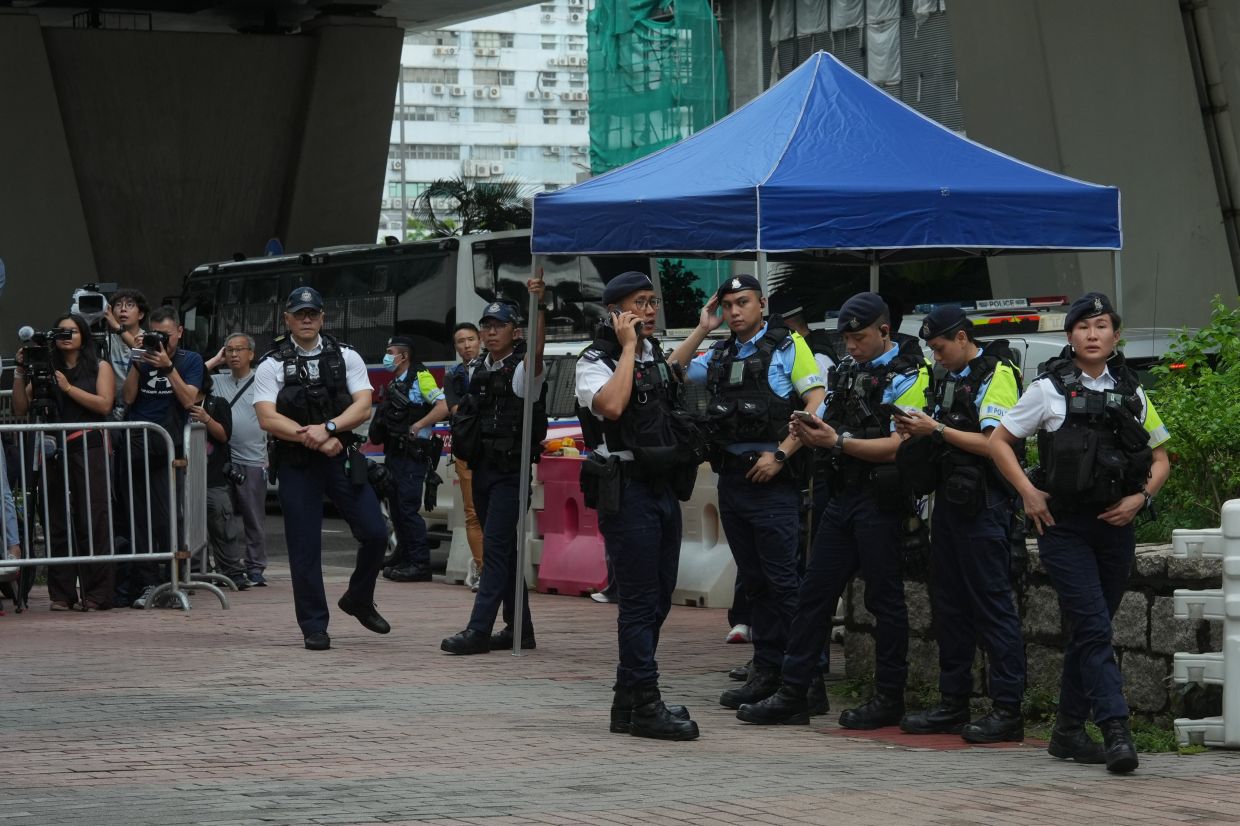
Hong Kong police arrested a woman last week for allegedly wearing a T-shirt carrying a seditious message while standing outside West Kowloon Court, according to a statement released by the force on Monday night. The detainee faced multiple charges including disorderly conduct in public, obstructing police operations, and acting with seditious intention. Authorities offered limited transparency on the incident, with a police spokesman stating only that the operation aimed to safeguard public order and safety, while withholding operational specifics from public disclosure.
The arrest unfolded in the early morning hours of Friday, as more than 50 people gathered outside the courthouse awaiting a significant legal judgment. A plain-clothes officer reportedly identified the woman and her garment as posing a security concern, subsequently removing her from the vicinity in a police vehicle. Footage captured by media outlets showed officers instructing journalists to step back as the woman was escorted away. Witness accounts described the garment as a black T-shirt bearing Japanese characters, though the exact nature of the suspected seditious content remained unclear from official statements.
The timing of this detention carried considerable political weight, occurring mere hours before judges delivered their verdict in a landmark case against Lee Cheuk‑yan, former chairman of the Hong Kong Alliance in Support of Patriotic Democratic Movements of China, and Chow Hang‑tung, the organization's former vice-chairwoman. Both individuals have remained in police custody for nearly five years as their case progressed through Hong Kong's judicial system. The verdict represented a culmination of charges stemming from the alliance's role in organizing Hong Kong's annual Tiananmen Square vigil, a commemoration that authorities increasingly view as politically problematic under the territory's evolving legal landscape.
The High Court's 216-page ruling found Lee and Chow guilty of inciting subversion under Hong Kong's national security law, a piece of legislation that has fundamentally reshaped the city's legal environment since its implementation in 2020. Three High Court judges determined that efforts to challenge or weaken the Communist Party of China's authority could constitute subversion, establishing an interpretation that reflects Beijing's constitutional framework, which does not accommodate Western-style democratic systems. This judicial reasoning extends national security law provisions far beyond traditional definitions of sedition, criminalizing political speech that questions the legitimacy of single-party rule.
Lee's background as a former lawmaker and pro-democracy activist made him a prominent figure in Hong Kong's opposition movement for decades, while Chow's credentials as a practicing barrister underscored the professional standing of those now caught within the national security law's expansive scope. Their conviction sends a clear message about the boundaries of permissible political expression within Hong Kong's transformed legal order. The alliance itself, which once organized one of Asia's largest commemorations of the 1989 Tiananmen Square incident, has been formally dissolved as authorities moved to eliminate institutional structures perceived as vehicles for subversive messaging.
A fourth defendant in the proceedings, Albert Ho Chun‑yan, who previously served as the alliance's vice-chairman, has spent more than four years in detention. Ho entered a guilty plea in January and now awaits sentencing determination from the courts. His decision to accept guilt stands in contrast to Lee and Chow's contested defense, potentially reflecting strategic calculations about the direction of national security law jurisprudence or personal circumstances surrounding the prolonged detention.
For Malaysian observers and policymakers, this case illuminates the trajectory of political freedoms within a major Asian financial hub and the mechanisms through which national security legislation can be applied to restrict civil liberties and political expression. The Hong Kong situation serves as a cautionary reference point for ongoing debates across Southeast Asia regarding the balance between security imperatives and fundamental freedoms. The expansion of sedition charges to encompass criticism of foreign governments' political systems, particularly China's, represents an extraordinary extension of national security law beyond conventional parameters and raises questions about how neighbouring jurisdictions might similarly interpret and apply comparable legislation.
The detention of the woman over her T-shirt's alleged message also reflects operational practices that blur the line between security operations and pre-emptive suppression of political expression. The lack of transparency regarding specific details of what rendered the garment seditious, combined with the apparent discretion exercised by plain-clothes officers in identifying and detaining the individual, raises concerns about arbitrariness in enforcement and the potential for targeting based on subjective judgments about political messaging. For regional media freedom advocates, the incident exemplifies how security frameworks can be deployed to constrain even passive forms of political communication.
These proceedings occur within a broader context of Hong Kong's political realignment following the 2020 national security law's introduction and the subsequent electoral reforms that narrowed democratic participation. The sustained detention and prosecution of prominent civil society figures sends signals about the acceptable scope of political activity that extend well beyond formal legislative or protest spaces. Educational institutions, cultural events, and community commemorations have all faced increased scrutiny, creating a chilling effect on historical remembrance and political discussion.
The convergence of the woman's arrest with the delivery of the high-profile verdict against Lee and Chow suggests coordinated messaging by authorities about the consequences of challenging the political status quo. Whether coincidental or orchestrated, the timing reinforces official positioning that national security imperatives override considerations of political expression or assembly rights. For Southeast Asian governments contemplating national security legislation or considering enhancement of existing frameworks, the Hong Kong example provides practical demonstration of how such laws function in application, particularly regarding their capacity to criminalize speech that authorities perceive as threatening to political stability or state legitimacy.
Moving forward, the conviction of Lee and Chow will likely face appeals, but the High Court's interpretation of subversion provides an established legal framework that subsequent cases will reference. Additional prosecutions under similar charges remain probable, and the demonstration effect of these convictions may discourage political organizing around historically sensitive issues. The case against the woman detained for her T-shirt, meanwhile, remains largely opaque, with minimal public information available about the specific charges or anticipated resolution of her situation, exemplifying broader challenges regarding judicial transparency and due process protections within Hong Kong's transformed legal environment.

