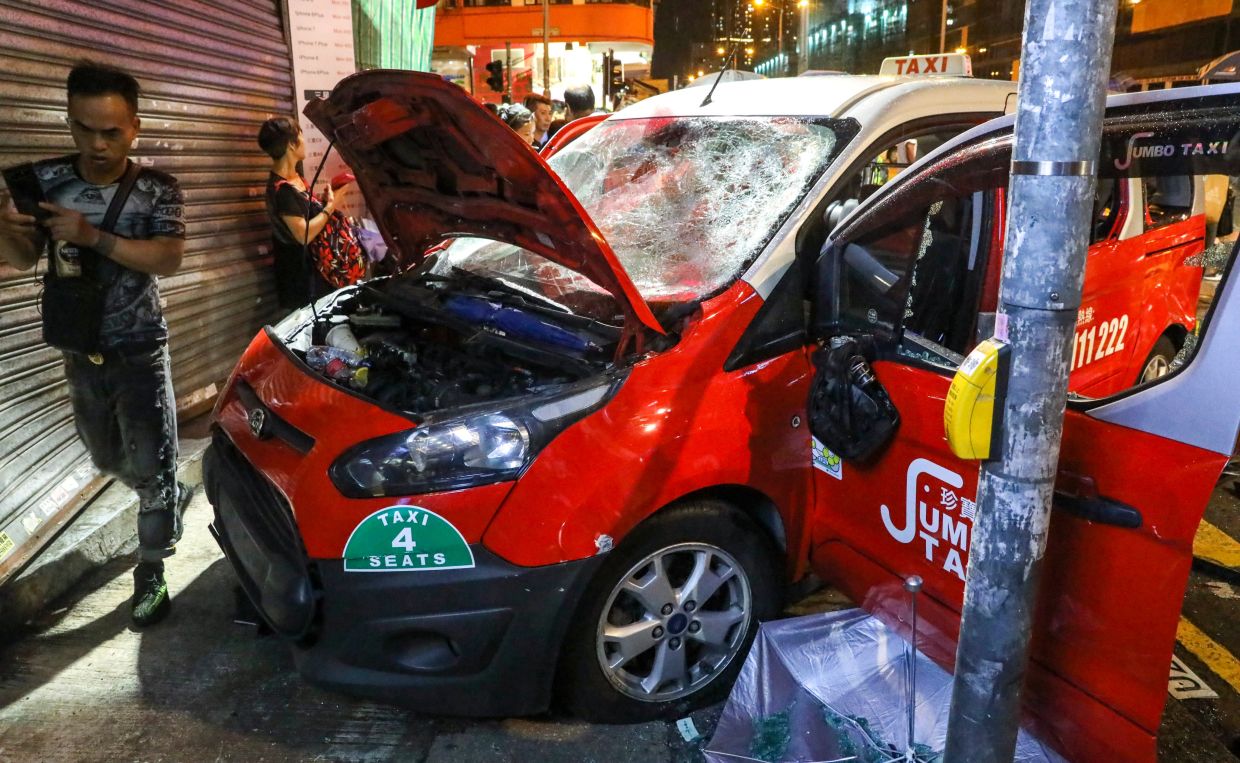
A Hong Kong kindergarten clerk has taken her case to court seeking HK$8.4 million in compensation after a taxi struck her during the chaotic 2019 Sham Shui Po protests, arguing that the collision fundamentally altered the trajectory of her life. Park Hoi-lam's legal team presented arguments this week before Justice Simon Leung Chun-man, positioning the October 6, 2019 incident as a clear case of driver negligence that occurred amid the broader civil unrest that gripped Hong Kong during that period.
The plaintiff's counsel, Susanna Leong, built her case on the premise that taxi driver Henry Cheng Kwok-chuen failed to exercise basic precautions before his vehicle mounted the pavement and collided with Park and another woman on Yen Chow Street. Critically, Leong emphasised that the driver gave no warning by sounding his horn and made no attempt to brake prior to impact. This absence of defensive driving measures, she argued, demonstrated negligence independent of the broader protest context. The legal strategy thus framed the incident as a straightforward traffic accident where reasonable care was absent, rather than situating it within the violence and chaos that characterised the demonstrations that day.
Park's account of events provides a window into how ordinary residents became caught in the disruptions. She was attempting to reach Tsim Sha Tsui by bus when road closures forced her group to exit in Sham Shui Po. Discovering that railway services had also been suspended, she and her friends decided to walk toward Mong Kok. However, Park became separated from her companions after walking faster than the group, leaving her alone when the taxi incident occurred. Her testimony suggests she was neither a protester nor a bystander deliberately positioned in the midst of confrontation, but rather a person displaced by infrastructure closures and navigating unfamiliar streets during a period of civil disorder.
The physical consequences of the collision have proven severe and enduring. Park underwent seven surgical procedures within the first three months following the accident, with her discharge occurring on January 18, 2020. Despite this intensive medical intervention, she continues to experience chronic knee pain that restricts her mobility. Walking for more than an hour now requires her to rest, a limitation that profoundly affects her capacity to perform even routine work duties. Her cosmetic surgeon has recommended reconstructive surgery to address scarring on her legs, but financial constraints have prevented her from pursuing this option. Medical advisors have further informed her that her condition has plateaued and unlikely to improve substantially, while the possibility of requiring knee replacement surgery looms as a future medical necessity.
The shift in Park's employment circumstances reflects the practical impact of her injuries on her economic life. Previously working as a packer at a pharmaceutical firm, she now works as a kindergarten clerk in Tuen Mun. This transition itself represents a significant adaptation, as her previous role would have demanded greater physical capacity. Yet even in her current position, her mobility restrictions create meaningful constraints. She cannot lift heavy objects while performing her duties, nor can she physically comfort distressed toddlers by carrying them—functions that form part of the essential emotional labour expected in early childhood education settings. These functional limitations suggest that Park's injury has narrowed both her professional options and her ability to perform her current role fully.
The defence mounted by Cheng's legal representatives introduces a countervailing narrative centred on victimhood and relative culpability. Defence counsel stressed that Cheng himself became a target of protester violence, sustaining attacks involving metal rods and hard objects in the course of his ordinary working duties. From this perspective, holding Cheng financially liable represents a form of injustice whereby one victim of the 2019 unrest is compelled to compensate another. The defence explicitly rejected the relevance of the subsequent assault on the driver to the question of how the collision itself occurred, attempting to separate causation from broader context. This framing positions the taxi driver as someone who suffered at the hands of crowds and suggests that pursuing damages against him compounds rather than remedies the injustices arising from that period.
Particularly telling is the defence's challenge regarding Park's post-incident circumstances. Defence counsel Ashok Sakhrani questioned why Park had engaged legal representation when providing her police statement in March 2020, implying that her actions suggested either protest involvement or concern about legal jeopardy. Park denied both contentions, maintaining that she was simply protecting her own interests. More substantively, the defence presented surveillance footage obtained through a private detective agency purporting to show Park conducting everyday activities—shopping and dining—without apparent difficulty. The defence used this material to argue that Park maintains normal functioning, a claim that Park countered by questioning whether occasional shopping trips genuinely reflect a meaningful life or capacity to work and engage in community roles as she once did.
This dispute over what constitutes evidence of functioning touches on a deeper tension in personal injury litigation. The defence's use of surveillance footage represents an attempt to reduce observable reality to discrete moments, arguing that if someone can shop or dine, they are adequately functional. Park's response invokes a more holistic understanding of living—one that encompasses not just episodic activities but sustained capacity to fulfil professional and personal roles. Her question to the court articulated this distinction with particular force: purchasing items and dining are activities that normal people perform, but do they truly equate to leading a meaningful existence? This rhetorical move reframes the dispute from whether Park can perform isolated tasks to whether she can meaningfully participate in the roles and relationships that structured her pre-injury life.
The trial's expected six-day duration reflects the complexity of weighing competing narratives about responsibility, victimhood, and causation during a politically turbulent period. The case sits at the intersection of several significant issues: traffic safety, civil unrest, the distinction between legal liability and broader moral responsibility, and the lasting consequences of violence for ordinary residents. For Hong Kong's post-2019 landscape, where numerous claims arising from protest-era incidents remain unresolved, this case represents an attempt by judicial proceedings to establish whether and how those injured during demonstrations can recover compensation when the person who caused their injury was themselves subjected to violence.
Moreover, the case raises questions about burden distribution following periods of civil upheaval. Should individuals who were caught in dangerous situations—neither protesters nor security forces—bear losses from incidents in which multiple parties bear some culpability? Park's journey from pharmaceutical packer to kindergarten clerk, from someone who could walk freely to someone restricted to hourly intervals of mobility, illustrates how the 2019 unrest imposed collateral costs on residents whose involvement was incidental rather than intentional. Whether the court will determine that these costs should be borne by the taxi driver, distributed among multiple liable parties, or absorbed by Park herself through an appeal to the vicissitudes of participation in public space during disorder remains the central question animating this litigation.

