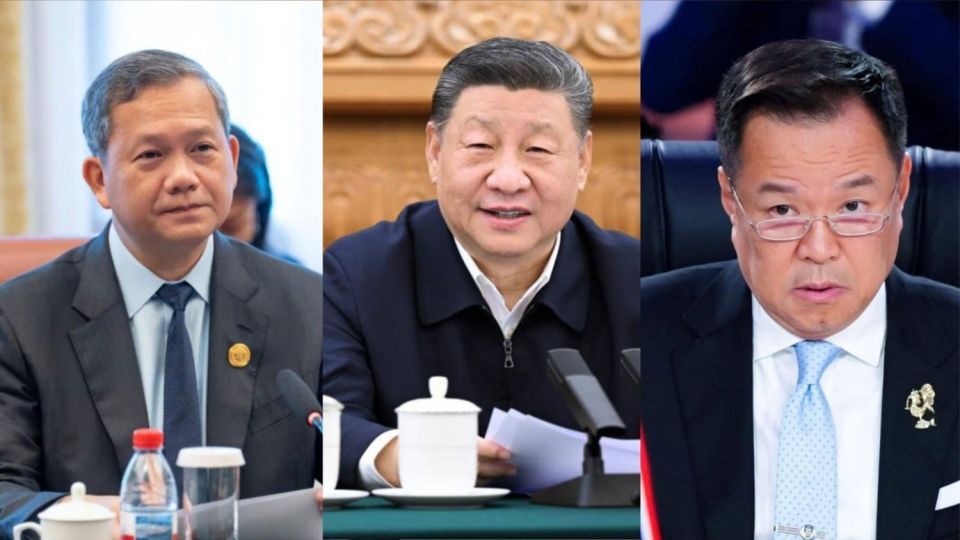
Prime Ministers Hun Manet of Cambodia and Anutin Chanvirakul of Thailand will converge on Shanghai on July 17 for the opening of the World AI Conference 2026, having accepted invitations from Chinese President Xi Jinping. The simultaneous presence of both leaders at a high-profile Chinese event in mid-July has sparked speculation about whether Beijing may leverage the gathering to advance border negotiations between the two Southeast Asian neighbours, who have not engaged in formal talks since December of last year.
The Cambodian contingent, arriving July 15-17, will include Foreign Minister Prak Sokhonn, Defence Minister Tea Seiha, and Sun Chanthol, the first vice-chairman of the Council for the Development of Cambodia. Thailand's delegation will be headed by Anutin alongside Foreign Minister Sihasak Phuangketkeow. Both leaders are scheduled to hold separate meetings with Xi and Chinese Premier Li Qiang, underscoring the diplomatic weight China places on these bilateral relationships and the potential for side conversations on regional matters.
Cambodia's foreign ministry framed the visit as a continuation of deepening ties, highlighting the Comprehensive Strategic Partnership of Cooperation and the Diamond Cooperation Framework between Phnom Penh and Beijing. Official statements emphasised building what Cambodia describes as an "all-weather Cambodia-China Community with a Shared Future in the new era"—language that reflects the strategic importance both nations attach to their relationship. Thailand's ministry similarly stressed strengthening the bilateral partnership for mutual benefit, though official announcements remained notably silent on any planned discussions regarding the border impasse.
The Shanghai gathering carries particular significance given that Hun Manet and Anutin last appeared together publicly at the 3rd ASEAN Future Forum in Hanoi in early June. That encounter, while cordial enough to produce a handshake for photographers, yielded no substantive discussion of the territorial dispute that has festered between their countries. The contrast highlights how regional diplomatic events often serve performative functions rather than solving fundamental disagreements, a pattern that underscores why observers are watching closely to see whether this Shanghai conference might break that cycle.
China's position as a major trading and investment partner to both Cambodia and Thailand positions Beijing uniquely as a potential mediator in disputes where other regional actors have limited leverage. Analysts suggest that Xi and Li Qiang may see an opportunity to use economic and strategic influence to encourage movement on the border question, particularly given the reputational benefit to China of facilitating peace in Southeast Asia. Such mediation would align with Beijing's broader strategy of deepening its role as a diplomatic arbiter in the region.
However, Kin Phea, director of the International Relations Institute at the Royal Academy of Cambodia, has identified a fundamental obstacle that transcends the formal positions of either government. According to Phea, the real impediment is not the civilian political leadership but rather the Thai military establishment, which has consistently failed to honour commitments made by Thailand's civilian administration. Phea contends that the Thai armed forces have pursued unilateral actions, including territorial encroachments, despite their government's ostensible agreement with Cambodia on dispute resolution.
This civil-military divide within Thailand's power structure explains why diplomatic progress has stalled despite formal acknowledgements of the problem. The December 2025 Fuxian Consensus, a China-brokered agreement between the two nations, was supposed to provide a framework for resolution but has languished in implementation. Phea argues that Thailand's military leadership has essentially ignored the civilian government's commitments, allowing ongoing incursions and occupation of Cambodian territory without facing consequences.
Phea has called for China to assume a more robust role as an arbiter, using its considerable influence to ensure both countries return to the negotiating table and implement previously agreed solutions. He emphasises that any resolution must be grounded in international law and pursued through diplomatic channels, which remains feasible if political will can be marshalled. The alternative—continued military posturing and civilian-military disconnect in Thailand—threatens to perpetuate indefinitely a situation that benefits no one and destabilises the broader region.
The human cost of this stalemate remains staggering. Approximately 20,000 Cambodian civilians continue to be displaced from occupied territory, unable to return to their homes and livelihoods. This population represents not merely a statistical casualty of international relations but families separated from ancestral lands and communities fractured by arbitrary lines drawn by colonial history and contemporary military adventurism. For these civilians, diplomatic conferences in Shanghai carry urgent personal significance, even if formal agendas avoid the topic.
Should China choose to activate its diplomatic channels during the Shanghai conference, the most effective approach would likely involve private conversations between Xi and both premiers, coupled with pressure on Thailand's military leadership to accept the implementation mechanisms outlined in the Fuxian Consensus. Such pressure would need to be calibrated to avoid appearing as external interference in Thailand's internal affairs, though the military occupation of Cambodian territory arguably transcends internal matters and becomes a regional concern justifying multilateral engagement.
For Malaysia and other ASEAN members, the Cambodia-Thailand border dispute carries implications beyond bilateral relations. Unresolved territorial disputes encourage militarisation, reduce regional cooperation, and create humanitarian crises that demand international attention. The Shanghai conference may represent an inflection point where patient diplomacy finally yields results, or it may become another episode in a prolonged stalemate. Either way, observers across Southeast Asia will be monitoring whether economic partners like China can successfully translate influence into constructive outcomes.

