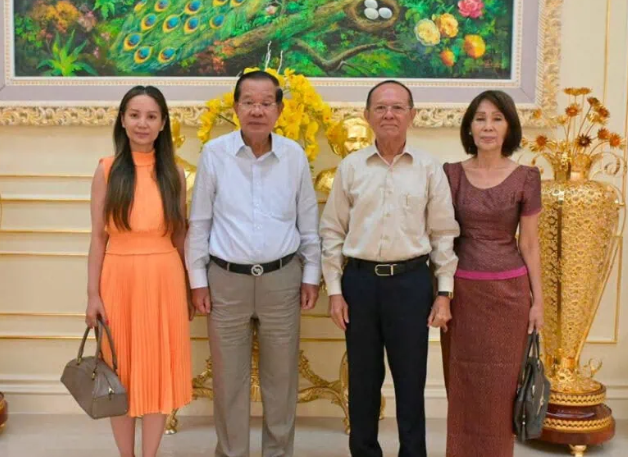
Cambodia's political landscape has undergone a significant shift as Senate President Hun Sen hosted former opposition leader Kem Sokha at his private residence on Sunday morning, marking another chapter in the rehabilitation of a man once positioned as his most formidable rival. The three-hour meeting, which concluded at noon after beginning at 9am, brought together Sokha, his wife and their daughter Kem Monovithya, yet Hun Sen declined to elaborate on the substantive topics addressed during their extended conversation.
The most striking element of Hun Sen's public commentary on the encounter was his effusive praise for Monovithya, whom he described as an "excellent human resource for the nation." His description carried particular weight given the younger woman's deep connections to opposition politics—she had been closely associated with the Cambodia National Rescue Party (CNRP), which her father led before its court-ordered dissolution in 2017. Hun Sen's willingness to publicly commend her suggests a calculated shift in rhetoric towards the Sokha family, though he offered no explicit indication of anticipated roles or positions.
This Sunday meeting represents the continuation of increasingly frequent contact between Hun Sen and Sokha following the former opposition leader's legal rehabilitation. Several weeks prior, according to Hun Sen's social media statement, Sokha had already visited the Prime Minister's residence before embarking on a humanitarian mission to border regions affected by the Cambodia-Thailand conflict. The pattern of escalating engagement indicates deliberate cultivation of dialogue, though both parties have refrained from characterizing these encounters as part of formal reconciliation or political arrangement.
Sokha's journey from political imprisonment to cautious rehabilitation has unfolded through a series of carefully calibrated legal interventions. Convicted in 2023 on controversial treason charges alleging conspiracy with foreign powers and sentenced to 27 years imprisonment, Sokha remained under house arrest and subject to multiple movement restrictions. The Phnom Penh Appeal Court upheld this conviction on April 30, 2026, confirming the lengthy sentence while imposing an additional five-year international travel prohibition. These measures had effectively sidelined the former CNRP co-founder from public and political life.
The trajectory shifted on May 25 when Sokha received a royal pardon that extinguished his remaining prison obligations and terminated house arrest, though prohibitions on political activity persisted. Subsequent developments accelerated his return to public visibility. On July 24, a royal decree lifted the overseas travel restriction that had confined him domestically, removing a significant constraint on his movements. Yet the ban on political participation remained firmly in place, creating an unusual status wherein Sokha could travel and be seen publicly but could not formally engage in party politics.
This legal grey zone enabled Sokha's emergence into public consciousness in a controlled manner. On July 28, just days after the travel restrictions lifted, he visited Banteay Meanchey province to meet families displaced by fighting along the Cambodia-Thailand border. The visit carried symbolic weight—it positioned Sokha as a concerned citizen responding to humanitarian need rather than as a political operative seeking to rebuild his party apparatus. Sokha himself reinforced this framing, explicitly stating he acted as a private individual rather than representing institutional interests, while simultaneously claiming he had brought the suffering of displaced Cambodians to the attention of international contacts.
The historical context renders these recent interactions particularly significant. For nearly two decades, Hun Sen and Sokha occupied deeply antagonistic positions across Cambodia's political divide. When the CNRP emerged as the dominant opposition force, it posed a genuine electoral threat to the ruling Cambodian People's Party's three-decade dominance. The party achieved historic gains in the 2013 national elections and again in 2017 commune-level balloting before the Supreme Court dissolved the organization in November 2017, just two months after security forces arrested Sokha.
Many international observers interpreted the CNRP's dissolution and Sokha's prosecution as politically motivated efforts to eliminate organized opposition. The dissolution decision eliminated the vehicle through which Sokha and his supporters had challenged Hun Sen's authority. Sokha's subsequent conviction appeared to many analysts as a mechanism to prevent his emergence as a political force, rendering the recent reversal of restrictions all the more noteworthy.
The implications of Hun Sen's publicly visible warmth toward the Sokha family extend beyond personal reconciliation. Monovithya, as the daughter of Cambodia's most prominent opposition figure, carries symbolic weight within certain political constituencies. Her positioning as a national resource by Hun Sen could eventually facilitate political rehabilitation for the Sokha family more broadly, or it could represent a strategic effort to co-opt opposition sentiment by demonstrating openness toward previously marginalized figures. The ambiguity itself proves instructive—both sides appear to be testing the boundaries of renewed engagement without committing to formal political realignment.
For regional observers monitoring Cambodia's democratic trajectory, these developments warrant careful attention. The gradual easing of restrictions on Sokha, the public nature of Hun Sen's meetings with him, and the specific praise for Monovithya suggest that Cambodia's leadership recognizes that absolute suppression of opposition figures may carry international reputational costs. Yet the persistence of restrictions on political activity, combined with the absence of formal announcements about reconciliation or institutional roles, indicates that Hun Sen maintains firm control over the pace and scope of any political rehabilitation.
Neither Hun Sen nor Sokha has publicly disclosed the content of their conversations, leaving analysts to speculate about potential pathways forward. The meetings could represent a prelude to expanded political participation for Sokha, or they might constitute mere acknowledgment of changed circumstances without substantive political restructuring. The silence itself carries meaning—it suggests that while both figures have determined mutual engagement serves their interests, they have not yet reached clarity or consensus on transformative political arrangements.
The situation reflects broader Southeast Asian patterns wherein long-standing political rivalries occasionally give way to accommodation without necessarily producing democratic liberalization. Cambodia remains a one-party dominant state, and Hun Sen's demonstrated willingness to meet Sokha does not necessarily indicate commitment to genuine political pluralism. However, the visible warming of relations between the former adversaries, combined with modest legal concessions, suggests that Cambodia's political establishment has concluded that some degree of managed opposition presence serves its interests more effectively than complete exclusion. How this calculus ultimately shapes Cambodia's political future remains uncertain.

