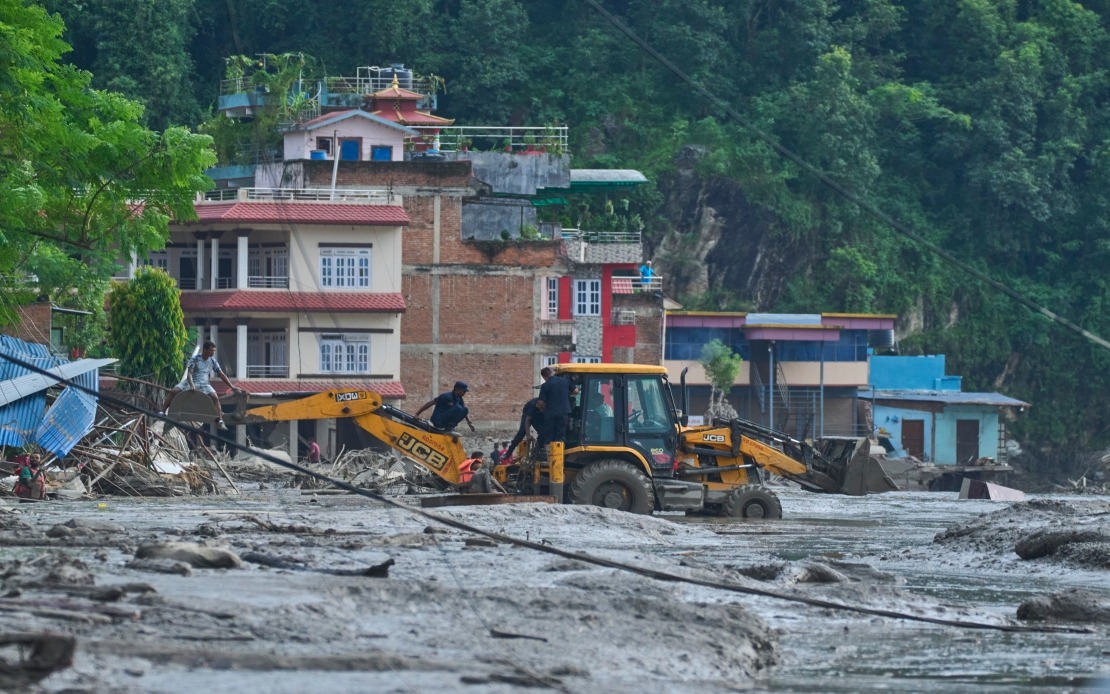
The death toll from devastating flash floods and catastrophic mudslides that struck the Nepal-China border region has reached 160, with more than 680 people reported missing across both nations. The disaster, which unfolded on Wednesday, represents one of the most severe natural calamities to impact the geographically sensitive border area in recent years, triggering coordinated international emergency responses and raising concerns about the vulnerability of the region's infrastructure and transient populations.
Nepalese authorities reported that rescue teams have recovered 157 bodies so far, while managing to extract 54 survivors from the devastated zones. The figures underscore the scale of the emergency, with the Nepalese Prime Minister's Office documenting that among those unaccounted for are 44 army personnel, 28 police officers, 13 armed police personnel, and 60 civilian employees engaged in hydropower project construction. The missing list also includes 484 tourists and travellers, comprising 391 foreign nationals and 93 Nepali citizens, reflecting the region's significance as a crucial transit corridor and trekking destination.
Chinese state authorities separately confirmed three deaths and 265 missing persons in the Xizang Autonomous Region, formerly known as Tibet. The disaster struck near Gyirong Port, a major bilateral border crossing in southwest China's Xigaze City. The mudslide at this strategic location severed road access on the Chinese side and crippled communications and electrical infrastructure, according to reports from Xinhua News Agency citing Gyirong County emergency management officials. Chinese President Xi Jinping issued directives for all-out rescue efforts and instructed authorities to evacuate at-risk residents and provide immediate medical care to minimise further casualties.
The scale of infrastructure damage reveals how thoroughly the disaster ravaged the border region's physical foundations. Nepalese government assessments documented the destruction of at least 19 bridges, damage to 40 kilometres of roadway, and compromised functionality of 13 hydropower projects. Nepal's Foreign Minister Sishir Khanal told parliament that the floods effectively obliterated numerous hydropower facilities, government offices, and transportation infrastructure across the Rasuwa, Dhading, and Chitwan districts. The destruction of hydropower installations carries particular significance for Nepal's energy sector and development aspirations, as these projects represent crucial investments in the nation's electricity generation capacity.
The international dimension of this catastrophe extends across multiple continents. Among those reported missing are nationals from Nepal, India, the United Kingdom, South Africa, Malaysia, Australia, and the Netherlands, with many additional nationalities yet to be confirmed. South Korea's Foreign Ministry reported that eight nationals were unaccounted for, while another ten South Korean travellers remained stranded in the flood zone. The geographic diversity of those affected underscores how border regions hosting popular tourist routes become international flashpoints when natural disasters strike, with ripple effects across multiple national governments and diplomatic channels.
The Rasuwagadhi area, where the disaster originated, holds particular prominence in regional tourism networks. It serves as a primary gateway for trekkers accessing the Langtang region, one of Nepal's most celebrated trekking circuits, and functions as the main transit point for adventurers and pilgrims journeying toward China's sacred Mount Kailash and Lake Mansarovar. The disaster therefore disrupted not merely local communities but an entire ecosystem of tourism-dependent businesses, religious pilgrimage routes, and international travel networks that have grown increasingly interdependent over recent decades.
Rescue operations unfolded across both sides of the border with substantial commitment of resources and personnel. Nepalese rescue teams deployed from the Nepal Police, Armed Police, and Nepal Army arrived at affected areas equipped with helicopters, drones, and rafting equipment. Chinese authorities similarly mobilised forces for search and rescue operations across the Xizang region. The coordination of such operations across a sensitive international border presents logistical and diplomatic complexities that both nations navigated during the emergency response phase.
The humanitarian response reflected broader regional patterns of diplomatic cooperation and mutual assistance. Indian Prime Minister Narendra Modi personally contacted his Nepalese counterpart Balendra Shah, conveying condolences and pledging comprehensive support. India dispatched ten tonnes of humanitarian assistance encompassing disaster relief supplies and essential medicines to bolster Nepal's emergency response capacity. Additionally, officials in Bihar state, India's eastern frontier region adjacent to Nepal, implemented precautionary measures including round-the-clock embankment monitoring and intensive night patrols across sensitive districts, anticipating potential secondary flooding as water systems settled.
Nepal's capital city, Kathmandu, mobilised its medical infrastructure to accommodate the injured. Government-run hospitals and medical facilities operated by security agencies were cleared to receive and treat disaster victims, indicating the nationwide scale of the emergency response. The coordination of hospital facilities across multiple agencies reflected the severity of medical demands generated by the disaster.
The Nepal-China border tragedy exposes the vulnerability of developing nations' infrastructure to catastrophic natural events, particularly where hydropower development, tourism operations, and cross-border commerce concentrate in geographically fragile zones. For Malaysia and other Southeast Asian nations with similar geographic and developmental profiles, the incident underscores the necessity for enhanced early warning systems, resilient infrastructure design, and robust regional disaster response protocols. The disaster demonstrates how border regions, despite their strategic and economic importance, often remain inadequately prepared for extreme weather events amplified by climate variability and terrain susceptibility.

