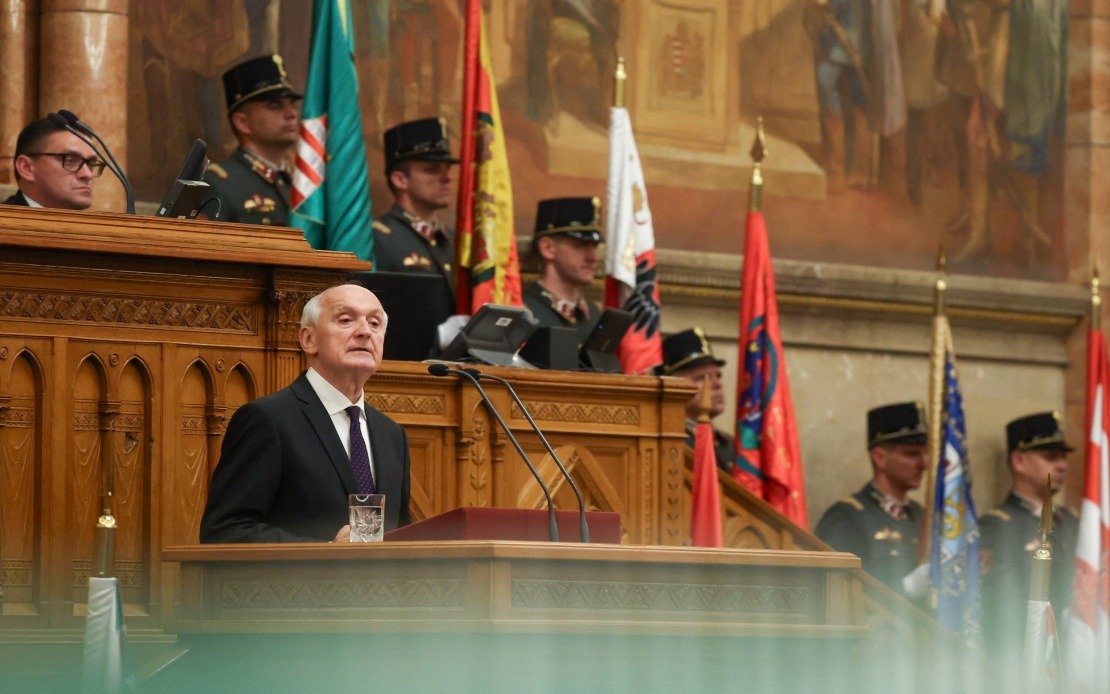
Andras Baka officially became President of Hungary on August 19, 2026, after being elected by the national Parliament on August 11. Prime Minister Peter Magyar announced the transition on social media, offering congratulations to the incoming head of state and expressing hopes that Baka would bring humanism to the office. The ceremonial assumption of power marks a significant moment in Hungarian politics, particularly given the contentious circumstances surrounding the election process and the absence of major opposition movements at the swearing-in.
Baka's career trajectory reveals a judge deeply entangled in Hungary's turbulent constitutional politics over the past two decades. He first led the Supreme Court of Hungary from 2009 to 2011, a relatively brief tenure that ended when he resigned in protest against sweeping judicial reforms introduced under then-Prime Minister Viktor Orban's government. Rather than fade from public view, Baka pivoted toward international judicial work, securing a position at the European Court of Human Rights in Strasbourg, where he gained experience in international human rights law and cross-border legal disputes.
Following the 2011 Supreme Court restructuring, the Hungarian government created the Curia as a replacement institution. Baka returned to lead this new body, serving as chairman from 2012 until 2020. This decade-long period encompassed some of Hungary's most contentious political moments, including ongoing disputes over judicial independence and the rule of law with European Union institutions. As head of the Curia during these years, Baka navigated an increasingly fraught environment where judicial matters became inseparable from broader political conflicts between the government and international oversight bodies.
The pathway to Baka's presidency was itself marked by constitutional controversy. The previous president, Tamas Szujok, was removed through constitutional amendments, a procedure that raised significant questions about the precedent being set for executive transitions in Hungary. Rather than occurring through the standard electoral process that might draw broad consensus, the removal represented a more forceful exercise of parliamentary power. This backdrop helps explain the heated political atmosphere surrounding the subsequent presidential election.
Opposition parties took the dramatic step of boycotting the presidential election entirely. Two major opposition movements—Fidesz and the Christian Democratic People's Party—refused to participate, using their absence as a protest mechanism against what they viewed as an illegitimate removal of the previous president. The boycott signals deep divisions within Hungarian politics and suggests that opposition groups viewed the constitutional amendments used to remove Szujok as setting a dangerous precedent that undermines normal democratic procedures.
For Malaysian observers and Southeast Asian political watchers, Hungary's institutional struggles offer instructive parallels worth examining. The Hungarian situation exemplifies how judicial independence can become a flashpoint in polarized democracies, with governments seeking to reshape courts through constitutional means while international bodies like the European Union raise concerns about democratic standards. The cycle of constitutional amendment, institutional restructuring, and presidential transitions driven by parliamentary supermajorities rather than consensus reflects broader patterns seen across different regions when political competition becomes adversarial.
Baka's background as both a domestic jurist and international human rights lawyer suggests he may attempt to navigate these tensions. His previous work at the Strasbourg court indicates familiarity with European legal standards and international human rights frameworks, even as his earlier resignation over Supreme Court reform shows he is not merely a pliant instrument of governmental judicial policy. His presidency will likely test whether he can maintain independence while operating within a political system where the executive and legislative branches have demonstrated willingness to reshape institutions through constitutional means.
The boycott by opposition parties reflects their fundamental objection not merely to Baka personally, but to the entire process through which the previous president was removed and a successor selected. This distinction matters because it indicates the opposition views the problem as systemic—concerning the rules by which leadership transitions occur—rather than purely about individual personalities. When major political movements refuse to participate in constitutional procedures, it suggests severe erosion of shared democratic norms and procedures.
For Hungary's relationship with the European Union, Baka's presidency carries implications given his international legal background and the EU's ongoing scrutiny of Hungarian judicial reforms and democratic standards. His European Court of Human Rights experience means he understands the expectations of international human rights bodies. Whether his presidency will ease tensions between Budapest and Brussels, or whether he will become another figure caught between competing institutional pressures, remains to be seen.
The broader context of Hungarian politics suggests that appointing a jurist with international credentials to the presidency may represent an attempt to restore some international legitimacy to Hungarian governance after years of tensions with EU institutions over judicial independence and the rule of law. At the same time, Baka's history of cooperation with post-reform Hungarian judicial structures means his presidency is unlikely to represent a fundamental rupture with the government's previous institutional choices.

