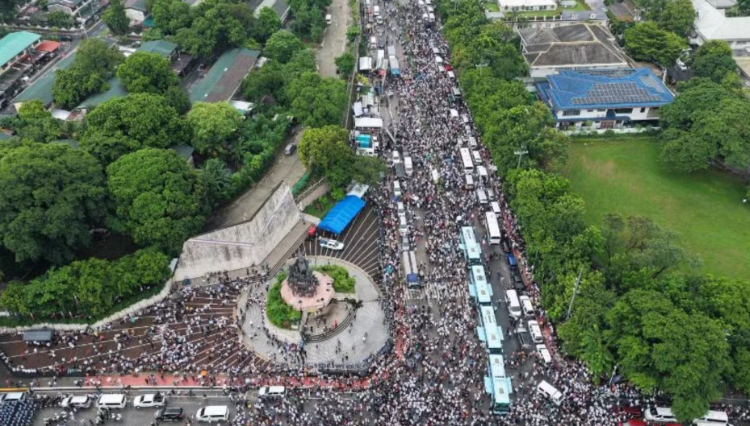
The Iglesia Ni Cristo, one of the Philippines' most influential religious organizations, demonstrated its considerable organizational muscle on Tuesday by bringing thousands of members onto Manila's arterial EDSA highway in a show of solidarity with Senator Rodante Marcoleta, who faces imminent arrest on graft-related charges. The massive congregation grinding traffic to a standstill across multiple kilometres illustrated the church's enduring capacity to mobilize its devotees at short notice, a capability that has long positioned it as a significant political player in Philippine electoral dynamics and governance.
Marcoleta, a senator and devoted INC member, stands accused of failing to declare 75 million pesos in unused election campaign contributions, according to an announcement by Government Ombudsman Jesus Remulla. The undisclosed funds represent a substantial sum equivalent to approximately 1.2 million US dollars, raising questions about campaign finance transparency and accountability mechanisms in the Philippine electoral system. The timing of the charges carries particular significance given the broader political turbulence engulfing the country's leadership.
The senator's position within the Senate carries outsized importance beyond his individual circumstances. Political analysts widely regard Marcoleta as virtually assured to vote against convicting Vice President Sara Duterte during her impeachment trial, scheduled to commence on July 6. With conviction requiring 16 affirmative votes from the 24-seat Senate, Marcoleta's loyalty to the Duterte political dynasty represents a crucial buffer against removal. His potential incarceration could shift the mathematical calculus of Duterte's trial, introducing uncertainty into calculations that have so far assumed his steadfast opposition to conviction.
The INC's mobilization reflects a broader pattern of the church positioning itself as a political protagonist rather than a neutral religious institution. Edwil Zabala, the church's official spokesman, framed the protest as a defense of justice itself, declaring that supporters would not cease demanding accountability even should Marcoleta face imprisonment. The rhetoric strategically recast the senator's predicament as symptomatic of selective justice, a framing designed to appeal to the church's membership and galvanize their sense of collective grievance against state institutions perceived as operating according to political rather than juridical considerations.
Regional police spokeswoman Hazel Asilo confirmed that the gathering had reached approximately 8,000 participants by mid-morning, with expectations of continued growth throughout the day. The protest's impact on Manila's transportation infrastructure proved immediate and severe, with only dedicated bus lanes remaining passable during rush hour, affecting countless commuters attempting to navigate the capital for employment and education. The disruption underscored the INC's willingness to impose tangible costs on the general public as a demonstration of political commitment and organizational capacity.
The Duterte political dynasty's relationship with the INC represents a long-standing and mutually beneficial alliance. The church's ability to deliver bloc voting support has historically been crucial to Duterte family electoral successes, while the family's political power has provided the INC with protective influence and institutional access. This symbiotic arrangement has deepened over decades, creating institutional interdependencies that extend beyond conventional patronage politics into questions of core governance and institutional legitimacy.
Marcoleta's predicament exists within a broader crisis affecting the Duterte political ecosystem. Senator Jose "Jinggoy" Estrada, another prominent Duterte loyalist, faces charges related to a monumental corruption scandal involving fraudulent flood control projects that generated substantial public outrage. Meanwhile, Senator Ronald "Bato" Dela Rosa has evaded arrest on an International Criminal Court warrant stemming from his alleged involvement in the drug war operations conducted under Rodrigo Duterte's presidency. These overlapping crises suggest a systemic vulnerability within the Duterte political movement, as its senior figures confront legal jeopardy on multiple fronts.
The INC's previous mobilization efforts demonstrate a pattern of escalating political engagement. In November, the church organized a massive rally, estimated to attract hundreds of thousands, demanding accountability regarding the flood control scandal that implicated multiple officials and lawmakers. That gathering directed substantial blame toward President Ferdinand Marcos, illustrating the church's capacity to orchestrate large-scale political messaging. Subsequently, in January 2025, the INC organized another significant Manila rally opposing Duterte's impeachment, a gesture that preceded but failed to prevent the House of Representatives from impeaching her last month.
The constitutional framework governing Duterte's trial imposes exacting thresholds for conviction. A supermajority of 16 senators among the 24-member chamber must vote to remove her from office and impose permanent electoral disqualification. This elevated requirement means that conviction demands substantial crossover support from senators not automatically aligned with the Duterte political movement. Marcoleta's near-certain opposition, combined with other anticipated Duterte loyalists, establishes a formidable barrier that prosecutors must surmount through either winning defections or preventing absences.
President Ferdinand Marcos' decision to cancel a scheduled luncheon with foreign press representatives on Tuesday to monitor the INC protest situation indicated official concern regarding the event's trajectory and potential implications. The cancellation signaled the administration's assessment that the situation warranted executive-level attention despite the president's historical conflicts with the Duterte family. The choice reflected the perceived stakes attached to street-level mobilization and its potential influence on elite political calculations regarding the vice president's trial.
The theological and organizational identity of the Iglesia Ni Cristo complicates straightforward characterization of these mobilizations as purely political phenomena. The church's members experience their participation as expressions of religious conviction and loyalty to faith leadership, not merely tactical contributions to factional political struggles. This fusion of religious conviction with political activism provides the INC with exceptional motivational resources and legitimizing rhetoric, enabling mobilizations that secular political organizations would find considerably more difficult to achieve.
Looking ahead, the convergence of Marcoleta's legal jeopardy and Duterte's impeachment trial creates potential pressure points within the Duterte coalition that may shape institutional outcomes with implications extending well beyond the immediate personalities involved. The INC's demonstrated capacity to mobilize thousands at short notice suggests that religious institutional power remains a formidable element of Philippine political economy, capable of imposing costs and shaping perceptions among both elites and publics engaged in consequential governance questions.

