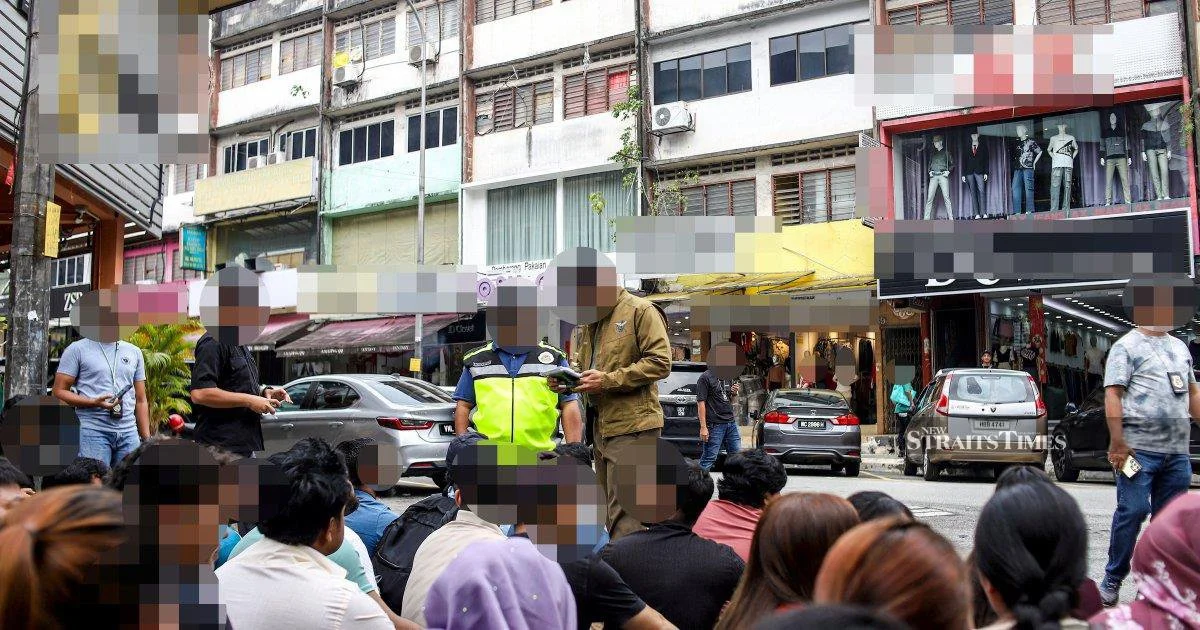
A significant immigration enforcement action unfolded across Jalan Kenanga's bustling wholesale clothing marketplace today, culminating in the detention of 111 individuals lacking proper documentation. The coordinated operation by immigration authorities targeted the sprawling commercial hub, reflecting persistent pressures within Malaysia's informal labour sector where undocumented workers continue to concentrate in substantial numbers.
Jalan Kenanga has long functioned as a major distribution centre for wholesale garments throughout the region, characterised by multiple levels of commercial activity ranging from small family-run operations to larger trading houses. The concentration of retail and distribution businesses in this area has historically drawn migrant workers seeking employment opportunities, with many lacking the requisite work permits and entry credentials. Immigration authorities have conducted periodic enforcement sweeps in comparable commercial districts, yet the scale of today's operation underscores the magnitude of irregular migration persisting within Malaysia's urban commercial zones.
The arrest of over 100 individuals in a single operation signals the depth of undocumented migration networks operating within Malaysia's labour market. Many undocumented workers cluster in wholesale and retail sectors where documentation requirements are often inadequately monitored, creating vulnerabilities both for workers and for business operators who may face significant legal consequences for non-compliance. The Jalan Kenanga sector represents a microcosm of broader employment patterns across Southeast Asia, where labour shortages coexist with irregular migration flows.
Malaysia's immigration enforcement challenges reflect regional dynamics affecting multiple Southeast Asian nations. The country experiences significant cross-border migration from neighbouring countries including Bangladesh, Myanmar, Indonesia, and Laos, where economic disparities and employment opportunities create powerful pull factors. Many migrants traverse into Malaysia through informal channels, subsequently entering labour markets where verification mechanisms remain inconsistent and enforcement capacity is stretched across vast operational areas.
The apprehensions at Jalan Kenanga coincide with broader government initiatives addressing irregular migration, though effective implementation remains complicated by resource constraints and the sheer scale of unauthorized worker populations. Estimates suggest hundreds of thousands of undocumented individuals remain in Malaysia, distributed across agriculture, manufacturing, construction, domestic service, and retail sectors. Each enforcement operation addresses only a fraction of this larger phenomenon, raising questions about sustainable solutions to irregular migration management.
For business operators in wholesale districts, the regulatory environment presents genuine complexity. Legitimate employers must navigate stringent employment verification requirements, yet entire segments of Malaysia's informal economy operate with minimal documentary oversight. The raid's timing and scope may prompt renewed scrutiny of workplace compliance within the Jalan Kenanga cluster, potentially affecting business operations and labour availability across the wholesale clothing ecosystem.
Immigration authorities have intensified operations following policy directives emphasizing improved border security and workplace enforcement. These coordinated sweeps generate headlines and demonstrate commitment to immigration control, yet they simultaneously reflect the limitation of enforcement-centric approaches when structural factors driving irregular migration remain unaddressed. Economic disparities between Malaysia and source countries, alongside persistent labour demand in low-wage sectors, continue creating conditions where undocumented migration remains economically rational despite enforcement risks.
The detained individuals face processing through Malaysia's immigration system, which includes detention, investigation, and ultimately deportation in most cases. However, the repatriation process itself carries logistical challenges, particularly when individuals cannot readily establish citizenship credentials or when diplomatic relationships with source countries complicate return procedures. This backlog creates secondary issues including overcrowded detention facilities and administrative burden on enforcement agencies.
For Malaysian consumers and the broader retail sector, the implications of such enforcement operations remain ambiguous. While ensuring workplace compliance protects local workers from unfair competition and protects vulnerable migrants from exploitation, disruptions to wholesale operations can momentarily affect supply chains and pricing. The long-term sustainability of Malaysia's retail and distribution networks depends partly on addressing labour shortages through either increased mechanical automation, improved wages attracting legal workers, or reformed migration pathways offering regulated access to needed migrant labour.
The Jalan Kenanga operation demonstrates that immigration enforcement remains an active government priority, yet single enforcement actions address symptoms rather than underlying causes of irregular migration. Regional solutions coordinating with source countries, addressing labour market imbalances, and potentially establishing expanded legal migration pathways might achieve more systematic impact than periodic raids. Until such broader approaches complement enforcement activities, Malaysia's commercial districts will likely continue hosting undocumented worker populations despite periodic enforcement interventions.

