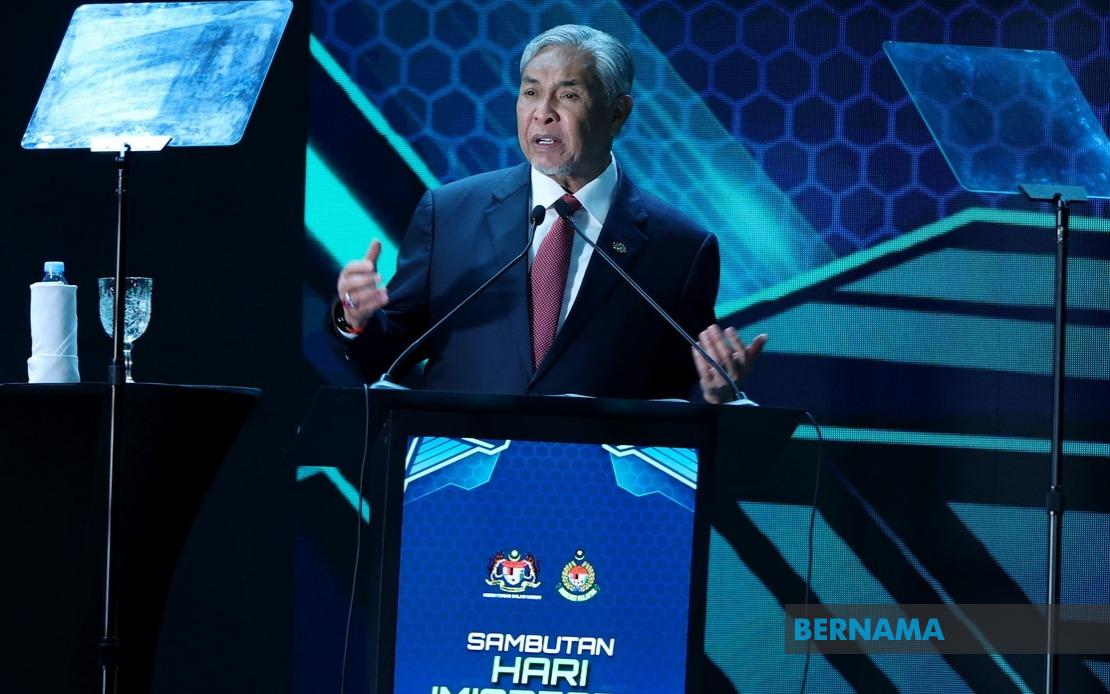
Deputy Prime Minister Datuk Seri Dr Ahmad Zahid Hamidi has thrown his weight behind efforts to reform the Immigration Officer Service Scheme, emphasising that personnel within the department warrant institutional recognition commensurate with their contributions to Malaysia's governance and financial standing. Speaking at the 2026 Immigration Day celebration in Cyberjaya, he endorsed proposals first raised by Home Minister Datuk Seri Saifuddin Nasution Ismail to enhance career structures and expand advancement pathways for immigration staff.
The DPM's statement represents a significant show of support from the country's second-highest office, signalling that the matter has gained traction within the federal administration's leadership circles. Ahmad Zahid specifically urged two key government figures—Chief Secretary to the Government Tan Sri Shamsul Azri Abu Bakar and Public Service director-general Tan Sri Wan Ahmad Dahlan Abdul Aziz—to treat the proposal with appropriate gravity and give it thorough examination during their ongoing policy deliberations.
Central to Ahmad Zahid's argument is the economic dimension of the Immigration Department's operations. By categorising it as Malaysia's third-largest revenue-generating agency, the DPM placed the discussion squarely within fiscal and budgetary frameworks that resonate with Treasury and cabinet priorities. This framing shifts the conversation beyond pure operational necessity or humanitarian concern, anchoring instead the proposition that compensation and career development structures should reflect the department's substantial contribution to state coffers.
The restructuring of strategic posts mentioned in both ministers' statements points to bottlenecks that have likely developed within the immigration service hierarchy. Malaysian civil service ranks have historically faced rigidity in advancement protocols, with limited routes for talented mid-career officers to progress into senior decision-making positions. A formal restructuring would presumably create fresh pathways, reduce congestion at promotional bottlenecks, and enable faster movement of competent personnel into leadership roles where their experience could be leveraged more effectively.
For frontline immigration officers stationed at airports, land borders, and maritime entry points across Malaysia and Southeast Asia, the scheme reform carries material implications. Service scheme conditions typically encompass salary scales, allowance structures, leave entitlements, and pension arrangements. The Home Minister's call for enhancement suggests current provisions may have fallen behind comparable departments or regional counterparts, potentially contributing to retention challenges or morale concerns within the workforce.
Ahmad Zahid's remarks on integrity and avoiding controversy reflected concern about the reputational risks facing any organisation handling sovereignty and border control. Immigration posts have historically attracted scrutiny regarding corruption and malpractice, given the financial incentives present at checkpoints where passengers, travellers, and goods must be processed. By coupling the service scheme reform with explicit calls for ethical conduct, the DPM underscored that institutional improvements must be accompanied by uncompromising standards of personal and professional rectitude among officers.
The reference to immigration personnel as "the nation's frontline guardians" and "the first line of defence protecting the country's sovereignty" reflects the broader geopolitical context in which Malaysian immigration operations function. Beyond routine passenger processing, the department must detect security threats, prevent human trafficking, interdict contraband, enforce visa compliance, and manage irregular migration flows—responsibilities that have grown more complex as transnational criminal networks and irregular migration routes have become more sophisticated throughout Southeast Asia and the Indian Ocean region.
The timing of this emphasis during the 2026 Immigration Day celebration was deliberate. Such annual observances serve as platforms for government messaging, morale-building, and recognition of institutional contributions. By positioning the service scheme reform as a priority during this event, both the Home Ministry and the Office of the Deputy Prime Minister signalled their intent to proceed with concrete action rather than treat the matter as rhetorical flourish.
For Malaysian civil servants more broadly, Ahmad Zahid's statement carries implications regarding whether the government intends to undertake wider public sector remuneration reviews. Immigration officers represent one constituency among numerous government agencies performing critical functions—defence, internal security, customs, tax administration—whose personnel might reasonably expect similar treatment. Any significant enhancement to the Immigration Officer Service Scheme could therefore establish precedent or pressure for comparable improvements across other frontline departments.
The mechanism for progressing these recommendations remains institutional in character. With the Chief Secretary and Public Service director-general now explicitly tasked with consideration of the Home Minister's proposal and the Deputy Prime Minister's backing, the proposal enters formal government machinery for evaluation. These officials would typically examine fiscal implications, comparative salary benchmarking, career progression modelling, and budgetary feasibility before advancing recommendations to cabinet or the Public Service Commission.
For Southeast Asian regional context, Malaysia's positioning of immigration as a revenue-generating function reflects the broader movement across the region towards treating border management as both security and commercial operations. Countries from Thailand to the Philippines have similarly sought to professionalise immigration services and improve compensation structures as migration pressures and tourism flows have intensified, making immigration efficiency increasingly relevant to national competitive positioning.
The implementation timeline remains unclear, but the convergence of statements from both the Home Ministry and the Deputy Prime Minister's office suggests the initiative has gained sufficient momentum to progress beyond preliminary discussion stages. Whether reforms materialise within the current budget cycle or extend into subsequent fiscal years will depend on funding availability and competing budgetary priorities across government departments.

