India faces a critical juncture in its educational credibility as 2.2 million aspiring medical students sit for a retaken entrance examination on Sunday, June 21, under extraordinary security measures. The retest represents a desperate attempt to restore confidence in the country's most competitive gateway exam—the National Eligibility cum Entrance Test—after the previous administration collapsed under the weight of a massive paper leak scandal that exposed vulnerabilities across India's testing apparatus and ignited fierce youth backlash.
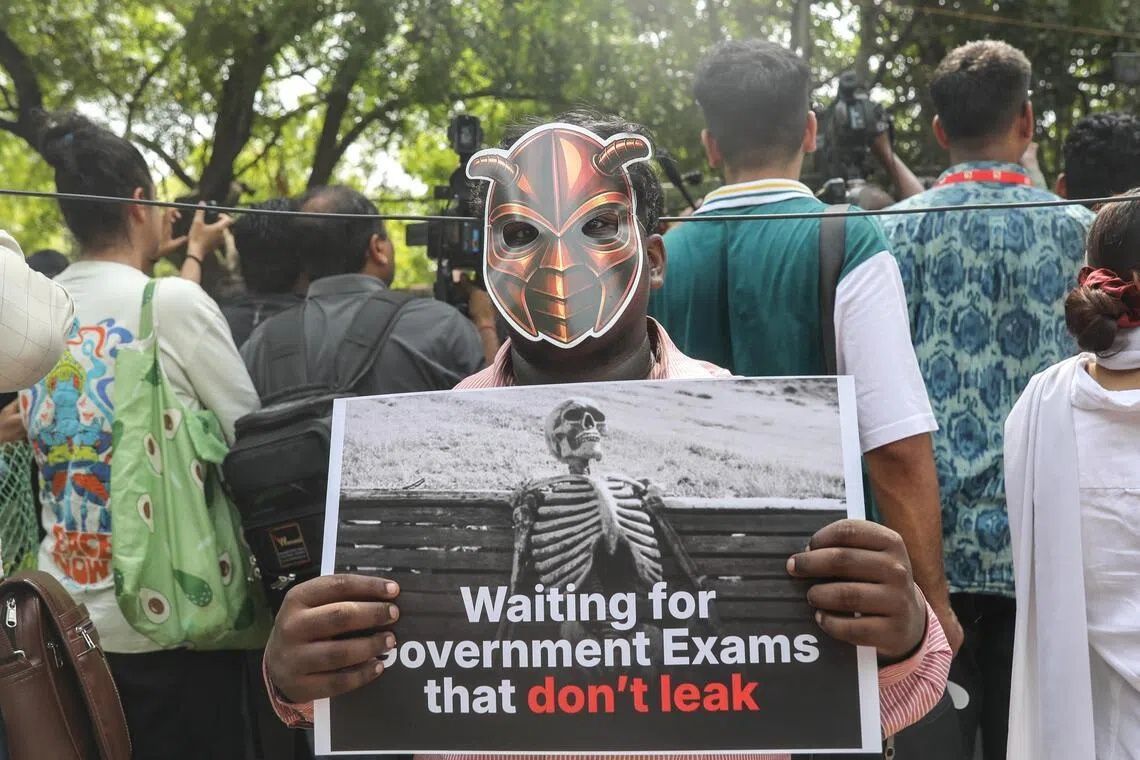
The original examination, conducted in May, was scrapped entirely following the disclosure that question papers had been leaked, prompting widespread anger among students, parents, and the public. The incident triggered a cascade of crises that extended far beyond the medical entrance test itself. Indian media reported that the shame and stress associated with the compromised exam drove some teenagers to suicide, transforming what began as an examination failure into a national tragedy that demanded urgent accountability.
The fallout intensified because India's medical entrance examination represents far more than a routine academic hurdle. With only slightly more than 100,000 undergraduate seats available annually, the competition attracts millions of candidates whose futures hinge on a single test performance. This extreme scarcity has created enormous pressure on students and their families, particularly in a society where medical degrees command extraordinary social prestige and financial security. The stakes explain the ferocity of public reaction when the examination's integrity was compromised.
Authenticity concerns were compounded by a parallel scandal affecting nearly two million high school students, who discovered that an online marking system had either assigned incorrect grades or attributed results to the wrong individuals. These dual failures in the national testing infrastructure suggested systemic breakdown rather than isolated incident, feeding suspicion that poor governance and inadequate oversight had become entrenched within India's examination apparatus. The cumulative effect was explosive: students and parents who had invested months in preparation and paid substantial fees found themselves victimised by institutional negligence.
The backlash quickly assumed political dimensions. Education Minister Dharmendra Pradhan became the focal point of youth anger, with widespread demands for his resignation echoing across social media and at street protests. The unrest proved potent enough to give rise to an unusual phenomenon—a satirical political movement called the "Cockroach People's Party" that, since its launch in May, has attracted millions of followers and leveraged dark humour to channel public frustration into organised dissent against government dysfunction.
Investigations revealed that the leak was not accidental but orchestrated by criminal networks exploiting insider connections. The Central Bureau of Investigation arrested the alleged mastermind, identified as a chemistry lecturer, exposing how educational institutions remain vulnerable to corruption by employees willing to monetise their access to confidential materials. Authorities subsequently identified that messaging platforms, particularly Telegram, had been weaponised by cheating syndicates to distribute leaked questions and coordinate fraud schemes targeting candidates desperate for any advantage.
Recognising the severity of the crisis and the imperative to restore institutional credibility, Indian authorities have mobilised unprecedented security apparatus for Sunday's retest. The National Testing Agency has deployed more than 200,000 officials, including armed police personnel, to oversee examination centres nationwide. This deployment represents one of the largest security operations ever mounted for an academic exercise in India, underscoring the seriousness with which the government now treats examination integrity.
Technological safeguards form the backbone of the new security framework. The retesting protocol incorporates biometric authentication to prevent impersonation and verify that only registered candidates access examination centres. AI-enabled camera surveillance systems monitor examination halls in real-time to detect suspicious behaviour and document proceedings comprehensively. GPS tracking of question papers provides a digital chain-of-custody that records the physical movement of test materials from printing facilities through distribution to examination rooms, enabling authorities to pinpoint any unauthorised access or diversion of documents.
Government authorities have also taken the extraordinary step of restricting access to the Telegram messaging application during the examination period. This represents a direct intervention in digital communication networks, reflecting official determination to eliminate the communication channels through which cheating syndicates previously coordinated their operations. However, Pavel Durov, the platform's founder, publicly questioned whether such restrictions would prove effective, arguing that organised cheating networks would simply migrate to alternative messaging applications. He contended that the fundamental problem was institutional—the existence of insiders willing to leak exam materials—rather than a technical issue amenable to platform restriction.
The retest is scheduled to commence at 2 p.m. local time on Sunday, with examination centres positioned across India to accommodate the millions of registered candidates. The compressed timeline for implementing enhanced security measures has required extraordinary logistical coordination, as authorities work to distribute updated protocols, train proctoring staff, and establish technological infrastructure at thousands of examination venues simultaneously. This operational challenge occurs against a backdrop of deep public scepticism about governmental capacity to execute complex tasks competently.
For Malaysian and Southeast Asian readers, the Indian examination crisis offers instructive lessons about vulnerabilities that may exist within regional educational systems. As nations across Asia increasingly rely on centralised entrance examinations to allocate scarce university places, the mechanisms securing these tests merit careful scrutiny. The Indian case demonstrates how inadequate oversight of printing facilities, insufficient vetting of personnel with access to sensitive materials, and reliance on insecure communication platforms can facilitate systemic fraud at massive scale.
The broader implications extend to questions about institutional resilience and public trust. When examination systems collapse, the damage transcends academic concerns to strike at fundamental fairness and opportunity allocation. India's response—deploying overwhelming security, investing in technological safeguards, and committing substantial resources to retest administration—reflects recognition that restoring credibility requires extraordinary, visible demonstration of commitment to accountability and integrity.