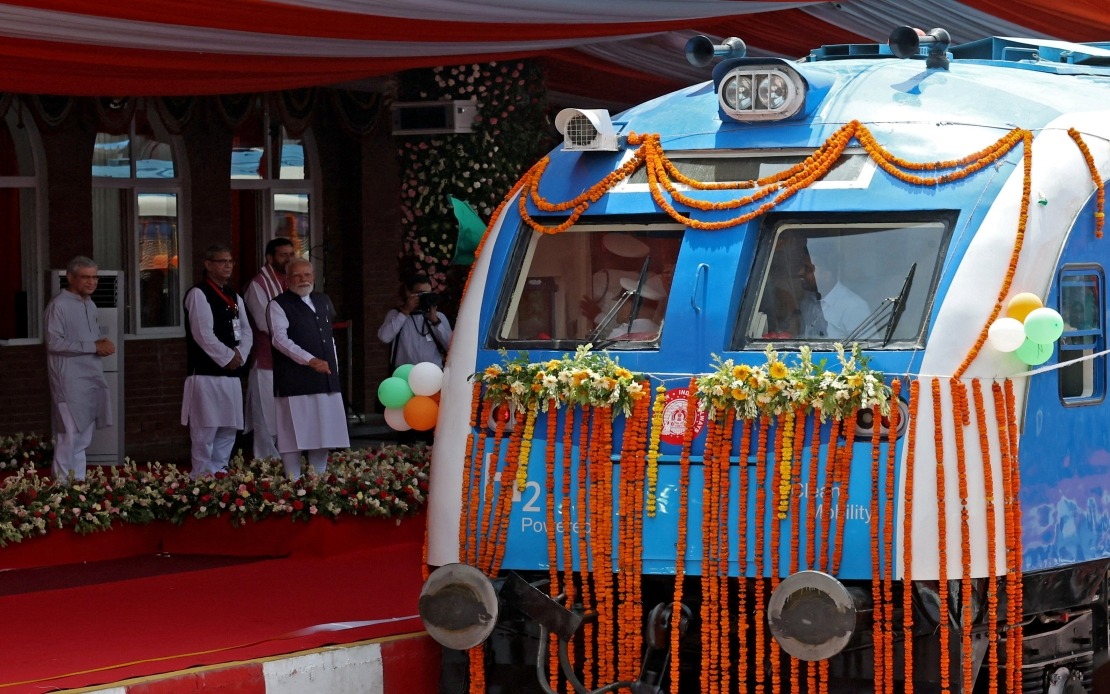
India has taken a significant step towards sustainable railway transport with the inauguration of its first hydrogen-powered train by Prime Minister Narendra Modi on Friday. The 10-coach train will operate along the 89-kilometre corridor connecting Jind and Sonipat in Haryana, one of India's most industrialised states. This milestone positions India alongside an exclusive group of technologically advanced nations already operating hydrogen trains, including China, Germany, Japan, and the United States. The development signals New Delhi's commitment to decarbonising its massive railway network, which carries over a billion passengers annually across the subcontinent.
The hydrogen fuel cell technology deployed represents a watershed moment for indigenous Indian engineering capabilities in the clean energy sector. Rather than relying on imported systems, Indian engineers have developed this hydrogen propulsion technology domestically, reducing dependence on foreign expertise and strengthening the nation's technical self-sufficiency. The system operates through a sophisticated Proton Exchange Membrane Fuel Cell (PEMFC) mechanism with a capacity of 1,200 kilowatts, which generates electricity through a chemical reaction between hydrogen and oxygen. This engineering achievement demonstrates that India possesses the intellectual capacity to innovate in frontier technologies critical to its sustainable development agenda.
The environmental credentials of this train are remarkable. Unlike conventional diesel locomotives that emit greenhouse gases and particulate matter, hydrogen fuel cells produce only water vapour and heat as byproducts. This means the train operates with virtually zero harmful emissions, addressing one of India's pressing air quality challenges, particularly in industrial regions like Haryana. For a nation grappling with severe air pollution in its northern regions, transitioning rail transport away from diesel represents a tangible opportunity to improve public health outcomes while simultaneously reducing carbon dioxide contributions to global warming.
Operationally, the train has been certified to run at maximum speeds of 75 kilometres per hour, though its design capacity reaches 110 kilometres per hour. This conservative operational speed on the Jind-Sonipat route reflects the cautious approach India's railways typically adopt when introducing new technologies. The relatively modest 89-kilometre route serves as an ideal testing ground, allowing engineers to monitor performance, gather real-world data, and troubleshoot any issues before scaling the technology across India's extensive 68,000-kilometre rail network. Such phased deployment strategies typically ensure reliability and public confidence in new systems.
The implications for Southeast Asia warrant careful consideration. India's hydrogen train development may influence regional transport policies across the Association of Southeast Asian Nations (ASEAN), where several nations are evaluating their own pathways toward decarbonisation. Malaysia, in particular, is developing its own clean rail strategies as it pursues its commitment to carbon neutrality by 2050. India's success with hydrogen technology could provide valuable lessons and potentially spark regional collaboration on clean transport innovation, particularly if Southeast Asian nations consider adopting similar hydrogen fuel cell systems for their rail networks.
Hydrogen technology represents a cornerstone of India's broader energy transition strategy. The country has set ambitious targets for hydrogen production and utilisation across multiple sectors, viewing green hydrogen as essential for achieving net-zero emissions by 2070. Railways, accounting for approximately three percent of India's carbon emissions, represent a significant but achievable decarbonisation opportunity. By demonstrating viability on passenger routes, India is laying groundwork for potential expansion into freight operations, where diesel locomotives currently dominate and consume substantial quantities of fuel.
The economic dimension of this initiative extends beyond environmental benefits. Hydrogen fuel cell technology, while capital-intensive upfront, can offer long-term operational cost savings compared to diesel, which remains subject to price volatility and import dependency for many nations. India's domestic hydrogen production capacity, particularly through green hydrogen generation using renewable electricity, could eventually reduce operational costs while simultaneously supporting the nation's renewable energy expansion objectives. For Malaysian observers, understanding India's cost-benefit analysis of this technology transition may prove relevant as regional railways evaluate similar investments.
The technology's introduction also carries implications for India's manufacturing ecosystem. Developing hydrogen fuel cell components and associated infrastructure creates opportunities for industrial expansion and employment in emerging green technology sectors. Supply chain development around hydrogen production, storage, and distribution could spawn new industries and business opportunities, particularly in states like Haryana that are positioned to become hydrogen hubs. This industrial dimension represents a long-term economic benefit beyond immediate environmental gains.
However, scaling this technology across India's railways faces substantial challenges. The nation must develop comprehensive hydrogen production infrastructure, establish safe storage and refuelling facilities at depots, and train maintenance personnel. These requirements demand significant capital investment and coordinated planning across federal and state governments. The Jind-Sonipat route serves as a crucial pilot project for identifying and addressing these implementation barriers before nationwide expansion becomes feasible.
International cooperation underpins this achievement, with technology partnerships and knowledge exchange enhancing India's developmental trajectory. By studying Germany's and Japan's hydrogen train experiences, India's engineers have accelerated learning curves and avoided costly mistakes. This collaborative approach reflects contemporary patterns in clean technology adoption, where developing nations benefit from global expertise while maintaining indigenous technological capacity. Such international partnerships may become increasingly important as Southeast Asian nations navigate their own energy transitions.
Looking ahead, India's hydrogen train programme carries symbolic significance extending beyond railway operations. It demonstrates that emerging economies need not wait for Western or Chinese technological leadership but can develop competitive solutions domestically. This confidence in indigenous innovation may inspire similar initiatives across multiple sectors, from renewable energy to manufacturing. For regional observers in Southeast Asia, India's achievement reinforces the principle that sustainable development need not be synonymous with technological dependence on wealthier nations.
The successful inauguration of India's first hydrogen-powered train reflects deliberate strategic choices to prioritise environmental sustainability alongside technological self-reliance. The Jind-Sonipat project represents an important step, though much work remains before hydrogen propulsion becomes mainstream across India's sprawling rail system. Nonetheless, this achievement establishes critical precedent and demonstrates feasibility, potentially inspiring similar investments throughout Asia and reinforcing India's position as a significant player in the global green technology revolution.

