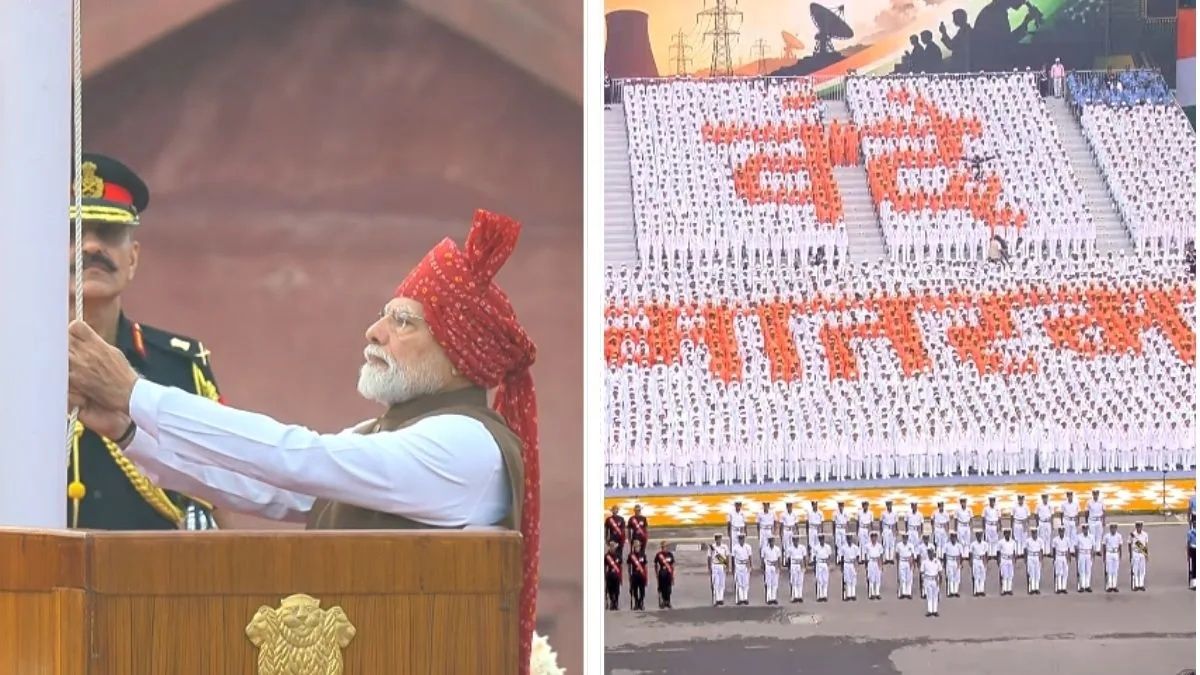
Prime Minister Narendra Modi on Independence Day, August 15, articulated India's sweeping ambition to transform itself into a developed nation within the next two decades and three years. Speaking from New Delhi's historic Red Fort during ceremonies marking India's 80th year of freedom, Modi framed this objective not merely as an economic target but as a civilisational aspiration that would reshape global perceptions of the subcontinent. The concept of 'Viksit Bharat'—developed India—emerged as the centrepiece of his address, a phrase designed to galvanise public consciousness around a singular national purpose.
The Prime Minister's articulation of this 2047 deadline carries particular resonance for India's strategic positioning in Asia and globally. Modi argued that when a nation of India's demographic scale and diversity commits to developmental transformation, it signals both internal self-assurance and a recalibration of how the international community should evaluate Indian capabilities. This messaging suggests recognition that India's trajectory influences regional dynamics and global power configurations, a theme likely to resonate across Southeast Asia where nations compete for investment and technological partnerships. Modi contended that national greatness emerges when societies transcend incremental thinking and harness collective determination alongside institutional strengths.
Central to Modi's argument was his contention that contemporary India must reject modest ambitions entirely. He explicitly cautioned against the limitations of constrained thinking, insisting that larger aspirations fundamentally expand how citizens conceptualise their nation's potential and their personal futures within it. This rhetorical pivot from small to expansive dreams reflects a broader philosophical approach to development—one that emphasises psychological and cultural transformation alongside material economic growth. For Malaysia and other regional economies, such discourse underscores how competitive positioning in Asia increasingly involves narrative-setting and vision-articulation alongside conventional policy measures.
Modi's retrospective analysis of India's economic transformation provided empirical scaffolding for his forward-looking ambitions. He highlighted India's transition from membership in the 'Fragile Five'—a characterisation applied to Brazil, India, Indonesia, South Africa and Turkey during periods of economic vulnerability—to emergence as a major growth engine. This repositioning narrative holds particular salience for Malaysian observers, as it parallels regional countries' own developmental aspirations and confronts comparable challenges around sustaining momentum, managing vulnerability to external shocks, and diversifying economic bases.
The Prime Minister itemised specific sectoral achievements across the previous dozen years, furnishing concrete metrics that ground his visionary ambitions in measurable progress. Defence production quadrupling over this period reflects India's strategic autonomy agenda and self-sufficiency in critical sectors. The sevenfold expansion of electronic manufacturing speaks to India's attempt to capture portions of global supply chains, particularly those relocating away from China—a dynamic with significant implications for Malaysian electronics manufacturing, which competes directly with Indian producers for multinational investment and market share. Mobile phone production increases of one-third and digital transaction growth of 100 percent underscore the digital transformation narrative that increasingly defines development discourse across Asia.
Khadi and Gramodyog production increases of five times deserves particular attention as it signals continued emphasis on rural livelihoods and traditional industries within India's modernisation framework. This dual focus—simultaneously pursuing cutting-edge electronics manufacturing and artisanal production growth—reflects India's complex developmental challenge of incorporating diverse population segments with varying skill levels and economic integration into its growth story. Malaysian policymakers similarly wrestle with balancing high-technology aspirations against the need to provide sustainable livelihoods across diverse regional economies.
A notable ceremonial dimension of Modi's address involved the first complete rendition of 'Vande Mataram' at the Red Fort on Independence Day since 1947. Modi characterised this moment as historically significant, suggesting that symbolic acts carry weight equivalent to policy measures in constructing national purpose and cohesion. The emphasis on the national song's resounding at this location and occasion reflects how Independence Day ceremonies serve functions beyond commemorative—they become occasions for redefining national narratives and mobilising emotional investment in stated objectives. For regional observers, such symbolic politics matter considerably in how governments attempt to consolidate public backing for long-term development trajectories.
The flag hoisting ceremony incorporated indigenous military capabilities, utilising 105mm Light Field Guns manufactured domestically and commanding personnel from India's defence establishment. This deliberately highlighted India's progress toward defence self-sufficiency, a priority that intersects with the broader developed-nation vision through demonstrating technological and manufacturing capacity in strategically significant domains. The involvement of Major Pawan Singh Shekhawat and other military personnel injected institutional legitimacy into Modi's civilian-oriented development vision, binding security establishment interests to the broader national objective.
Modi's acknowledgment of recent flooding affecting multiple Indian regions injected a note of immediate practical concern into his otherwise visionary remarks. He assured affected families that national mechanisms of support would mobilise, explicitly framing this as an expression of collective solidarity. This interjection demonstrates awareness that transformative developmental visions, however compelling rhetorically, require concurrent attention to citizens facing immediate material hardship. For Southeast Asian governments pursuing comparable long-term development objectives, such balancing—between future orientation and present responsiveness—remains perpetually challenging.
The 2047 target itself merits analytical consideration regarding its political and practical implications. As a 23-year horizon, it extends beyond typical electoral and political cycles in democratic India, yet remains sufficiently proximate to theoretically influence policy decisions throughout that period. The date also possesses symbolic resonance, falling 100 years after Independence, positioning developed status as a centennial commemoration of the freedom struggle's conclusion. This temporal framing connects developmental achievement to historical narrative in ways designed to imbue the objective with deeper meaning than pure economic metrics might convey.
For Malaysia and the broader Southeast Asian region, Modi's articulation of India's developmental vision carries implications across multiple domains. Economically, India's pursuit of manufacturing self-sufficiency and electronics expansion directly competes with Malaysian and Vietnamese industries for investment flows and multinational partnerships. Geopolitically, India's assertion of ambitious transformation reinforces its competition with China for influence across Asia and its positioning within regional architecture. The emphasis on citizen participation and collective dreaming reflects broader trends across Asia toward more participatory framing of national objectives, even within systems with significant executive authority concentration.
Modi's Independence Day address ultimately represents an attempt to redirect Indian national consciousness toward a specific temporal objective through combination of backward-looking achievement documentation, forward-looking vision articulation, and symbolic ceremonial reinforcement. Whether this constructed consensus can persist across India's diverse political economy and whether the specific 2047 target remains credible if economic conditions shift remain open questions. Yet the exercise itself—a major democratic government explicitly framing development in terms of civilisational advancement and collective aspiration—carries significance for how Asian nations increasingly narrate their developmental purposes and mobilise populations toward specified objectives.

