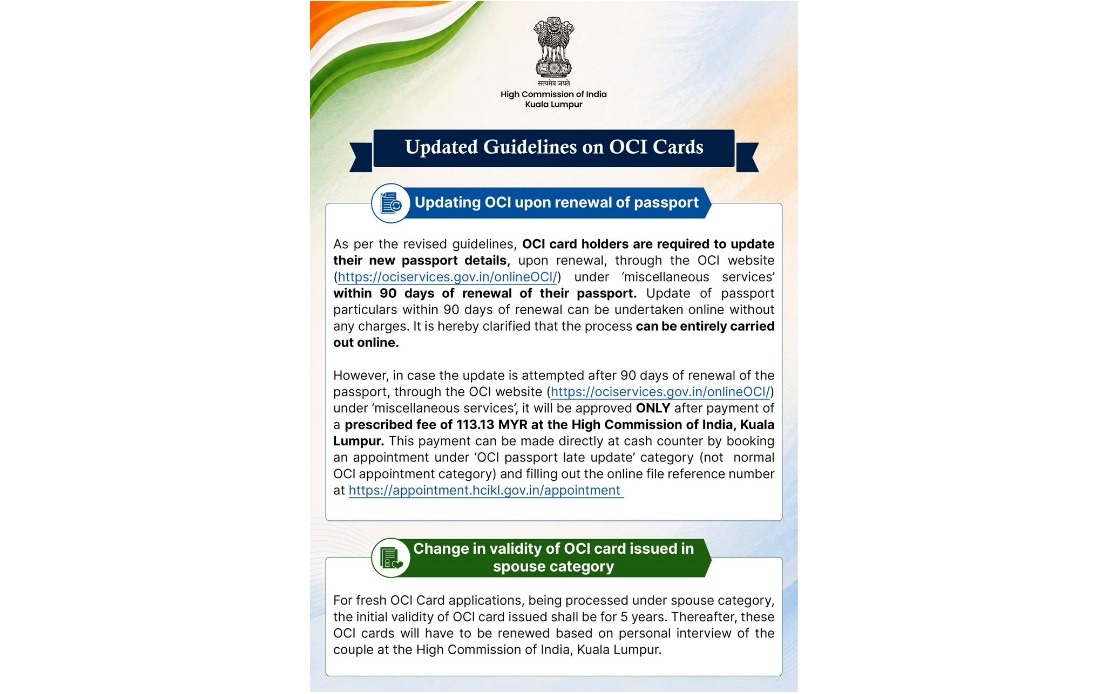
The High Commission of India in Kuala Lumpur has introduced a streamlined administrative framework for managing Overseas Citizen of India (OCI) cards, reflecting evolving documentation standards for the roughly 1.7 million OCI cardholders globally. The revised directives establish a critical 90-day window for cardholders to synchronise their OCI credentials with newly issued passports, marking a shift toward greater compliance oversight among the Indian diaspora in Malaysia.
Under the refreshed protocol, passport particulars must be updated through the dedicated OCI website portal, accessible via the "miscellaneous services" category. This digital-first approach eliminates the need for in-person visits during the initial update phase, reducing administrative burden for busy professionals and frequent travellers. The process remains entirely cost-free when completed within the prescribed timeframe, making compliance straightforward for the majority of cardholders who process their updates promptly.
The 90-day deadline carries significant consequences for those who miss the window. Delayed updates, attempted after the grace period expires, trigger a mandatory service fee of RM113.13. This fee structure incentivises timely filing while generating revenue to cover administrative costs at the mission. Applicants seeking late updates must first secure an appointment slot specifically categorised as "OCI passport late update" rather than standard OCI appointments, and must present their online file reference number when submitting payment at the High Commission's cash counter in Kuala Lumpur.
For Malaysian-based Indian diaspora members planning passport renewals, the new guidelines necessitate proactive calendar management. Many expatriates underestimate the administrative machinery surrounding identity documents, treating OCI updates as secondary to main passport processing. The revised framework essentially penalises procrastination, encouraging integrated renewal strategies where both passport and OCI updates occur in tandem. This architectural change reflects broader trends across Commonwealth nations toward tighter document synchronisation protocols.
Beyond passport mechanics, the High Commission introduced substantive changes affecting spousal OCI applications. Fresh applications processed under the spouse category now receive initial validity periods of five years rather than longer terms previously available. This represents a meaningful tightening of spousal OCI privileges, transforming what was traditionally a straightforward process into a renewable credential requiring periodic review. The shift may reflect heightened verification procedures or policy recalibration around family-based citizenship linkages.
The renewal mechanism for spouse-category OCI cards introduces an additional layer of administrative engagement. Rather than automatic renewal processes common in other categories, couples must participate in mandatory in-person interviews at the High Commission before renewal approval. This requirement fundamentally alters the convenience proposition of spousal OCI cards, necessitating coordinated travel and scheduling for both partners. For binational couples where one spouse resides in India and the other in Malaysia, the interview requirement complicates renewal timelines and may necessitate cross-border logistics planning.
Malaysia's Indian community—comprising significant professional, business, and expatriate populations—stands directly affected by these procedural shifts. The country hosts a substantial population of OCI cardholders, many engaged in cross-border commerce, ancestral property management, and extended family connections in India. Technology companies, healthcare workers, and financial professionals from India frequently rely on OCI status to facilitate business operations and periodic home returns. The new guidelines effectively raise compliance expectations without correspondingly increasing convenience infrastructure, creating friction for an otherwise mobile demographic.
The High Commission's communication strategy, centred on social media announcements and portal updates, reflects modernised administrative practices. However, the reliance on digital platforms risks excluding less tech-savvy cohorts within the diaspora, particularly elderly cardholders or those unfamiliar with online portals. Outreach efforts through community organisations and cultural associations might enhance awareness and compliance rates beyond current social media reach.
Comparative regional analysis reveals that Malaysia's revised OCI procedures align with stricter verification trends across Southeast Asian Indian missions. Singapore, Thailand, and Vietnam have similarly tightened documentation requirements in recent years, suggesting coordinated policy direction from New Delhi. This standardisation potentially reflects concerns about documentation integrity or evolving international standards for diaspora credential management. For Malaysian policymakers monitoring bilateral administrative efficiency, India's approach offers case study material on compliance mechanisms and fee structures.
The financial implications warrant scrutiny. While RM113.13 represents modest cost, aggregated across thousands of delayed applicants, the fee generates meaningful revenue. More significantly, the structure creates administrative incentives favouring timely processing, theoretically reducing mission workload during renewals. The cost-recovery model embedded in late-update fees reflects resource constraints facing Indian diplomatic missions globally, which increasingly delegate consular functions to increasingly mobile populations.
Looking forward, OCI cardholders in Malaysia should bookmark renewal dates and integrate passport updates into broader identity management calendars. The shift toward stricter timelines and spousal interview requirements signals that India's diaspora administration is modernising and tightening verification mechanisms. For Malaysia's Indian diaspora—a demographic increasingly important to bilateral economic and cultural relations—these procedural changes represent an evolution toward greater formality in managing citizenship links, ultimately requiring more deliberate engagement with administrative processes previously treated as routine. Navigating these updated requirements effectively now prevents costly delays and complications during future travel or documentation needs.

