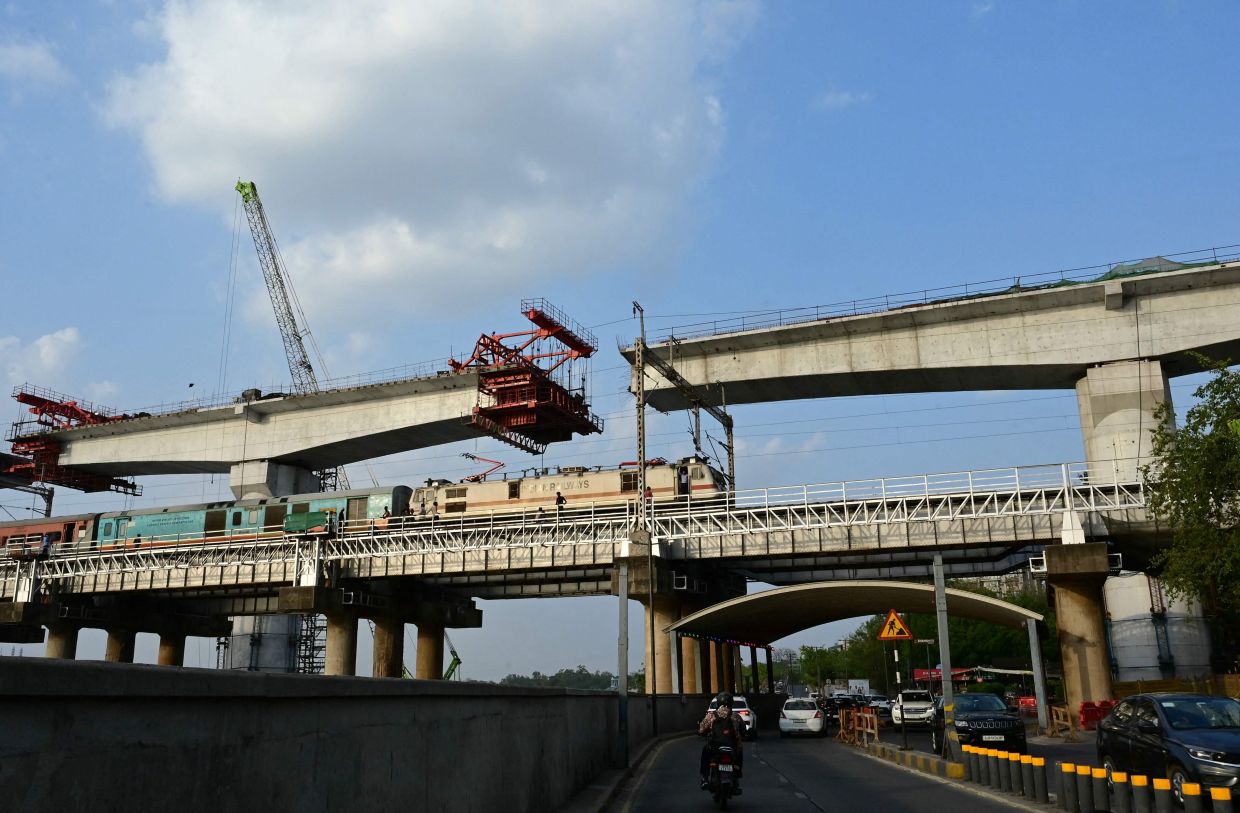
India's ambitious first bullet train project has overcome years of delays to enter a decisive phase, with railway officials confirming that the inaugural section will become operational in 2027 — a significant turning point for a scheme that has tested the nation's capacity to deliver large-scale infrastructure. The initial operating stretch of 100 kilometres will connect Surat and Vapi, two commercially significant cities in western India, marking the realisation of technology and expertise that the government believes will catalyse an entirely new approach to rail transportation across the subcontinent.
The broader Mumbai-Ahmedabad High Speed Rail Corridor stretches 508 kilometres along India's west coast and represents the flagship of New Delhi's modernisation drive. Government officials project that completing the entire line by end-2028 will revolutionise connectivity between the financial metropolis of Mumbai and Ahmedabad, Modi's home state's principal city, compressing journey times from six hours to just under two. This acceleration carries economic implications for the densely populated western region and signals India's readiness to compete with global standards in passenger rail infrastructure.
The Surat-Vapi section may appear modest in scale, yet it embodies years of engineering ambition and international partnership. Surat, renowned globally as the diamond cutting and polishing capital, sits alongside Vapi, which anchors a major hub for chemical manufacturing and industrial production. The corridor threading between these economic engines symbolises how high-speed rail aims to bind productive regions into tighter commercial networks — a particularly relevant model for Southeast Asian nations watching India's progress with interest.
Since Prime Minister Narendra Modi and then-Japanese Premier Shinzo Abe launched the project in 2017, the venture has weathered substantial headwinds. The original completion target of 2023 proved unrealistic, and land acquisition complexities combined with mounting expenses have stretched timelines and budgets. Initial projections of 17 billion US dollars, financed through an 81 percent loan from Japan's Japan International Cooperation Agency, may now be conservative given the documented cost escalations that have plagued the initiative throughout its journey.
Japanese railway expertise, embodied in the Shinkansen technology underpinning the project, brings proven standards to Indian railways at a moment when the bilateral relationship deepens considerably. The incoming visit of Japanese Premier Sanae Takaichi, Abe's chosen successor, underscores Tokyo's continued investment in India's infrastructure aspirations and the strategic importance both nations assign to the bullet train as a symbol of their technological partnership.
India's railway transformation over the past decade reflects a broader modernisation thrust that extends far beyond bullet trains. The Indian Railways network, inheriting colonial-era infrastructure built primarily for goods movement and administrative control, now carries 7.41 billion passengers annually alongside 1.67 billion tonnes of freight. Approximately 80 percent of the roughly 85,000-kilometre network currently operates at speeds of 110 kilometres per hour or above, demonstrating how systematically New Delhi has upgraded what was once a creaking continental transport system.
The domestically engineered Vande Bharat trains, capable of 180 kilometres per hour and symbolically named "Salute to India," transported nearly 40 million passengers last year and showcase Indian engineering capability. However, the bullet train, with its design speed of 350 kilometres per hour and operational capacity of 320 kilometres per hour, remains the crown jewel of this modernisation programme. Its speeds would match or exceed the most advanced systems globally, positioning India as a potential knowledge exporter rather than merely an importer of rail technology.
The connectivity gains promise to reshape economic geography in western India. Compressed travel times between Mumbai and Ahmedabad will enable business commuting impossible under existing conditions, potentially generating agglomeration effects that concentrate skilled workers and capital in ways that benefit both anchor cities. For Ahmedabad specifically, the bullet train arrives as infrastructure investment that the government has coordinated with hosting the 2030 Commonwealth Games — an event positioned as a stepping stone toward India's declared ambition to host the 2036 Olympics.
The engineering challenges embedded in the route testify to India's growing technical sophistication. A 21-kilometre mountain tunnel and the nation's first undersea railway tunnel represent feats that would have been unthinkable for Indian Railways a generation ago. These elements remain under construction, yet their very existence demonstrates that India now tackles complex technical problems once considered beyond its capabilities or financial reach.
Government planners envision this initial corridor as the foundation for an exponentially larger network. Seven proposed high-speed rail corridors spanning 4,000 kilometres exist in advanced planning stages, though without assigned timelines or committed funding. These routes would link New Delhi with Varanasi — Modi's parliamentary constituency and Hinduism's holiest pilgrimage destination — and extend to Siliguri, the critical junction connecting northeastern states to the rest of India. A second proposed network would arc from Ahmedabad southward through Pune and Hyderabad to Chennai, binding the technology and business centres of southern India into a unified high-speed rail system.
The government rhetoric frames these corridors as "growth connectors," yet their transformation from planning documents to operational reality depends on securing financing, managing land acquisition, and maintaining political continuity through inevitable delays and cost escalations. For Malaysia and other Southeast Asian nations evaluating their own high-speed rail ambitions, India's experience offers instructive lessons in both the transformative potential of such infrastructure and the substantial patience required to realise that vision. The 2027 opening of the Surat-Vapi section will demonstrate whether India can finally translate its transport aspirations into functioning modern systems.
Modi's personal commitment to the project, dating to his 2014 election platform pledging a nationwide high-speed network, lends political durability to the initiative despite its troubled timeline. The bullet train has become synonymous with his modernisation narrative, making completion essential to his broader legacy. This political dimension ensures continued government attention and resource allocation, factors that have proven decisive in maintaining momentum through the numerous obstacles that typically derail large infrastructure schemes in South Asia.

