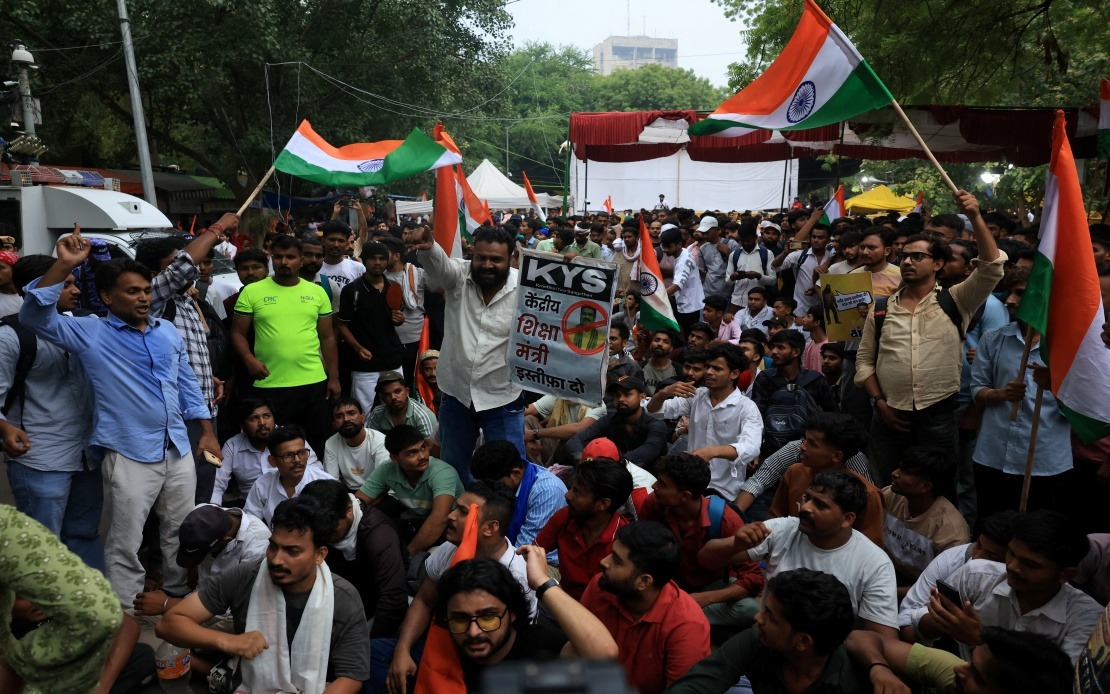
New Delhi witnessed significant civil unrest on Monday as police intercepted thousands of protesters attempting to advance toward the Parliament building during a "Sansad Chalo" (march to parliament) demonstration. The clash between demonstrators and security forces underscored growing tensions surrounding academic reform in India, particularly among younger citizens who have mobilised through digital platforms to amplify their grievances.
The timing of the protest coincided with the opening of the Monsoon Session of the Indian Parliament, a politically sensitive period when legislative agendas take shape for the coming months. Prime Minister Narendra Modi's departure from the parliamentary complex in a protective convoy reflected the security concerns authorities faced as crowds gathered in the national capital's restricted zones. Police had established barriers to prevent direct access to the parliament building, citing public safety protocols governing demonstrations in sensitive government areas.
At the heart of the protest lay demands for substantive transformation of India's educational framework. The youth-led movement, which has reportedly cultivated millions of online adherents, articulated concerns about curricular relevance, teaching methodologies, examination systems, and access to quality instruction across socioeconomic strata. The movement's digital-first strategy has enabled rapid mobilisation, allowing organisers to coordinate large-scale action with minimal traditional infrastructure, a pattern increasingly evident across South Asia's protest landscape.
The restrictions imposed on public gatherings by New Delhi authorities reflected official anxiety about demonstrations converging on Parliament during active legislative sessions. Such restrictions, while justified by authorities as necessary for orderly governance, frequently become flashpoints for civil liberties advocates who argue they limit legitimate democratic expression. The confrontation between police and demonstrators illustrated this recurring tension between state security imperatives and citizens' constitutional rights to petition government.
India's education system has faced mounting criticism from multiple constituencies in recent years. Students, parents, and educators have raised concerns about an examination-centric approach that prioritises memorisation over critical thinking, insufficient funding for rural and marginalised communities' schools, and a curriculum perceived as disconnected from contemporary labour market demands. The emerging youth movement appears to have synthesised these disparate concerns into a coherent reform platform capable of mobilising substantial numbers.
The deployment of crowd-control measures, including the positioning of police barriers and likely water cannons or similar dispersal techniques, resulted in tense standoffs that captured attention on social media platforms where the movement maintains significant support. This digital amplification extends the protest's reach beyond those physically present in New Delhi, potentially influencing public discourse and political calculations about education policy among parliamentarians.
For Malaysian observers, the Indian protest carries relevant implications. Southeast Asian nations, including Malaysia, grapple with similar educational challenges: examination pressure on students, rural-urban educational disparities, and questions about curriculum alignment with economic transformation. The tactics employed by India's youth movement—leveraging social media for coordination, framing education reform as a generational priority, and targeting legislative bodies—offer templates that activist movements across the region may emulate or adapt.
Security authorities in New Delhi substantially increased their presence in key governmental districts following the Monday demonstration, suggesting official concern that additional protests might occur during the parliamentary session. This heightened vigilance reflects recognition that education remains a politically charged issue capable of mobilising large constituencies, particularly among younger voters who increasingly view educational access and quality as central to their economic futures.
The Monsoon Session running concurrent with these protests provides an institutional context in which education policy could receive parliamentary attention. Whether the government responds substantively to demonstrators' demands, through committee inquiries, policy announcements, or legislative proposals, will significantly influence perceptions about the protest's efficacy and the viability of future civil mobilisation around this issue. The coming weeks will illuminate whether this youth-led movement proves merely a significant moment in Indian civil society or a catalyst for meaningful systemic change.
The incident also highlights how India's political landscape continues evolving as digital-native generations develop novel strategies for political engagement. Traditional protest spaces—marches, rallies, direct confrontations with authorities—increasingly complement or hybrid with online organising and digital discourse, creating multifaceted movements that authorities find difficult to contain or co-opt. This evolution shapes not only Indian democratic practice but also sets precedents influencing how protest movements operate throughout South and Southeast Asia.

