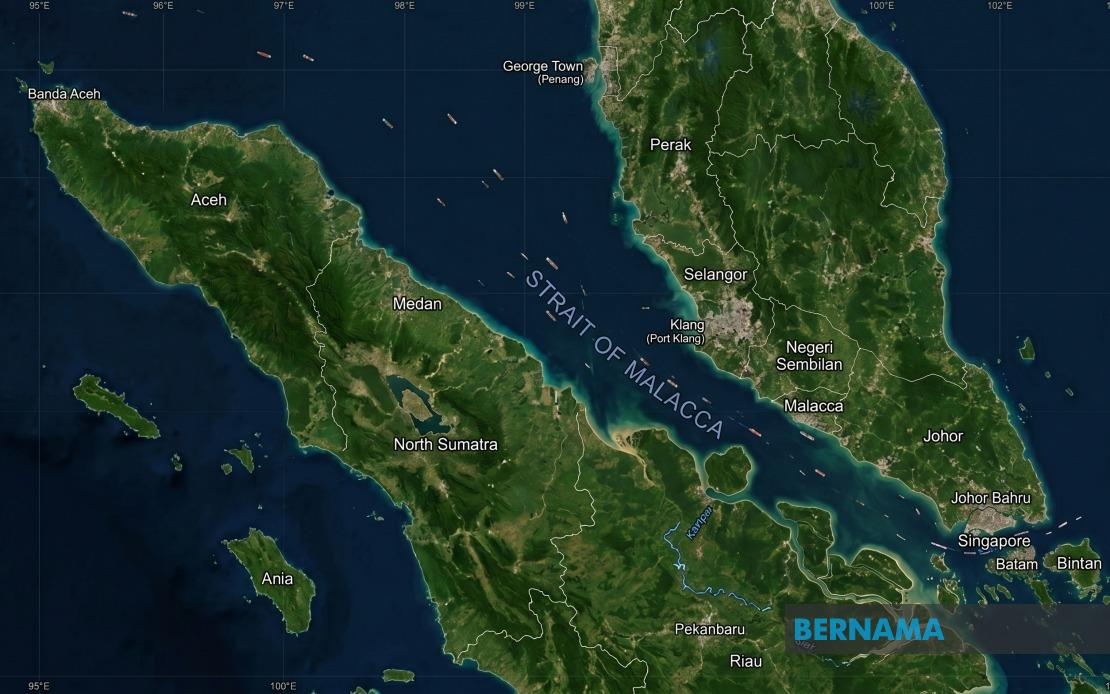
Indonesia and Singapore have renewed their joint commitment to safeguarding the Strait of Malacca, with both nations pledging enhanced coordination alongside Malaysia and Thailand to maintain security, safety and unobstructed passage through one of the world's most critical maritime corridors. The assurance came during an annual leadership retreat in Jakarta where President Prabowo Subianto and Singapore Prime Minister Lawrence Wong addressed shared interests in preserving the waterway's strategic importance under international maritime law.
President Prabowo underscored that Indonesia and Singapore, as direct littoral states of the Strait of Malacca, possess fundamental interests in maintaining the passage as an open route accessible to all nations. Speaking at a joint press conference at Istana Merdeka, he anchored this position within the framework of the 1982 United Nations Convention on the Law of the Sea (UNCLOS), the internationally binding treaty that governs maritime zones and navigation rights. This legal grounding reflects how both nations view their responsibilities not merely as neighbouring states but as custodians of a waterway whose strategic and economic significance extends far beyond Southeast Asia.
The Strait of Malacca remains one of the world's busiest shipping lanes, with an estimated one-third of global maritime trade passing through its narrow waters. For Malaysia, Indonesia, and Singapore—the three littoral states—the corridor represents both economic lifeline and security challenge. The commitment articulated by Jakarta and Singapore carries particular weight given ongoing regional tensions, including disputes in the South China Sea and concerns about maritime security threats. By publicly reaffirming their dedication to the strait's stability, both leaders signalled their determination to prevent great power competition from destabilising this vital passage.
Beyond the basic principle of maintaining open navigation, President Prabowo identified a broader security agenda encompassing protection from marine pollution, the prevention of maritime accidents, and the suppression of piracy. These practical concerns reflect real challenges that have plagued the region for years, with piracy incidents sporadically occurring despite increased naval patrols and international cooperation. Environmental hazards, whether from shipping accidents or deliberate dumping, pose long-term risks to the strait's ecosystem and the livelihoods of fishing communities throughout the region. By naming these specific threats, Prabowo framed the protection mandate as extending beyond geopolitical calculation to encompass the tangible wellbeing of maritime communities and the waterway's ecological health.
The bilateral engagement represents the second annual Indonesia-Singapore Leaders' Retreat, reflecting a deepening high-level dialogue between the two largest economies in Southeast Asia. Wong's arrival in Jakarta came amid the broader context of ASEAN positioning itself as a cohesive regional voice during a period of global strategic competition. The retreat served as platform for discussing not only bilateral matters but also regional and global issues capable of affecting both nations' interests. This broader aperture suggests both leaders view their partnership as extending beyond maritime security to encompassing the full spectrum of geopolitical and economic challenges facing Southeast Asia.
The leaders reaffirmed ASEAN's fundamental position that all disputes, whether within Southeast Asia or globally, should be resolved through peaceful dialogue and diplomatic channels rather than coercive measures. This stance carries particular resonance given ongoing South China Sea tensions and concerns about how great power competition might escalate regional conflicts. By explicitly endorsing this principle during their joint appearance, Prabowo and Wong reinforced ASEAN's commitment to inclusive dialogue mechanisms, implicitly contrasting this approach with unilateral assertions of maritime claims or military posturing. The emphasis on resolving misunderstandings openly as friends suggests both nations recognise that maintaining the Strait of Malacca's stability requires not only operational coordination but also political trust and transparent communication.
The commitment to continued coordination with Malaysia and Thailand underscores the multilateral dimension of strait management. While Indonesia and Singapore wield considerable influence as the strait's primary gatekeepers, Malaysia's substantial coastline and Thailand's northern proximity mean all four nations possess legitimate interests in the waterway's security. By publicly pledging cooperation with both neighbours, Jakarta and Singapore demonstrated awareness that durable stability cannot be achieved through bilateral arrangements alone. This multilateral framing also reflects the inclusive approach embedded in ASEAN's maritime security frameworks, which emphasise consensus-building and collective problem-solving rather than hegemonic arrangements.
Looking ahead, both nations acknowledged that 2025 will mark the sixtieth anniversary of Indonesia-Singapore diplomatic relations, a milestone that carries symbolic weight in Southeast Asian regional diplomacy. President Prabowo expressed confidence that sustained bilateral cooperation would contribute to broader stability, economic growth, and prosperity across Southeast Asia. This forward-looking perspective positions the Strait of Malacca protection commitment within a longer historical arc of Indonesia-Singapore partnership, suggesting that today's pledge represents not a temporary initiative but an enduring facet of bilateral relations. The anniversary milestone also provides both nations an opportunity to deepen their maritime cooperation frameworks and upgrade operational coordination mechanisms.
For Malaysia and other regional observers, the Indonesia-Singapore commitment carries important implications. The explicit reaffirmation of UNCLOS-based principles and multilateral coordination suggests that the region's major powers remain committed to rules-based maritime governance rather than spheres of influence arrangements. However, the emphasis on bilateral Indonesia-Singapore coordination also reflects a reality that the two largest littoral economies will inevitably play leading roles in strait governance. Malaysia's own interests in maintaining the waterway's security and safety remain paramount, particularly given the strait's importance to Malaysian trade, energy security, and territorial waters integrity. The explicit mention of Malaysia as a coordination partner suggests Jakarta and Singapore recognise the importance of keeping Kuala Lumpur engaged in strategic discussions rather than marginalised.
The joint commitment also carries implications for major maritime powers with interests in the strait, including China, Japan, India, and the United States. By emphasising the waterway's openness to all parties and reaffirming commitment to UNCLOS, Indonesia and Singapore positioned themselves as defenders of international maritime order rather than as parties to factional divisions. This framing becomes increasingly important as great powers compete for influence in Southeast Asia. The Strait of Malacca's continued openness to all nations remains fundamental to global maritime trade and energy security, making Indonesia and Singapore's custodial role essential to international economic stability and geopolitical balance.

