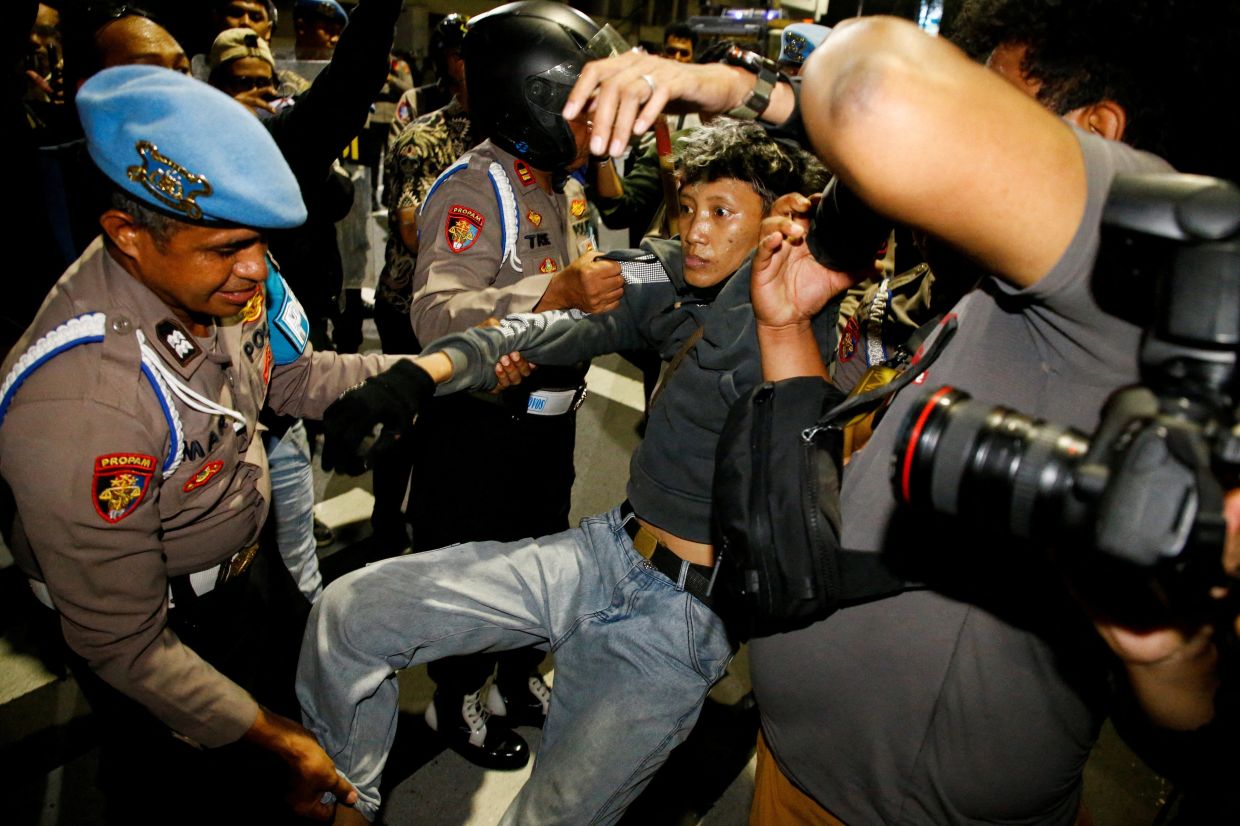
Indonesian police have pressed charges against four individuals following an anti-government demonstration in Surabaya, the country's second-largest city, according to statements from local law enforcement on Sunday. The charges come after approximately 100 people gathered outside a government building on Friday to voice opposition to recent economic measures and social programmes affecting millions of Indonesians. The incident reflects growing public dissatisfaction with government policies that have triggered widespread unrest across multiple urban centres this month.
The focal point of the Surabaya protest centred on two distinct grievances. Participants objected to the government's decision to raise prices of non-subsidised petrol by roughly 30 per cent, a decision made to relieve budgetary strain as global geopolitical tensions disrupt energy markets. Additionally, demonstrators expressed alarm over a federally-funded school feeding initiative that has become entangled in controversy, with critics pointing to documented cases of mass food poisoning and suspected embezzlement affecting programme implementation nationwide.
Surabaya police chief Luthfie Sulistiawan detailed the official response, explaining that some rally participants engaged in disruptive behaviour including throwing firecrackers and stones at government premises. In response, law enforcement adopted what Sulistiawan characterised as "firm actions" to restore order and disperse the assembled crowd. The police operation resulted in the initial detention of 24 individuals at the scene, though most were subsequently released without facing formal accusations.
Among those initially apprehended, authorities singled out four people for prosecution on specific charges relating to property damage and physical assault against police personnel. Beyond these four, a separate group of six detainees remains under investigation after authorities discovered traces of controlled substances in toxicology screening. The differentiated approach suggests police are distinguishing between protest participation itself and alleged criminal conduct during the demonstration.
Indonesia's fuel subsidy structure creates a unique domestic context for such protests. As Southeast Asia's largest economy and an oil-producing nation, Indonesia paradoxically relies on significant petroleum imports to meet domestic demand. This structural reality places the government in a difficult position—maintaining fuel subsidies strains public finances, yet raising prices triggers immediate public backlash from cost-conscious consumers. The 30 per cent increase announced this month reflects policymakers' assessment that fiscal pressures from Middle Eastern conflicts affecting global energy supplies necessitate difficult rebalancing of expenditure priorities.
The free meal scheme controversy compounds existing frustrations over economic management. The government positioned the multi-billion-dollar programme as a strategic intervention to address childhood malnutrition across the archipelago. However, implementation has revealed serious vulnerabilities. Tens of thousands of people have fallen ill following consumption of meals distributed through the scheme, triggering investigations into food safety protocols and sourcing procedures. Simultaneously, anti-corruption advocates have documented financial irregularities suggesting diversion of allocated resources, undermining public confidence in programme administration.
The Surabaya demonstration is merely one manifestation of broader resistance to these policies. In Jakarta, the capital, thousands of students have mobilised to oppose both the petrol price restructuring and the school meal initiative. Youth participation indicates that dissatisfaction crosses generational lines, with younger Indonesians viewing these decisions as symptomatic of misguided governance. Student movements historically wield significant political influence in Indonesia, and sustained protest activity could eventually pressure policymakers toward policy adjustment or programme reform.
The government's partial suspension of the free meal scheme represents a tacit acknowledgement that the programme requires substantial restructuring. However, critics contend that suspension without comprehensive overhaul represents an insufficient response to documented failures. Resumption of the initiative without substantive changes to procurement, quality assurance, and financial accountability mechanisms would likely reignite public opposition and student activism.
For Malaysian observers, Indonesia's turbulent experience with fuel price liberalisation and targeted subsidy reform offers instructive parallels. Malaysia has similarly navigated the politically sensitive intersection of fiscal consolidation and public welfare, with debates over optimal petrol pricing mechanisms and government spending priorities continuing to generate public discourse. Indonesia's current difficulties underscore the political risks accompanying rapid price adjustments without complementary communication strategies or alternative support mechanisms to cushion impacts on lower-income households.
The broader implications extend beyond immediate domestic politics. Regional stability depends partly on Indonesia's capacity to implement necessary economic reforms while maintaining social cohesion. Escalating protest activity, if mishandled by security forces, risks generating grievances that persist long after particular policy disputes conclude. The four individuals now facing prosecution may become symbols either of legitimate dissent or criminal troublemaking, depending on how courts handle proceedings and how media frames their actions.
Moving forward, the Indonesian government faces pressure to balance fiscal discipline with social stability. Hastily implemented price increases without accompanying measures to assist vulnerable populations, or unresolved corruption within welfare programmes, create conditions for sustained public mobilisation. The coming weeks will indicate whether authorities pursue dialogue with protest organisers and address underlying concerns, or whether they rely primarily on law enforcement to suppress dissent. Either approach carries implications for Indonesia's democratic health and regional trajectory during a period of economic strain and geopolitical uncertainty.

