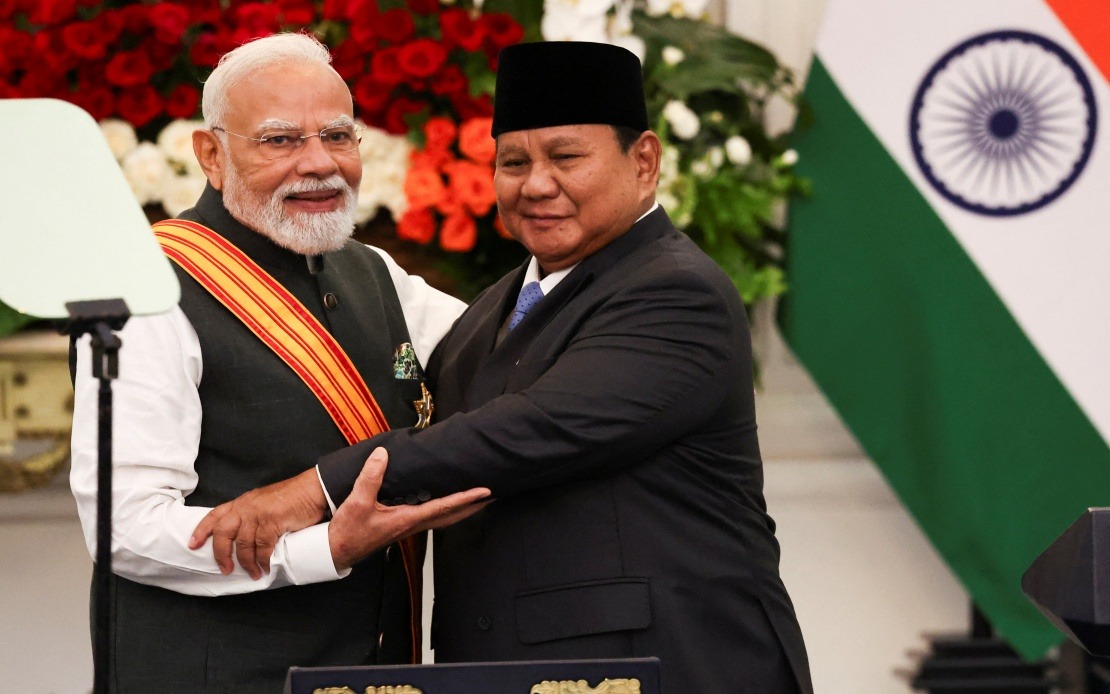
President Prabowo Subianto of Indonesia formally presented the nation's most prestigious state decoration to Indian Prime Minister Narendra Modi on Tuesday at the Merdeka Palace in Jakarta, cementing what both leaders describe as a defining moment in bilateral relations. The award, traditionally reserved for individuals who have substantially advanced Indonesia's national interests and international standing, underscores the considerable weight Jakarta now places on its strategic alignment with New Delhi across multiple domains.
The Indonesian president framed the honour as recognition of Modi's personal leadership and his government's sustained commitment to elevating Indonesia-India ties beyond traditional diplomatic niceties. Prabowo emphasised that the award acknowledges not only Modi's stewardship of India's foreign policy but also his tangible support for Indonesian developmental priorities and infrastructure initiatives. During remarks delivered at a joint press conference following their formal bilateral meeting, Prabowo highlighted that the conferment reflects Delhi's practical engagement with Jakarta's national agenda, positioning India as more than a ceremonial partner but as an active stakeholder in Indonesia's economic and social advancement.
The distinction carries particular historical weight given its previous recipient list. Jawaharlal Nehru, India's founding prime minister, received the same accolade in recognition of his foundational role in establishing modern Indonesia-India relations and his pioneering contributions to the Non-Aligned Movement during the Cold War. By grouping Modi alongside Nehru, Prabowo signals that contemporary India under the current premier deserves comparable historical significance in Indonesia's strategic calculations. This comparison suggests Jakarta views the present geopolitical moment as requiring closer institutionalisation of ties with a major Asian power capable of balancing competing regional interests.
Modi's presence in Indonesia represents a state visit extended at Prabowo's personal invitation, reciprocating the Indonesian leader's earlier trip to India this year. This bilateral rhythm of high-level visits demonstrates both capitals' determination to translate the formal designation of their relationship—the Comprehensive Strategic Partnership framework—into sustained engagement and tangible cooperative outcomes. Rather than symbolic exchanges, both nations appear intent on deepening practical collaboration across defence, trade, technology, and cultural sectors, using such visits as anchors for announcing new initiatives and reaffirming commitment to existing programmes.
One significant dimension of the Modi visit involves Indonesia's BRICS membership trajectory. Prabowo expressed explicit appreciation for India's advocacy supporting Indonesia's permanent admission to the grouping, which has evolved into a counterweight to Western-dominated international institutions. India's backing for Indonesian membership signals New Delhi's interest in strengthening voices favouring a multipolar world order within this influential bloc. For Malaysia and the broader Southeast Asian region, India's active support for Indonesian integration into BRICS carries implications for regional positioning relative to Chinese and Western strategic interests, particularly as BRICS expands its economic and political influence.
Prabowo's characterisation of India as a longstanding friend of Indonesia reflects Jakarta's historical narrative positioning India as a consistent partner since Indonesia's independence struggle. The Indonesian president stressed that deep cultural and historical foundations undergird contemporary diplomatic ties, rooted in centuries of trade, religious influence, and intellectual exchange across the Indian Ocean. This framing grounds modern strategic calculations in enduring civilisational connections, suggesting that Indonesia-India cooperation transcends transactional interests and rests on foundations unlikely to erode with changing administrations or temporary policy shifts.
The Comprehensive Strategic Partnership framework, repeatedly referenced by Prabowo, represents a deliberate elevation from earlier partnership categories. Such designations typically encompass defence cooperation, intelligence sharing, maritime security collaboration, and coordinated positions on regional and global issues. For Indonesia, a nation straddling critical sea lanes and facing security challenges ranging from maritime disputes to non-traditional threats, deeper strategic alignment with India offers tangible benefits. New Delhi brings naval capabilities, technological expertise, and diplomatic influence that complement Jakarta's own regional role, particularly in the Indian Ocean and broader Indo-Pacific domain.
From a Southeast Asian perspective, Indonesia-India deepening ties carry broader ramifications. As the largest economy and most populous nation in ASEAN, Indonesia's strategic choices significantly influence regional dynamics. India's growing engagement with Indonesia, and by extension with Southeast Asia through the ASEAN-India framework, represents a conscious effort to establish itself as an indispensable partner in an increasingly competitive Asia-Pacific environment. Malaysia, Vietnam, Thailand, and other regional states observe such developments carefully, calculating how to position themselves amid competing great power interests and how India's activism reshapes the regional balance.
The timing of this honour, occurring during a period of intensifying geopolitical competition between established and rising powers, suggests Indonesia recognises the value of formalising its alignment with India through symbolic gestures that carry domestic and international audience effects. Such high-profile recognition signals to Indonesia's population and international observers that Modi and India warrant strategic priority, potentially justifying future military expenditures, defence technology transfers, or security cooperation that might otherwise face domestic scrutiny. Simultaneously, the award sends a clear message to China and other regional actors that Indonesia is deliberately cultivating partnerships beyond its immediate neighbourhood.
The joint press conference at Merdeka Palace, with proceedings broadcast live on YouTube, reflects both nations' interest in public diplomacy and demonstrating the vigour of their partnership to domestic constituencies and global audiences. Such transparent engagement contrasts with earlier diplomatic eras when state visits remained largely closed affairs known primarily through official communiqués. Contemporary India-Indonesia engagement prioritises demonstrating to their respective publics that bilateral relations deliver concrete benefits and merit continued investment of political capital and economic resources.
Looking forward, the implications of this honour extend to future cooperation modalities and institutional arrangements between the two nations. Recognition at this level typically precedes more binding commitments, whether through defence agreements, joint industrial projects, or coordinated diplomatic initiatives in multilateral forums. For Malaysia and regional observers, monitoring the substantive outcomes of Modi's visit—any new defence pacts, trade agreements, or security arrangements—will illuminate how rhetorical commitment translates into material cooperation. The award itself represents declaratory diplomacy; the real test lies in what follows in bilateral implementation and whether Indonesia-India partnership deepens sufficiently to reshape regional alignments.

