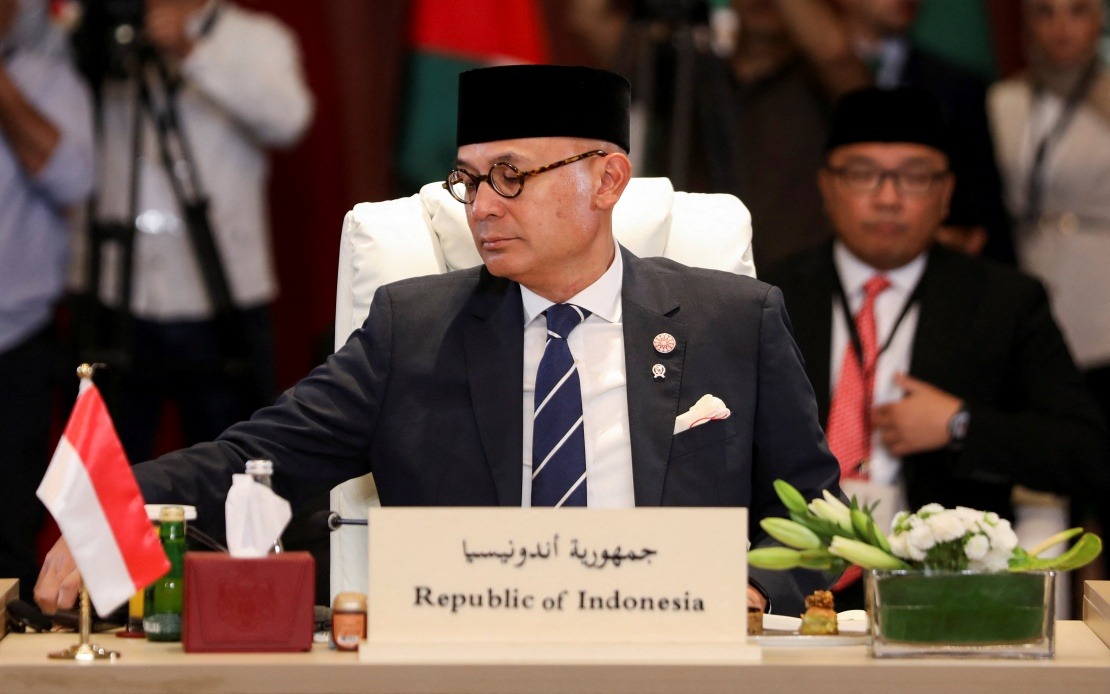
Indonesia has escalated its diplomatic push for a unified international response to the Israeli-Palestinian conflict, warning that the world's fractured approach has only benefited Israel's strategic interests. Speaking at a high-level ministerial meeting in Amman, Jordan, on Wednesday, Deputy Foreign Minister Arrmanatha Nasir articulated Jakarta's conviction that the Palestinian cause transcends religious boundaries and demands coordinated action from the global community rather than scattered, ineffective individual responses.
The call represents Indonesia's attempt to mobilise consensus among major regional and international players on a question that has defied resolution for decades. Nasir, representing Foreign Minister Sugiono at the Ministerial Meeting on Jerusalem, emphasised that Israel has consistently exploited international divisions to advance its territorial and military objectives. This strategic observation reflects Jakarta's analysis that fragmented condemnations and uncoordinated diplomatic efforts have proven insufficient to constrain Israeli actions in occupied territories.
To translate its vision into actionable policy, Indonesia tabled a comprehensive five-point programme designed to strengthen and coordinate global support for Palestinian self-determination. The framework begins with developing a unified strategic approach grounded in international solidarity, moving beyond rhetorical gestures toward binding collective positions. The second pillar focuses on rigorous enforcement of international law, including adherence to rulings from the International Court of Justice—a mechanism that has previously rendered judgements regarding Israeli conduct but which remain unenforced without coordinated pressure from major powers.
The Indonesian proposal also emphasises expanding international recognition of Palestine's statehood, a measure that would strengthen Palestinian institutional legitimacy on the world stage and complicate diplomatic isolation. Concurrently, Jakarta advocates for intensified protection of the Al Aqsa Mosque compound, framing religious and cultural preservation as integral to any sustainable political settlement. The remaining elements address humanitarian reconstruction in Gaza and support for the UN Relief and Works Agency for Palestine Refugees, acknowledging that Palestinian economic stabilisation and refugee welfare represent essential foundations for longer-term peace.
Indonesia's intervention occurs against a dramatically altered regional landscape. The proliferation of illegal Israeli settlements in the West Bank, combined with major military operations across Gaza, Syria and Lebanon, has fundamentally shifted the strategic environment. Simultaneously, escalating tensions between the United States and Iran have introduced additional volatility that threatens to transform the Palestinian question into a proxy arena for great-power competition. These developments, Nasir argued, create urgent necessity for consolidated international action rather than the status quo of unilateral declarations.
Jakarta simultaneously reaffirmed its longstanding position supporting Jordan's Hashemite Custodianship over Jerusalem's holy sites, particularly the Al Haram Al Sharif complex. This support reflects Indonesia's acknowledgment of Jordan's historical and religious role while simultaneously positioning Indonesia within a broader Arab and Muslim coalition framework. The emphasis on Jordan's custodial role rather than Israeli sovereignty underscores Indonesia's unambiguous stance on Jerusalem's international status.
The Amman gathering itself demonstrated the breadth of concern among diverse state actors. Delegations from Malaysia, Algeria, Saudi Arabia, Iraq, Egypt, Türkiye, Tunisia, Somalia, Pakistan, Morocco, Palestine and Qatar participated alongside senior Arab League representation, indicating sustained regional consensus on the issue despite broader geopolitical differences. The composition of attendees revealed how the Palestinian question continues to command diplomatic attention across sectarian, ideological and strategic divides within the Muslim world and beyond.
The summit's concluding joint statement reflected convergence on several instrumental objectives. Signatories committed to strengthening Palestinian institutional capacity specifically in Jerusalem, rejecting any unilateral relocation of diplomatic missions to the city as violations of international law. The statement additionally called for coordinated media campaigns to communicate Israeli actions and their destabilising effects to international audiences, recognising that strategic messaging and narrative control form essential components of diplomatic struggle.
For Southeast Asian observers, Indonesia's activism carries particular significance. As the world's largest Muslim-majority democracy and a major voice in regional affairs, Jakarta's diplomatic engagement on Palestinian issues shapes ASEAN's collective positioning and influences how non-aligned nations approach Middle Eastern conflicts. Indonesia's emphasis on legality and international institutional mechanisms rather than purely religious solidarity offers a framework through which diverse societies with varying geopolitical interests might achieve common cause.
The Amman meeting represents an incremental effort to translate rhetorical support into structural coordination, though scepticism regarding implementation remains justified given previous initiatives' limited practical impact. Indonesia's five-point framework essentially reiterates longstanding international consensus on Palestinian rights, yet the emphasis on abandoning fragmentation and building institutional coalitions suggests Jakarta recognises that rhetorical unanimity has proven insufficient without mechanisms ensuring sustained, coordinated enforcement.
Looking forward, the viability of Indonesia's coalition-building depends substantially on whether major powers beyond the Arab world—particularly permanent UN Security Council members and influential regional actors outside the Arab sphere—can be persuaded to subordinate competing interests to Palestinian rights advocacy. Indonesia's diplomatic strategy tacitly acknowledges this constraint while attempting to build the strongest possible coalition from genuinely committed actors, establishing a foundation upon which broader international support might eventually consolidate.

