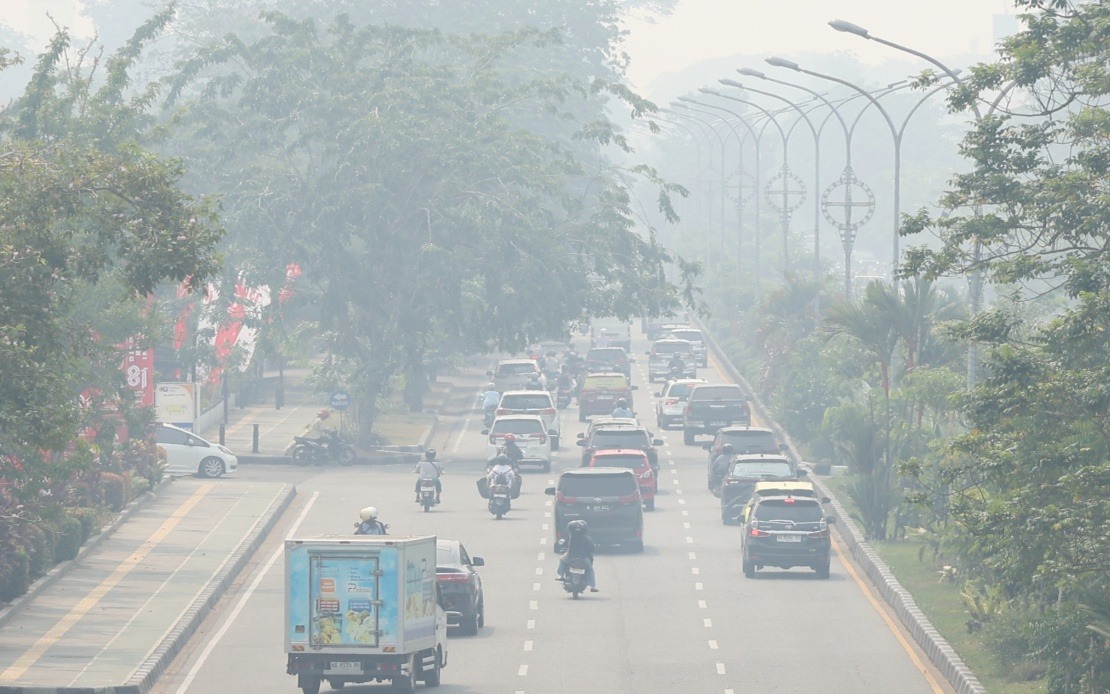
Forest and peatland fires burning across Indonesia have triggered a severe air quality crisis, with pollution indices climbing to hazardous thresholds that pose immediate risks to public health. Measurements taken on Wednesday morning recorded an Air Pollutant Index (API) of 573 in Jekan Raya, a subdistrict within Palangka Raya in Central Kalimantan—well beyond safe levels and among the worst readings documented across affected regions. According to Then Suyanti, the Environmental Health Director at Indonesia's Health Ministry, this figure emerged from continuous monitoring at seventeen air-quality stations, underscoring the widespread and persistent nature of the contamination.
The haze originating from these fires has blanketed vast swathes of Indonesia's most densely vegetated regions. Beyond the critical conditions in Central Kalimantan, Muaro Jambi Regency in Jambi province also reached hazardous API levels at 302. Additional areas across both Sumatra and Kalimantan islands registered very unhealthy readings between 201 and 300, including Pelalawan in Riau, communities in South Sumatra such as Penukal Abab Lematang Ilir and Ogan Ilir, Southeast Pontianak in West Kalimantan, and further districts in Central Kalimantan including Gunung Mas and Katingan. This geographical distribution reveals the scale of the crisis, affecting predominantly forested regions that have long grappled with fire management challenges.
For Malaysian and Southeast Asian observers, the severity of Indonesia's pollution crisis carries direct implications. Cross-border haze episodes have historically impacted air quality across the region, including Malaysia, Singapore, and Brunei. When Indonesia's API readings reach such extreme levels, transnational air pollution typically follows within days, depending on wind patterns and atmospheric conditions. The current situation demonstrates the cyclical nature of this environmental challenge and underscores why coordinated regional action remains essential for mitigation.
The Indonesian Health Ministry has moved to enforce immediate public health protections. Then Suyanti advised that residents in hazardous zones should cease outdoor activities entirely, reflecting the acute threat posed by such pollution concentrations. For populations experiencing very unhealthy air quality levels, authorities recommended limiting outdoor exposure to reduce risks particularly among vulnerable populations—children, the elderly, and those with respiratory or cardiovascular conditions. The ministry announced plans to issue a comprehensive circular within two days, potentially including provisions that allow schools to transition to remote learning when air quality deteriorates substantially, prioritising the wellbeing of students and staff.
The scale of human exposure to these dangerous conditions extends across seven provinces spanning both major islands. Agus Jamaludin, Head of the Health Crisis Centre, confirmed that approximately 3.4 million people across Riau, Jambi, and South Sumatra on Sumatra island, plus West, Central, East, and South Kalimantan have been affected. These provinces have formally declared emergency alert status—though notably not yet emergency response status—indicating authorities recognise the serious threat while still maintaining hope that containment efforts can prevent further deterioration. To date, 321 health personnel have been deployed across these provinces to monitor and respond to health impacts.
Cassualties from the fires themselves, distinct from pollution-related illnesses, have remained relatively contained thus far. Agus reported that forty-two individuals sustained minor injuries from fire-related incidents, while two burn victims in South Kalimantan experienced serious injuries requiring hospitalisation. Remarkably, no deaths have been recorded and no evacuations deemed necessary at this reporting stage. However, these figures likely represent only immediate fire-related trauma and do not capture the longer-term health consequences of prolonged exposure to hazardous air pollution, which can trigger respiratory infections, asthma exacerbations, and cardiovascular complications across large populations.
The underlying cause of this environmental catastrophe lies in the combination of forest and peatland fires currently spreading across Indonesia. Peatlands are particularly concerning because they contain carbon-rich soils that burn intensely and extensively once ignited, releasing vast quantities of smoke and particulates into the atmosphere. The timing of these fires—occurring during Indonesia's dry season when moisture levels drop—creates conditions where fires spread rapidly and burn for extended periods. Agricultural clearing practices, combined with natural weather cycles and inadequate firefighting resources, have historically converged to create seasonal haze events of this magnitude.
Satellite monitoring by Indonesia's Forestry Ministry revealed the vast extent of ongoing fire activity as of late Tuesday evening. Across the nation, authorities detected 805 high-confidence hotspots and 11,313 medium-confidence hotspots where fires were either actively burning or likely to ignite. Among the six priority provinces designated for intensive intervention, South Sumatra showed the highest concentration of confirmed active fires with 239 high-confidence hotspots, followed by Central Kalimantan with 113, South Kalimantan with 89, and West Kalimantan with 86. Jambi and Riau reported significantly fewer confirmed hotspots at seven and one respectively, yet both provinces showed substantial numbers of medium-confidence fire signatures, indicating smouldering vegetation or incipient fires not yet fully developed.
West Kalimantan emerged as the region with the largest total fire burden when medium-confidence hotspots were included in the analysis, with 2,447 such signatures detected. Central Kalimantan followed with 2,168 medium-confidence hotspots, South Sumatra with 1,161, South Kalimantan with 710, and Riau and Jambi each with approximately 200. This distribution underscores that fire risk remains highly dispersed rather than concentrated in one location, complicating firefighting efforts and suggesting that contained blazes in one district do not guarantee improved conditions elsewhere.
The sustainability of Indonesia's response hinges on the effectiveness of ongoing firefighting operations and the timing of the seasonal transition. Officials expressed hope that intensified suppression efforts would gradually eliminate active fires and thereby reduce atmospheric haze concentrations. However, achieving this objective requires sustained resource deployment, favourable weather conditions including rainfall, and coordination across multiple provinces with varying institutional capacities. The declaration of emergency alert status rather than full emergency response status suggests officials remain cautiously optimistic about averting the most severe scenarios—yet the trajectory of fire detection data and pollution indices will determine whether this optimism proves justified or whether conditions deteriorate further before improvement arrives.

