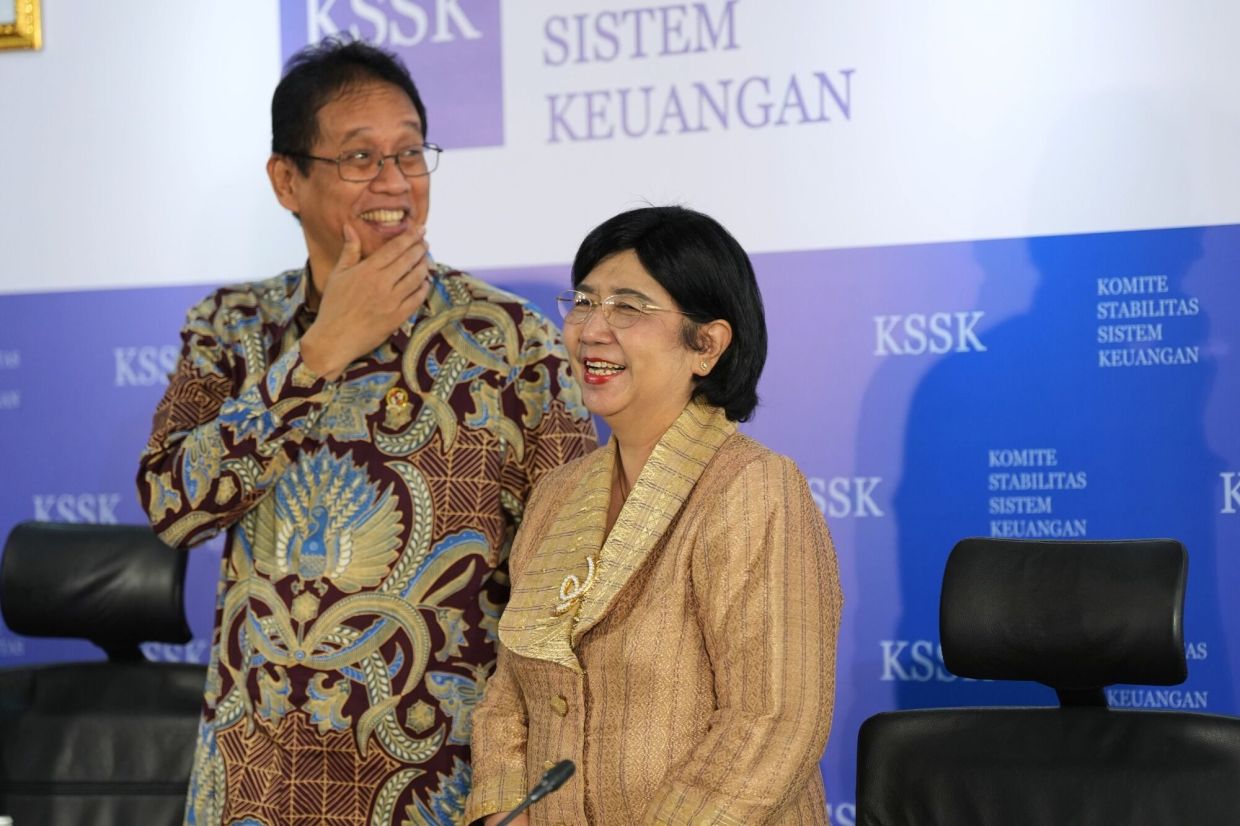
Destry Damayanti's appointment as acting governor of Bank Indonesia has thrust her into one of Southeast Asia's most delicate balancing acts. Within hours of taking the role two weeks ago, she demonstrated her political sensibility by scheduling separate meetings with Finance Minister Purbaya Yudhi Sadewa before meeting President Prabowo Subianto. The carefully orchestrated sequence sent an unmistakable message: coordination with the government's economic machinery would be a hallmark of her tenure. Days later, the two officials sat shoulder-to-shoulder at a public briefing, shaking hands and projecting the kind of unified front that had largely been absent during the administration of her predecessor, Perry Warjiyo.
That contrasting dynamic between Destry and her predecessor reveals much about Prabowo's strategic intentions for the central bank. Warjiyo's interactions with the finance ministry were predominantly formal and structured, typically occurring within broader settings such as presidential palace committee meetings. A solitary one-on-one engagement between Warjiyo and Purbaya, held at the central bank's Jakarta offices, represented a notable exception—and occurred only in September 2025. By comparison, Destry's willingness to cultivate a closer working relationship with Purbaya signals the administration's desire for tighter alignment between monetary and fiscal authorities. This shift reflects Prabowo's broader vision: he seeks a central bank chief who can embrace market-friendly economic principles while simultaneously advancing his ambitious agenda to accelerate growth to eight percent by 2029.
The challenge before Destry extends far beyond managing personal relationships. She must navigate a complex and often contradictory set of pressures that have already begun constraining Indonesia's economic management. The rupiah has depreciated approximately six percent against the US dollar during 2024, making it Asia's worst-performing major currency. Credit rating agencies including Fitch Ratings and Moody's Ratings have placed Indonesia's sovereign credit on negative watch, citing persistent policy uncertainty, though S&P Global Ratings has maintained a stable outlook. These signals from the investment community underscore investor anxiety about the government's populist policy direction, including Prabowo's significant spending commitments on free school meals and expanded state involvement in commodity markets.
Destry's predecessor had deployed an intricate policy toolkit to manage competing objectives, raising interest rates three times since May whilst simultaneously intervening in foreign exchange markets to defend the rupiah's value. Bank Indonesia also employed non-rate policy instruments designed to maintain credit availability and support economic activity. The central bank's approach reflected the fundamental tension that now confronts Destry: how to contain inflation and stabilise the currency whilst accommodating government requests for easier financial conditions to support growth. International interest rate increases and ongoing dollar strength continue to apply substantial downward pressure on the rupiah, complicating this calculus considerably.
Market participants have expressed cautious optimism about Destry's elevation. When her nomination was announced on Monday, the rupiah strengthened to its highest point in a month, outperforming most regional Asian currencies and signalling investor relief. Economists broadly anticipate that her appointment will ensure policy continuity and prioritise rupiah stability. Helmi Arman, an economist at Citigroup Inc., noted in analysis that market observers expect improved communication between Bank Indonesia and the government going forward, though he cautioned that the broader institutional credibility environment remains fluid and subject to considerable change.
Destry arrives at this position with credentials that have earned credibility among the international investment and analyst communities. She holds an economics degree from the University of Indonesia and a master's degree in regional science from Cornell University. Her career trajectory before joining the central bank included a senior role as chief economist at PT Bank Mandiri, one of Indonesia's largest financial institutions, and a commission position at the Indonesia Deposit Insurance Corporation, the same agency previously led by Finance Minister Purbaya. She has maintained regular engagement with investor and analyst networks throughout her tenure at Bank Indonesia, cultivating relationships and demonstrating her commitment to transparency in monetary policy communication.
Yet her closest connection to Purbaya—who led the deposit insurance agency before moving to the finance ministry—introduces a dimension that requires careful management. Investors will be scrutinising whether Destry can maintain sufficient distance from government influence to preserve the central bank's credibility on monetary stability. Irman Faiz, chief economist at PT Bank Danamon, has articulated this concern succinctly: coordination between monetary and fiscal authorities is essential, but policy subordination to government objectives must never occur. Monetary decisions, he argues, must ultimately derive from the central bank's own assessment of inflation dynamics, currency stability and financial system health.
The technical demands on Destry are formidable. She must navigate rising global interest rates and a persistently strong dollar, both of which create consistent pressure on the rupiah, even as domestic inflation remains relatively subdued. Simultaneously, Prabowo's administration is explicitly seeking robust growth acceleration toward eight percent within the next five years. These objectives frequently pull in opposite directions: higher interest rates combat currency depreciation but constrain growth, whilst accommodative monetary policy supports expansion but risks further rupiah weakness and imported inflation.
Fakhrul Fulvian, chief economist at PT Trimegah Sekuritas Indonesia, has suggested that Destry's agenda should extend beyond merely preserving the stability achieved in recent years. The next phase, he argues, requires the central bank to translate macroeconomic stability into improved liquidity conditions, a more normalised yield curve structure, stronger monetary transmission mechanisms, and restored private-sector confidence. This prescription implies that Destry must accomplish more than defensive stabilisation; she must build the foundation for sustainable growth.
The parliamentary process for confirming Destry's nomination will provide further insight into political consensus around the central bank's future direction. Her nomination requires approval from legislators who themselves have expressed support for Prabowo's growth ambitions. Yet the business community and international investors are watching closely to ensure that the confirmation process does not compromise the institution's independence. Destry's task is to demonstrate convincingly that pursuing growth and maintaining monetary credibility are not mutually exclusive objectives, but rather complementary goals that require sophisticated policy management and institutional steadfastness.
For Malaysia and other Southeast Asian economies, Destry's performance will carry regional significance. Investor sentiment across ASEAN is increasingly sensitive to central bank independence and credibility. If Indonesia succeeds in combining growth acceleration with stable monetary management under Destry's leadership, it would provide a compelling model for other developing economies. Conversely, if her tenure witnesses a gradual erosion of Bank Indonesia's operational independence, regional financial markets would likely respond with heightened risk premiums across ASEAN assets. The stakes, therefore, extend well beyond Jakarta.

