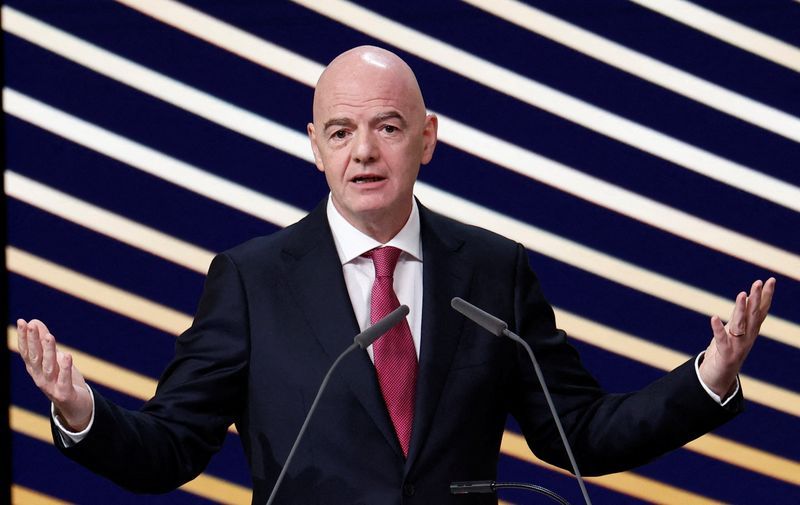
Gianni Infantino faces an increasingly precarious situation as FIFA President, calling an emergency meeting with senior officials in Morocco on Wednesday to salvage what remains of his leadership credibility following the implosion of an audacious scheme to commercialise World Cup broadcasting rights. The collapse of his plan to raise $4.2 billion through a controversial private investment arrangement has unleashed an unprecedented wave of criticism and left his reelection prospects for a fourth term in March significantly damaged compared to the certainty that seemed assured just weeks earlier.
The underlying proposal involved surrendering 20 percent of a newly created commercial rights entity to private investors, a move critics argued would fundamentally compromise FIFA's independence and the integrity of football's premier tournament. The involvement of a company with connections to the Trump family added another layer of controversy that opponents seized upon, though the precise nature of those ties remained contested. When Infantino formally withdrew the proposal last Friday, observers hoped the decision might allow the episode to fade quickly, yet the damage to his standing and the trust of key stakeholders appears far more durable than such a simple retreat might suggest.
The revolt extends into FIFA's own corridors of power, demonstrating how thoroughly the initiative has fractured consensus around the President's leadership. Secretary General Mattias Grafstrom circulated an internal staff memorandum describing the episode as a "sad and reproachable series of events" that resulted in the project being "permanently abandoned," a carefully worded statement that conspicuously avoided mentioning Infantino by name while clearly assigning responsibility for what had unfolded. Chief Operating Officer Kevin Lamour struck a harsher tone, characterising the plan as "the project of one person" and suggesting staff had been systematically deceived about its parameters and implications. These interventions from senior administrators carry particular weight because they signal institutional concern about governance rather than merely partisan opposition.
Infantino's own advisory team has begun distancing itself from the proposal. Carlos Cordeiro, a senior adviser, resigned in protest immediately after the announcement. Arsene Wenger, the former Arsenal manager now serving as FIFA's Chief of Global Football Development, moved to disassociate himself from the initiative on Tuesday, insisting he had played no role in drafting the proposal and characterising its withdrawal as "absolutely necessary." These departures and clarifications suggest that even those closest to Infantino recognise the reputational hazard of remaining identified with the scheme.
European football's governing body UEFA has emerged as the most formidable obstacle to Infantino's continuation, explicitly stating that it has lost confidence in his leadership and accusing him of betraying the fundamental values underpinning world football. This stance carries enormous symbolic and practical weight, given Europe's traditional influence within FIFA's hierarchy. Several European national associations have already withdrawn their pledged support for his reelection. The confederation's position has been reinforced by CONCACAF, which oversees football in North and Central America and the Caribbean, alongside the Asian Football Confederation (AFC), creating a formidable coalition united in questioning Infantino's suitability for continued leadership.
Yet Infantino retains meaningful sources of support that could prove decisive in a March vote. He has spent the past week in Morocco, where the 2030 World Cup will be co-hosted, and the Moroccan football association has publicly committed to backing him. More significantly, poorer nations dependent on FIFA's financial distributions have declared loyalty to the President, recognising that he has consistently directed resources toward developing football associations that receive minimal revenue from other sources. The original proposal itself was explicitly designed to appeal to these constituencies, promising individual dividends ranging from $20 million to $40 million per association if they endorsed the commercial rights sale. This structural advantage explains why support for Infantino remains genuine in parts of the football world even as it collapses in wealthier, more established confederations.
African football administrators have begun circulating messages of support, and Infantino is clearly banking on the continent's 54 member associations to anchor his coalition. The African confederation (CAF) has not yet adopted an official position, leaving that constituency available for persuasion. The Oceania confederation's executive committee is scheduled to meet next Wednesday to determine its approach, while smaller bodies recognise their voting power remains disproportionately significant under FIFA's one-federation-one-vote structure. This means San Marino, whose men's team ranks last globally, wields the same electoral influence as Brazil or Argentina, a principle that fundamentally advantages candidates with broad-based support among weaker federations.
The mathematics of survival appear challenging but not insurmountable for Infantino. An Extraordinary Congress can be triggered if 43 or more FIFA member associations submit a formal written request, a threshold that UEFA, CONCACAF, and the AFC are allegedly working to exceed according to reports circulated this week. The Times of London reported that these confederations are discussing the possibility of paralysing FIFA's operations or even establishing rival competitions if Infantino refuses to resign voluntarily, though none of the organisations immediately confirmed this account. However, Infantino's supporters within Asian and Middle Eastern associations, particularly Qatar, Kuwait, Lebanon, Sri Lanka, and Indonesia, have publicly affirmed their loyalty despite their confederations' institutional opposition.
Infantino's immediate challenge is securing seven months of stability before the March election, during which his weakened position could deteriorate further if additional member associations withdraw support or external pressure intensifies. Wednesday's meeting in Salé, at FIFA's Africa office overlooking the Bou Regreg river near Rabat, will address these survival questions and attempt to rebuild fractured relationships with key stakeholders. The absence of a clear alternative candidate currently willing to challenge him represents his most significant advantage, though Prince Ali bin Hussein, who previously contested FIFA elections, has already levelled accusations of blackmail, claiming FIFA offered assistance to member associations in exchange for endorsing the President's continuation.
The crisis reflects deeper tensions within global football governance between wealthy European confederations accustomed to exercising disproportionate influence and developing football nations that have increasingly flexed their numerical strength within FIFA's democratic structures. Infantino's tenure has been characterised by courting these emerging constituencies, a strategy that has generated genuine loyalty among associations that previously felt marginalised. The failed commercialisation scheme appeared designed to consolidate this support through dramatic financial commitments, but its controversial structure and opaque development process triggered a backlash that exposed the fragility of coalitions built primarily through transactional relationships rather than shared institutional vision.
The coming months will test whether Infantino can weather this turbulence through careful diplomacy and calculated concessions, or whether the scale of institutional and confederational opposition proves too substantial to overcome. His previous elections have suggested an uncanny ability to navigate FIFA's complex political terrain, yet the depth of current opposition from UEFA and its allied confederations represents uncharted territory for his presidency. The electoral outcome will not only determine FIFA's leadership but also signal whether the global football community will continue accepting the centralisation of power within FIFA's executive or demand greater institutional restraint and transparency.

