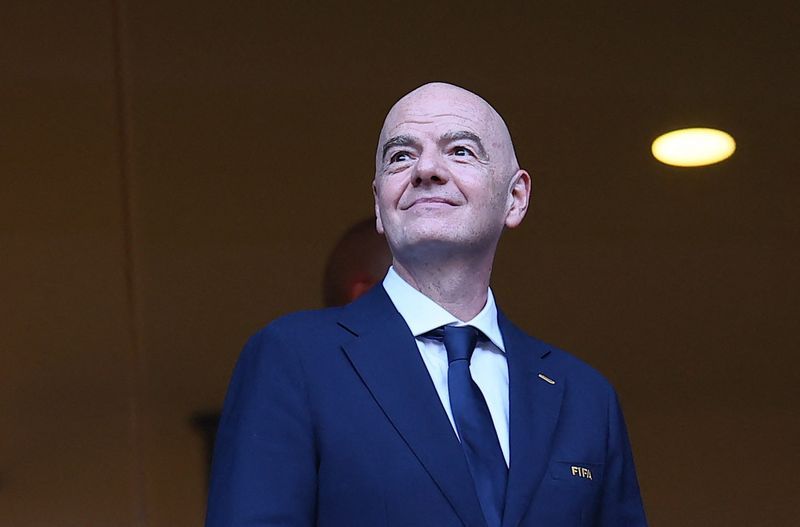
The fallout from FIFA President Gianni Infantino's aborted attempt to monetise the World Cup through a $4.2 billion stake sale continues to reverberate through global football administration, with reports emerging that three regional confederations are now actively working to unseat him from power. The 56-year-old Swiss-Italian administrator, who has led the world football governing body since 2016 and aspires to extend his tenure until 2031, withdrew his controversial proposal on Friday night following three days of internal turmoil that exposed deep fractures within FIFA's leadership structure.
The proposed scheme would have represented an unprecedented shift in World Cup financing, introducing private investment into the tournament for the first time in its history. Infantino's retreat from the plan, accompanied by a public apology acknowledging the damage the proposal had caused to football's unity, came after an extraordinary display of coordinated resistance from football's major power brokers. The damage to his previously commanding position at FIFA, however, appears far more substantial than a simple withdrawal could repair.
Opposition to Infantino's reelection has crystallised into formal defections, with five prominent European national associations—including the Football Association of England—formally rescinding their endorsement for the FIFA Congress scheduled in Morocco in March. Denmark's football federation went further, declaring they had never intended to support his candidacy regardless of the stake sale controversy. Alongside these high-profile rejections, the federations of Morocco, Qatar, Kuwait, Lebanon, and Sri Lanka have publicly affirmed their continued backing for the incumbent president, yet these declarations of loyalty cannot mask the erosion of his previously solid coalition.
The mathematics of FIFA's electoral process, where 211 national federations hold voting rights at Congress, mean that while committed positions remain relatively limited in number, the loss of confidence from powerful regional confederations carries outsized significance. UEFA, European football's governing body representing 55 member nations, and CONCACAF, which oversees football across North and Central America plus the Caribbean, both issued unambiguous statements on Saturday asserting they had fundamentally lost confidence in Infantino's leadership. The AFC, representing Asian football and historically more circumspect in its criticism, stopped short of explicit calls for his removal but characterised FIFA's failure to consult them regarding the scheme as wholly unacceptable and signalled support for institutional reforms.
According to reporting from the Times of London, these three confederations—UEFA, CONCACAF, and AFC—are reportedly coordinating a strategy to force Infantino's departure, including threats to either paralyse FIFA's operations or establish rival continental competitions if he refuses to step aside voluntarily. Such moves would represent extraordinary escalation in football governance conflict, reflecting the depth of alienation even among confederations that have customarily worked within FIFA's existing structures. The absence of immediate responses from CONCACAF, AFC, and FIFA itself to these reports leaves their veracity unconfirmed but suggests a strategic decision to withhold comment during a sensitive phase.
Infantino confronts an immediate tactical challenge in avoiding the convening of an Extraordinary Congress, which could be triggered by formal written requests from 43 or more FIFA member associations. Such a session would significantly diminish his control over the procedural environment and provide a forum for organised opposition to operate. Beyond this immediate hurdle lies a seven-month window before the March Congress in which Infantino must undertake extensive diplomatic work to restore relationships and consolidate remaining support among voting federations.
Historically, Infantino's strategic foundation mirrors that of his two predecessors, Joao Havelange and Sepp Blatter—both of whom similarly constructed their power bases primarily outside Europe, where football federations with limited financial resources depend substantially on FIFA distributions to sustain operations. Infantino's proposed dividend scheme, offering individual national associations $20 million to $40 million in immediate payments upon endorsement, was explicitly designed to appeal to these less wealthy confederations. The promise of substantial financial windfalls represented a direct pitch to the material interests of associations that otherwise exercise limited influence in global football governance.
The vulnerability of his political position lies not merely in the immediate opposition but in the difficulty of rebuilding the asymmetrical coalition that previously sustained his authority. His opponents must identify and successfully nominate a candidate before the November 18 deadline who can credibly address the financial interests of less prosperous associations—Infantino's traditional constituency—while simultaneously appealing to the wealthier, more influential associations in European and other developed football markets that have now withdrawn support.
For Malaysian and Southeast Asian football stakeholders, the FIFA leadership struggle carries tangible implications. These regions depend upon FIFA's commercial distributions and strategic direction to develop football infrastructure and talent pathways. The AFC's reported coordination with UEFA and CONCACAF signals that Asian football may be prepared to exercise greater independent influence in FIFA's governance rather than defaulting to existing leadership. A transition in FIFA presidency could substantially alter how global football resources are allocated, potentially affecting everything from World Cup qualification pathways to continental competition structures that directly impact Southeast Asian federation operations and commercial opportunities.
The unprecedented civil conflict within FIFA's administrative structures also raises questions about the organisation's future governance model. Infantino's initial proposal, whatever its commercial merits or defects, emerged without consultation with confederations that command substantial representation within FIFA. The backlash suggests growing sentiment that FIFA's leadership must operate with greater institutional transparency and stakeholder engagement. Such systemic changes, should they materialise, could reshape how decisions affecting Malaysian and regional football are made at the global level.
Infantino retains significant advantages heading into the coming months. His control over FIFA's internal apparatus, access to substantial institutional resources, and relationships cultivated with numerous developing-world federations remain formidable assets. However, the revelation that even historically loyal confederations question his judgment, combined with formal public rejections from major football markets, represents a qualitative shift from his previously secure dominance. The Malaysian football community, through the FAM and AFC participation, now finds itself positioned within a confederation that appears prepared to exercise its collective power to reshape FIFA's leadership—a development that may ultimately prove consequential not only for global governance but for how Southeast Asian football develops within the emerging international order.

