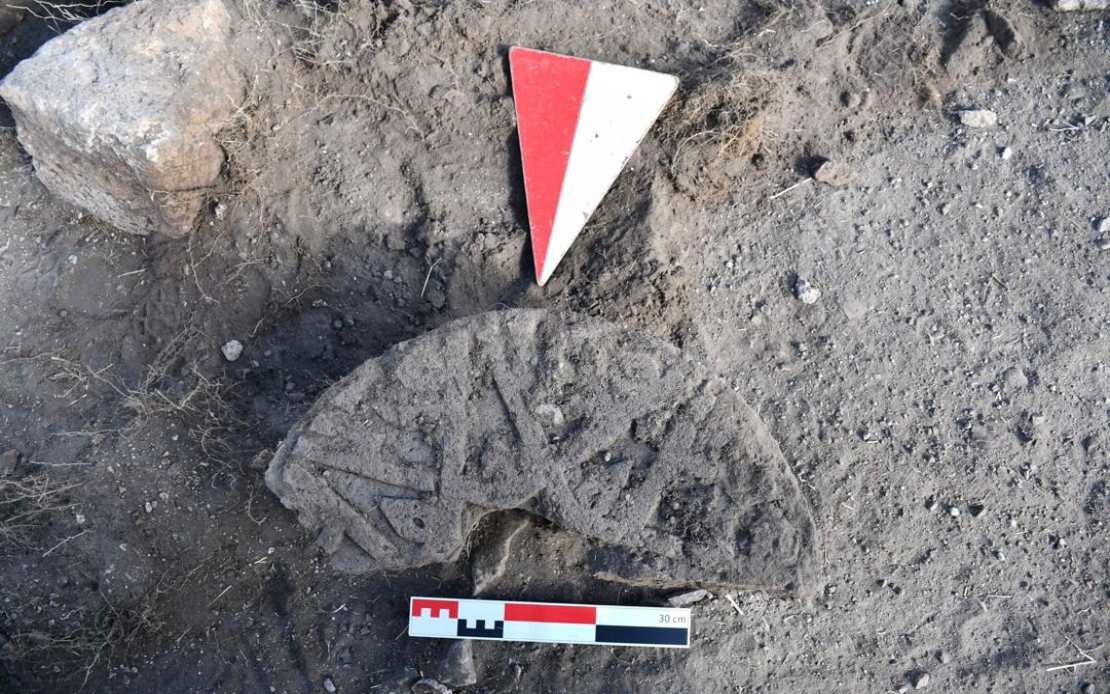
Turkish authorities have announced the discovery of a remarkable stone artefact bearing multiple inscriptions of Prophet Muhammad's name at Ani, the ancient archaeological complex situated in Kars province near the Turkish-Armenian border. The finding, revealed by Turkish Culture and Tourism Minister Mehmet Nuri Ersoy, represents a significant contribution to understanding the religious and cultural landscape of medieval Anatolia and the broader Islamic world. The inscription appears six times on the stone in Kufic script, an early Arabic calligraphic style that flourished during the Islamic Golden Age, suggesting the artefact dates to a period of considerable Islamic influence in the region.
The artefact's design demonstrates sophisticated craftsmanship characteristic of the Seljuk period. Three of the six inscriptions have been intricately carved into a decorative band that encircles an eight-pointed star, a geometric motif frequently employed in Islamic architectural and decorative traditions. This combination of epigraphic and ornamental elements suggests the stone may have served a religious or commemorative purpose, possibly adorning a significant structure or serving as a boundary marker within a sacred space. The remaining three inscriptions' placement on the stone indicates a deliberate compositional strategy, reflecting the Seljuk artisans' attention to both textual and visual harmony.
The discovery emerged during systematic excavations at a Seljuk cemetery that archaeologists have been studying since 2021, underscoring the importance of long-term, sustained archaeological investigation. Seljuk cemeteries provide invaluable evidence of burial practices, religious beliefs, and social structures during a pivotal period in Anatolian history. The strategic positioning of the stone within this burial ground suggests it may have been associated with a tomb tower or mausoleum, structures known as türbes, which were prominent features of Seljuk funerary architecture throughout the region.
Ani's historical significance extends far beyond the Seljuk period. This UNESCO World Heritage Site, inscribed in 2016, occupies a commanding position along the ancient Silk Road, the network of trade routes that connected East Asia with the Mediterranean world. During the 10th and 11th centuries, Ani served as the capital of the Bagratid Armenian kingdom, a period often regarded as the height of Armenian cultural and political independence. The city flourished as a centre of learning, commerce, and religious devotion, earning the epithet "City of 1,001 Churches" due to its numerous Christian places of worship.
The site's political fortunes shifted dramatically following the decline of the Bagratid kingdom. Successive waves of conquest brought Byzantine, Seljuk, and Ottoman rule, each leaving distinctive architectural and cultural imprints on the landscape. This layering of civilisations, evidenced in the standing ruins and archaeological deposits, makes Ani a palimpsest of Near Eastern history. The newly discovered stone, inscribed during the Seljuk era, represents one chapter in this complex historical narrative, demonstrating how Islamic culture and religious expression took root in a previously Christian-dominated landscape.
For Southeast Asian readers, particularly those from Malaysia with its significant Muslim population and diverse historical heritage, the Ani discovery offers intriguing parallels. Like Malaysia, Anatolia experienced transformations through conquest and cultural exchange, with different religious and ethnic communities coexisting across centuries. The Seljuk inscriptions at Ani reflect how Islamic civilisation integrated with pre-existing cultural environments, much as Islam became integrated into Southeast Asian societies through trade, migration, and peaceful conversion rather than solely through military conquest. Understanding Ani's religious archaeology enriches appreciation for how Islam developed distinct regional characteristics while maintaining core theological principles.
The inscription in Kufic script merits particular attention from historians and epigraphers. Kufic, named after the Iraqi city of Kufa, represents one of the earliest formal systems for writing Arabic and remained in use for centuries, particularly in religious contexts. The presence of Kufic inscriptions at Ani indicates sustained contact with broader Islamic intellectual and religious movements, suggesting the Seljuks at this location maintained awareness of stylistic conventions practised throughout the Islamic world. This inscriptional tradition reveals sophisticated networks of cultural transmission across vast geographical distances, predating modern communication technologies.
The cemetery context provides additional interpretive richness. Seljuk funerary monuments often incorporated epigraphic programmes designed to commemorate the deceased and invoke divine blessings through Quranic verses or names of God and the Prophet. The repetition of Prophet Muhammad's name across the stone may have served apotropaic functions, offering spiritual protection to the grave or deceased individual. Such practices reflect medieval Islamic beliefs about the intercessory power of the Prophet and the protective qualities of divine names. Archaeological investigation of burial contexts thus yields insights into religious practices that rarely appear in textual sources.
The continuing excavations at Ani promise further discoveries that will refine scholarly understanding of Seljuk Anatolia. The stone's recovery demonstrates that Ani remains archaeologically productive despite centuries of study, suggesting substantial unexcavated deposits remain beneath the surface. Future seasons of work, following the methodologies established since 2021, may yield additional inscribed stones, artefactual assemblages, and architectural features that collectively construct a more comprehensive picture of daily life, religious observance, and artistic production during this transformative historical period.
For regional audiences in Southeast Asia, the Ani excavations exemplify how archaeological work continues reshaping historical narratives across the Islamic world. Malaysian and regional scholars increasingly engage with comparative studies of Islamic archaeology, examining how religious expression manifested across diverse geographical and chronological contexts. The Turkish discoveries at Ani contribute to this expanding body of evidence, reminding us that Islamic history encompasses remarkable diversity and complexity, with local variations reflecting particular historical circumstances while maintaining connections to broader Islamic civilisational networks.

