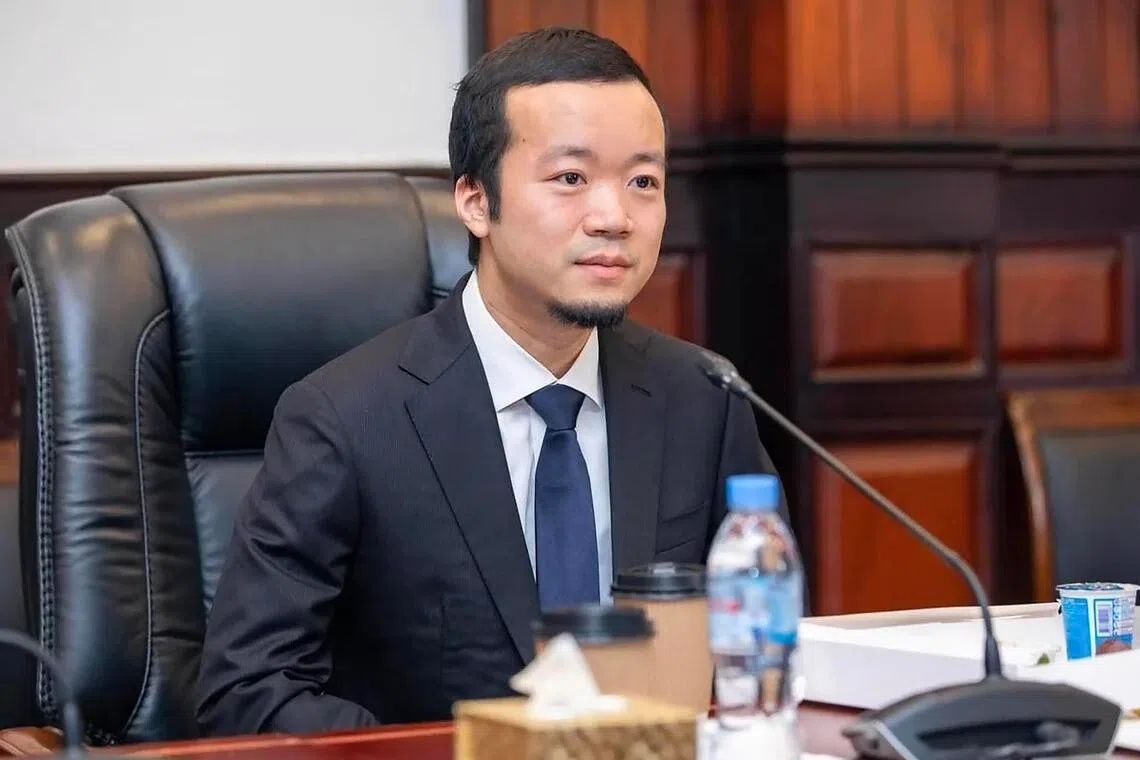
A six-month collaborative investigation by The Straits Times and the Organised Crime and Corruption Reporting Project has exposed the hidden infrastructure behind one of the world's largest financial fraud operations, centering on a Shanghai-born businessman who reinvented himself repeatedly across multiple jurisdictions. Chen Sokly—originally named Chen Xing and born in 1986—emerged as the second-ranked conspirator in the criminal indictment filed in New York on October 8, 2025, serving as the trusted lieutenant to scam kingpin Chen Zhi in an operation that generated an estimated US$30 million daily through illicit activities.
The scale of the Prince Holding Group's operations became apparent when US authorities subsequently seized 127,271 bitcoins valued at approximately US$15 billion, representing one of the largest financial fraud takedowns in history. Six days after the indictment, the US government dropped sanctions against Chen Zhi, the Prince Group, and affiliated entities, a move that underscored the complexity and reach of the investigation. Yet the operational mechanics of how this criminal enterprise functioned—particularly how it laundered billions sourced from forced labour operations in Cambodian scam compounds—remained obscure until journalists systematically combed through hundreds of pages of official records spanning multiple countries and corporate databases.
Sokly's journey from Shanghai to Singapore illuminates the sophisticated identity-switching strategies employed by high-level criminals operating across borders. He obtained Cambodian citizenship around the end of 2017 according to government gazette records, simultaneously acquiring citizenship in Cyprus and establishing residences in both Singapore and the United States. Within Singapore's business circles, he cultivated a carefully crafted public persona as Martin Chen, a wealthy entrepreneur, while simultaneously holding multiple directorial positions across at least 16 registered companies. This fractionalisation of identity served a critical function: it compartmentalised his legal exposure and obscured the true ownership structures underlying the group's asset holdings.
Within the Prince Group hierarchy, Sokly's role transcended typical money laundering functions. The indictment revealed that Chen Zhi had specifically tasked him with overseeing the syndicate's risk control operations—effectively making him responsible for anticipating, managing, and neutralising threats posed by law enforcement investigations worldwide. Sokly's primary responsibilities included monitoring regulatory activity across jurisdictions and engaging in what prosecutors termed corrupt bargaining with foreign officials to shield the group's interests. His confidence in these corrupt relationships extended to dismissing the Cambodian government's crackdown on scam compounds, reportedly assuring Chen Zhi that nothing would transpire to the Prince Group because he had sufficient officials in his pocket.
The mechanics of Sokly's corruption networks reveal the transnational bribery infrastructure supporting the operation. In May 2023, prosecutors alleged that Sokly communicated with a Chinese government official who offered to facilitate the release of Prince Group associates from legal jeopardy. The quid pro quo arrangement was strikingly direct: in exchange for protection, Sokly committed to providing personal assistance to the official's son. The relationship extended further, with Sokly allegedly directing the same Chinese official to orchestrate extortion operations by local police officers against businesses on behalf of the Prince Group. A ledger of bribes maintained by Chen Zhi and recovered by US authorities demonstrated the scale of these arrangements—in 2019 alone, Sokly purchased a yacht exceeding US$3 million specifically as a bribe to a foreign government official.
Sokly's tenure in Singapore from 2017 onwards reveals how the Prince Group embedded itself within the city-state's property and corporate ecosystems. His inaugural Singapore move involved purchasing a luxury five-bedroom apartment at 10 Leedon Heights for S$11 million in 2017, establishing an immediate presence in one of the island's most exclusive residential enclaves. Subsequently, he incorporated M Capital Global Holdings and invested just over S$5 million alongside his wife, maintaining equal shareholdings that persist in Singapore's corporate registry today. Over the ensuing two years, Sokly systematically registered himself as director across 16 Singapore entities, many sharing an office address in Shenton Way's central business district. By 2020, he had begun removing his name from most of these corporate structures—a deliberate de-identification strategy that preceded the major sanctions and crackdowns by several years.
Former employees who encountered Sokly described a pattern of extended stays punctuated by frequent international movement. Despite maintaining substantial Singapore property holdings and a fleet of luxury vehicles including a Bentley and a seven-seater luxury automobile at his Leedon Heights residence, Sokly typically spent only two to three months annually in the city-state. His social activities, conducted in the evenings with associates including Chen Zhi himself, centred on dining and drinking with members of the criminal syndicate—moments when strategic discussions about the group's operations, asset positioning, and official management occurred outside formal business settings. This dual-life pattern—alternating between extended absences and concentrated periods of face-to-face coordination with Chen Zhi—allowed Sokly to maintain operational continuity across his multiple jurisdictions whilst reducing his physical exposure to any single regulatory environment.
Sokly's real estate portfolio across the United States further demonstrates the Prince Group's systematic asset diversification strategy. In 2019, he purchased a California property from Fang Zhizhen, a member of the Knight Attack Group, a Chinese cybercriminal syndicate predating the Prince Group and later identified in the same OFAC sanctions. The transaction itself embedded Sokly within a broader ecosystem of transnational cybercriminals, whilst property acquisition served dual functions: wealth concealment and money laundering through appreciated real estate. The 2024 sale of that same property for approximately US$4.5 million represented a significant capital gain that further demonstrated his successful penetration of legitimate US real estate markets. More tellingly, on November 4, 2025—merely weeks after sweeping sanctions targeting the Prince Group—Sokly transferred ownership of a separate US$4 million property to his wife, subsequently placing it in a trust structure under her name in December 2025.
This final transfer represents a textbook asset protection manoeuvre executed in real-time as the criminal operation collapsed. The temporal proximity between the sanctions announcement and the property transfer indicates that Sokly anticipated legal jeopardy and moved decisively to shield assets from potential seizure through spousal transfer and trust structures. Such actions, whilst potentially constituting additional criminal conduct in themselves, highlight how mid-level operatives within major crime syndicates execute contingency planning strategies designed to preserve family wealth should the primary operation face collapse. The failure of these protective measures—evident from the subsequent asset forfeitures—underscores the complexity of modern international financial crime investigations and the coordination required among multiple law enforcement jurisdictions to successfully unwind sophisticated asset-hiding schemes.
For Malaysia and Southeast Asia more broadly, the Sokly case carries profound implications regarding the regional significance of the Prince Group operation. The syndicate's reliance on forced labour compounds in Cambodia to generate its fraudulent investment schemes demonstrates how criminal enterprises exploit governance gaps across the region's fragmented regulatory environments. That a key lieutenant could operate relatively openly in Singapore whilst maintaining protection through corrupted officials across China, Cambodia, and other jurisdictions reveals the vulnerability of even the region's most developed financial centres to high-level penetration by transnational organised crime. The investigation's methodology—combining traditional journalism with cross-jurisdictional corporate record analysis—established a template for identifying hidden ownership structures that Malaysian authorities and regional counterparts might emulate in their own financial crime investigations. Moving forward, the takedown of the Prince Group and the exposure of Sokly's operational network should catalyse enhanced information-sharing protocols and coordinated asset-tracing capabilities among ASEAN financial intelligence units.

